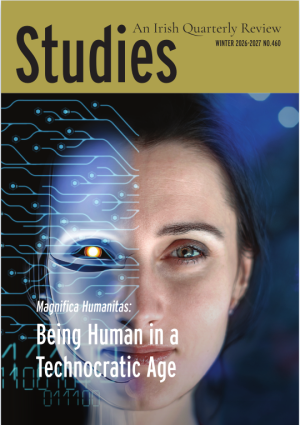

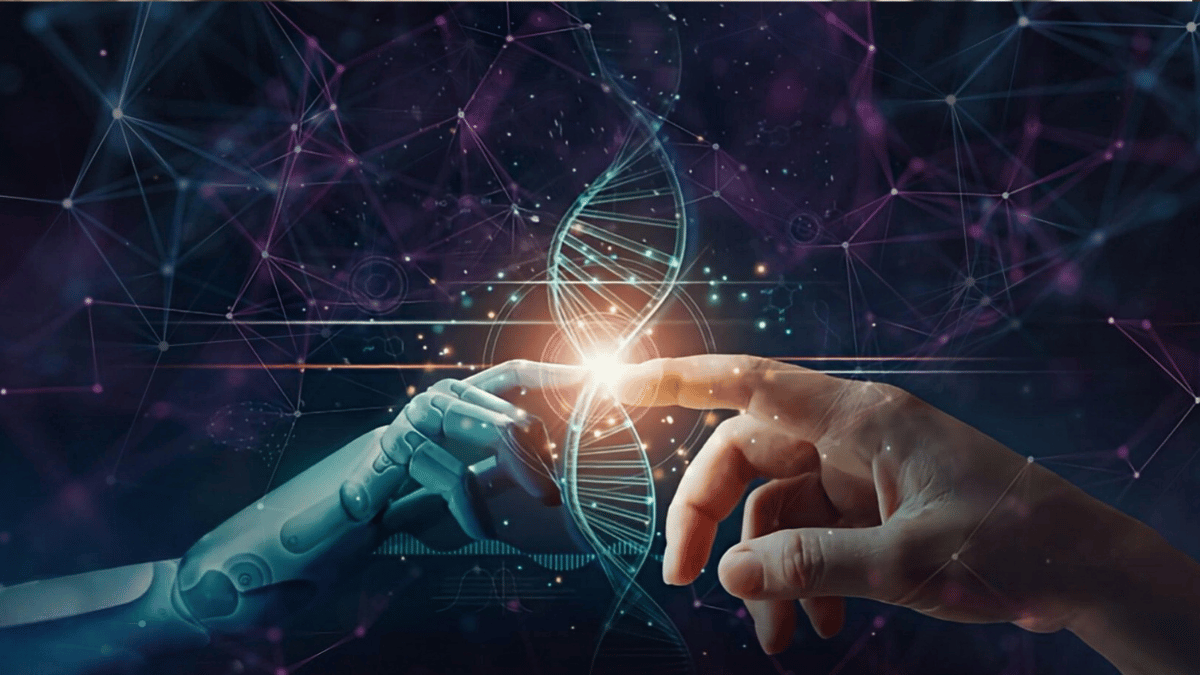
In one of his ‘Interesting Times’ podcasts from 2025, Ross Douthat questions Peter Thiel, billionaire co-founder of PayPal and Palantir, about the prevalence among Silicon Valley tech leaders of transhumanist thinking1 – that is, some version or other of the belief that new technologies, especially AI, will allow humans to transcend the built-in limitations of their species, such as weak cognition, memory decay, physical fragility, disease, the aging process, maybe even death. At one point, Douthat interrupts himself with a quick question, just for clarity: ‘You would prefer the human race to endure, right?’
Thiel: ‘Um … ’ Douthat: ‘You’re hesitating.’
Thiel: ‘I don’t know – I would, I would, um … ’
Douthat: ‘This is a long hesitation.’
Thiel: ‘There are so many questions implicit in this.’
Douthat: ‘Should the human race survive?’
Thiel: ‘Uh, yeah … But …’
Thiel’s eventual answer, such as it is, is that the transformation of the human that he and his fellow tech leaders are aiming for is total. They want a radical resolution of the problems of human weakness: ‘We want you to be able to change your heart and change your mind and change your whole body.’ He seems to suppose that the subject of all these bio-enhancements would retain its human identity, and he even believes, perversely, that such a transformation is a playing out of the Christian injunction to transcend the fallenness of human nature. Other big-tech transhumanists don’t tend to frame the matter in religious terms, yet they do share Thiel’s belief that technology will deliver a kind of salvation from the limitations of being human.
Some go further, into a full-blown posthumanism: the supplanting of the human race by ‘rapidly improving AI or a genetically enhanced species’, in the words of Sam Altman, co-founder of OpenAI.2 In fact, nearly ten years ago, Altman wrote that ‘superhuman AI is going to happen, genetic enhancement is going to happen, and brain-machine interfaces are going to happen.’ The AI models that emerge from these advances will constitute a new species, a super-species, one that would likely become the dominant species on the planet. The best-case scenario, according to Altman, is for humanity to merge with it. ‘My guess’, he writes, ‘is that we can either be the biological bootloader for digital intelligence and then fade into an evolutionary tree branch, or we can figure out what a successful merge looks like.’
These are not marginal opinions in the tech world. And given both the alarming proximity of the technocrats to political power and the vastness of their wealth, it is a matter that impacts on everyone. That fraction of 1 per cent at the top that sets the political and social agendas of the world – what is their understanding of what it is to be human? Not a few of them, including Thiel and Altman, have judged the prospect of AI causing a human extinction event to be ‘non-zero’; and some of them, including Elon Musk, Dario Amodei, and Marc Andreessen, have set the probability – what they call ‘p(doom)’ – at between 10 per cent and 25 per cent. Surely, then, their perspective on human nature, on human dignity, equality, and solidarity, and on the relationship between humankind and technology are of the utmost concern.
Some of the technocrats have suggested, albeit weakly, that developments should be slowed down, at least until guardrails are in place. Others, however, most notably Peter Thiel, believe that the West is in a race for AI dominance and that deceleration would amount to capitulation. Thiel, for this reason, was not impressed by Pope Leo’s first encyclical, Magnifica Humanitas,3 published in May of this year. The pope is concerned, as the subtitle goes, with ‘safeguarding the human person in the time of Artificial Intelligence’. He stresses the need ‘to establish adequate regulatory tools capable of upholding justice and curbing the distorting effects of technological power’.4 When it comes to these developments, he argues, we have to remember our ‘pressing duty to remain profoundly human’ and ensure that we are ‘building for the common good’. For Thiel, these words of caution might contribute to a slowdown in the US, but they won’t in China – which means, he commented, that the pope is ‘acting as a useful idiot’ for the Chinese Communist Party.5
There are two radically different visions of human worth here. For Thiel and for many of his fellow technocrats, the matter of paramount importance is geopolitics and the civilisational struggle for hegemonic control; the value of human lives is subordinated to that. Risks to the life and livelihood of people are worth taking if they help to stave off a threat to Western leadership. Studies • volume 115 • number 460 523Editorial: Winter 2026 Even Anthropic, which has made more extensive commitments to AI safety than its competitors, has worked to limit the regulatory power of government when it comes to new AI developments. In October it proposed a legislative framework under which the US Congress could block the release of an AI model only in a narrow set of circumstances involving an imminent risk of more than $1 billion in damages or of killing or seriously injuring more than fifty people.6 That, they believe, is a reasonable risk threshold.
Pope Leo’s perspective is very different. He is no Luddite, of course: technology is not of itself ‘a force antagonistic to humanity’; it is a ‘profoundly human reality’ that has formed part of history since the beginning.7 The key issue, he notes, ‘is not the use of technology as such, but the vision that underlies it’.8 He roundly rejects any suggestion that AI models are moral agents or that their ‘intelligence’ can be equated with that of human beings. What lies at the core of his critique, then, is a thick description of human nature, radically distinct from the shallow, functionalist version espoused by many tech leaders. Human nature is not reducible to cognition, and no increase in the computational speed of AI bots brings them closer to being human. ‘We must avoid the misconception of equating this type of “intelligence” with that of human beings,’ Pope Leo insists:
So-called artificial intelligences do not undergo experiences, do not possess a body, do not feel joy or pain, do not mature through relationships, and do not know from within what love, work, friendship, or responsibility mean. Nor do they have a moral conscience, since they do not judge good and evil, grasp the ultimate meaning of situations, or bear responsibility for consequences.9
Worthy of particular note is the pope’s repudiation of a supposition that lies at the heart of the AI revolution, namely that human limitations are defects to be corrected. Humanity flourishes, he says, ‘not despite limitations, but often through them’.10 He adds:
Indeed, precisely because we experience limits – vulnerability, suffering, and failure – we can recognise the inviolable dignity of every person, both our own and that of others. In this same experience, we remain capable of intuiting a fraternity greater than ourselves and of perceiving injustice as a scandal. Authentic culture and art preserve this spark, resisting the normalisation of evil.
By taking the papal name Leo, the pope intended to connect his papacy with Pope Leo XIII’s deepening of the Church’s social teaching in Rerum Novarum in relation to the ‘new things’ of the late nineteenth-century world. The res novae of our own time are, no doubt, of even more consequence than those addressed by Leo XIII. Magnifica Humanitas responds to them with a profound and robust account of the truly human, which makes it a papal intervention of the first importance.
***
In ‘Human Dignity and the Mystery of the Human Person: Three Foundational Dialectics in Magnifica Humanitas’, John Loughlin notes the shifts over time in the way in which human dignity has been understood, making it difficult for the concept to support a shared moral vision. Pope Leo’s encyclical, he argues, is an attempt to recover the Christian anthropology that helps to give fixed meaning to the language of dignity. The crises raised by AI and biotechnology, he argues, are not technological but anthropological, and Magnifica Humanitas is Pope Leo’s attempt to set the question of what it means to be human at the centre of contemporary debate.
Peadar Kirby identifies in Magnifica Humanitas a thorough and textured articulation of what is entailed in the Church’s understanding of the common good. In ‘Rescuing the “Common Good”: Pope Leo, Chantal Mouffe ,and the US Catholic Far Right’, he notes that the term ‘common good’ has been badly abused by postliberal Catholics who misconstrue it as a rigid map of an ideal society that may be imposed on the body politic, thus invoking it to justify distorted visions of social order and other ‘dark causes’. Kirby finds the critique of Belgian political theorist Chantal Mouffe enlightening, especially her perception that liberal individualism often leads to ‘the selfish pursuit of private interests’; but he notes her wariness about the concept of the common good if it is taken to mean that there is only ever a single substantive idea of human flourishing. Pope Leo, he believes, helps to correct this view, especially by insisting that the common good is not ‘an external code of ethics imposed from above’, but comes out of ‘a Church that walks alongside humanity, recognising the autonomy of earthly realities’.
In ‘Human and Robot Selves Arising from Magnifica Humanitas’, Fiachra Long draws a sharp distinction between the concept of selfhood when applied to humans and when applied to robots. He sees human selves to be essentially immersed in a culture of care and commitment, in relation to one another, to the common good, and to the earth. The pope’s encyclical, as Long reads it, rejects a gnostic Cartesianism that establishes a clear separation between the self and the res extensa, the world beyond. Artificial intelligence, Long judges, is closely aligned with the mind–body dualism of the Cartesian Ego, that stands outside the concrete reality of embodied life. The encyclical reminds us, however, that human existence is much more magnificent than this.
David William Sheehan finds a valuable point of correspondence between Pope Leo’s encyclical and the Brehon tradition of ancient Gaelic society. In ‘When the Centre Stops Listening: Ancient Irish Governance, Magnifica Humanitas, and the Obligations of Authority’, he describes the Brehon understanding of governance as a duty and service to a people, a relationship built on the ruler remaining reachable and accountable to the people he ruled. This is radically different from the ‘technocratic paradigm’ that Pope Leo rejects, in which governance comes down to data gathering and efficiency. ‘Governance is not only an information problem,’ Sheehan asserts; ‘It is also a relationship problem.’
In ‘Mind the Gap: Artificial Intelligence, Human Dignity, and Moral Agency’, Alan Moran poses Pope Leo’s question in Magnifica Humanitas about whether or not technologies such as AI ‘truly help individuals and peoples to become more humane and fraternal, while respecting our common home and future generations’. He suggests that the question be approached through the lens of integral human development – ‘the authentic flourishing of the human person and not as something that can be reduced to economic growth, technological progress, consumerism, or productivity’. Specifically, he notes the risk of AI supplanting ‘everyday human decision-making in spite of its lack of moral conscience and inability to bear responsibility’; and he concludes that the moral problem of AI is ‘baked into its architecture and into the assumptions we form around intelligence when we omit consideration of human dignity’.
David Begg’s review article based on Rowan Williams’s latest book, Solidarity: The Work of Recognition, sits well with these essays on Magnifica Humanitas. In ‘A Tractarian For Our Age?’, Begg reflects on Williams’s ‘magisterial examination of the true meaning of the word [solidarity] and the possibilities it offers for human flourishing’. He traces Williams’s investigation into the multiple ways in which solidarity has been invoked, often in the name of unity and inclusion, but sometimes also as a weapon of resentment and hostility. Williams’s sources include Edith Stein, Dietrich Bonhoeffer, and the tradition of Catholic social teaching, starting with Rerum Novarum in 1891. It is Begg’s judgement that there is little substantial difference in the general thrust of the book and Pope Leo’s call for a ‘civilisation of love’ in Magnifica Humanitas.
***
The current issue of Studies also includes a number of other essays on disparate subjects. In ‘For We Know Not What We Do: Arendtian Reflections on Punishment and Forgiveness’, Pieter de Witte uses Hannah Arendt’s distinction between work and action to mount a rejection of certain forms of rehabilitative punishment in the prison system. This is the text of the Jesuit Centre for Faith and Justice’s 2026 annual lecture, delivered on 21 April of this year.
Ethna Regan was invited to launch the spring 2026 issue of Studies at an event in Books Upstairs, D’Olier Street, Dublin, last April. ‘Faithful Justice Today’ is the text of her address. She reflects on the need to seek congruence between people’s formal commitment to justice and the way in which they actually live their lives. Also on the role of the imagination in conceptualising faithful justice.
In ‘Democracy Under Attack: Hitler’s Germany and Trump’s America’, James J. Kelly examines issues such as freedom, power, authority, and leadership in an effort to understand how there could be such a proliferation these days of authoritarian and autocratic regimes.
Kevin Williams, in ‘The Complex Legacy of Colonialism: Soundings in French Literary Sources’, begins recalling the spate of racist attacks on Kylian Mbappé during this year’s World Cup, and then seeks to shed light on this attitude through a reflection on French colonisation and the literary treatment of the phenomenon.
Declan O’Keeffe was an avid walker of the Camino de Santiago for many years. Then, in 2021 he experienced two strokes while walking on it and nearly died. In the set of journal entries in ‘”Set the World on Fire”: A Different Account of the Camino’, he offers a number of reflections on what this pilgrimage path has meant for him.
Bishop Brendan Leahy was present at the World Day of Prayer event in Assisi on 27 October 1986, to which Pope St John Paul II invited representatives of various religions in a show of solidarity to pray for lasting peace in the world. In ‘Remembering Assisi Forty Years On’, Bishop Leahy recounts his experiences of the day and remarks on its significance.
This issue also features a poem, ‘Glacial Erratics’, by Louise Callaghan and two further review essays. The first, ‘Reports of Liberalism’s Discontent Are Greatly Exaggerated’ by Joseph Rivera, is on Francis Fukuyama’s 2023 book, Liberalism and its Discontents; and the other, ‘Late Style in the Poetry of Graham Powell’ by Martin Wallace, brings together two of Powell’s volumes of poetry, Dragonflies and Tempera.
Notes
1 Interesting Times With Ross Douthat, ‘A.I., Mars, and Immortality: Are We Dreaming Big
Enough’, Youtube,26 June 2025, www.youtube.com/watch?v=vV7YgnPUxcU, 38:15 mins in.
2 Sam Altman, ‘The Merge’, blogpost from 7 December 2017, https://blog.samaltman.com/the-
merge
3 Pope Leo XIV, Magnifica Humanitas (The Holy See, 2026).
4 Pope Leo XIV, Magnifica Humanitas, 5.
5 MDMEETS – Essential Talks with Mathias Döpfner, ‘Peter Thiel: The AI Crisis, Europe’s
Decline & the Battle for America’, Youtube, 24 September 2026, www.youtube.com/
watch?v=B7yl7fEHeKM, 8:00 mins in.
6 ‘Anthropic Quietly Pitches Its Own AI Safety Bill to Lawmakers’, Politico, www.politico.com/
news/2026/10/16/anthropic-ai-safety-01124654
7 Pope Leo XIV, Magnifica Humanitas, 4.
8 Pope Leo XIV, Magnifica Humanitas, 117.
9 Pope Leo XIV, Magnifica Humanitas, 99.
10 Pope Leo XIV, Magnifica Humanitas, 118.
11 Pope Leo XIV, Magnifica Humanitas, 122.