John Walshe
National education conventions don’t just happen without a lot of persuasion and preparation. Just ask those who initially came up with the idea of a public debate on this important topic seven years ago, which culminated in the current Convention on Education. They lobbied the politicians hard for a citizens’ assembly on the future of education, an idea which worked its way into party manifestos and then programmes for government before morphing into an education convention under the current coalition government. Martin Hawkes from the Burren College of Art traces the twists and turns of that particular journey elsewhere in this publication.
This paper explores the origins and outcomes of the first national education convention (NEC) in 1993. What transpired before, during and after that 1993 convention is a fascinating example of the interplay of policies, politics, personalities, and what former UK prime minister Harold Macmillan once called ‘events, Dear Boy, events’.
If you also consider the upheaval caused by a general election, two changes of taoiseach mid-term, extraordinary security arrangements, leaks of draft papers, long lunches over Chateau Musar to convince a reluctant trade union to participate in the Convention, you begin to see how public policy is not always formulated in a linear progression.
The story involves well-known Fianna Fáil politicians like taoisigh Charles Haughey and Albert Reynolds, ministers for education Mary O’Rourke, Noel Davern, Séamus Brennan, and future taoiseach Micheál Martin, the Labour Party’s first minister for education, Niamh Bhreathnach, and the taoiseach she served under, John Bruton. The saga also involves senior Department of Education officials and advisers as well as academics, including Maynooth professor John Coolahan, rightly described as a national education treasure. Other actors were the 42 stakeholder groups invited to the Convention representing the educational partners. This was long before the notion of citizens’ assemblies was even suggested. The idea of randomly selected adult participants, students, and young people joining stakeholders, as is the case in the current convention, would have been seen as some kind of democratic frippery at that time.
The cast also included nearly 1,000 organisations and individuals who took great care in answering the question ‘Whither Irish education?’ when they were invited to make submissions to the Department of Education. Apart from school management bodies and trade unions, they included the Industrial Development Authority, Disability Federation of Ireland, and some unexpected groups, such as the Croquet Association of Ireland, the Bowling League of Ireland, and the Dublin All Stars Marching Band.
The newspapers also played a role, albeit one that was not always welcome. Great efforts to prevent leaks of documents to the media were undertaken by the department, which printed drafts of one paper on ‘no-copi’ dark red security paper that could not be photocopied and was hard to read, especially at night.
The Green and the White
The year 1990 was another turbulent one for Taoiseach Charles J. Haughey, one of the most controversial and divisive figures in Irish public life, and one with an abrasive leadership style. After yet another political setback that summer, he asked his cabinet what new ideas they had to boost his government’s ratings. After other colleagues talked about job creation and other plans, the minister for education, Mary O’Rourke, said she was planning to bring out a white paper on education.1 She went public on her intention in an interview with Christina Murphy of the Irish Times in August 1990. Two months later the taoiseach told the Dail that the government intended to produce a comprehensive Education Act. (It’s often overlooked that Haughey took more than a passing interest in this area: he had been acting minister for education for three weeks in October 1982 when the then holder of the office, Dr Martin O’Donoghue, resigned after refusing to back him in a forthcoming leadership challenge.)
The timing of a discussion paper was fortuitous as the late 1980s and early 1990s saw a quickening of pace in debates on educational issues and an unstoppable momentum towards change on many fronts. At that time there was also considerable concern over what was commonly referred to as a ‘lacuna’ in Irish education structures. The system was run in an ad hoc fashion, relying largely on circulars, directives, and regulations that had very little legislative underpinning. A drawing together of disparate discussions was becoming increasingly necessary.
In the traditional course of events, a white paper outlining government decisions is preceded by a green paper, which is issued for consultation purposes. The idea of a national convention in the interregnum between the two papers wasn’t even considered at the beginning of this particular tale and didn’t come into play for another decade.
The drafting begins
The initial draft of the Green Paper was undertaken by department officials but was not to Minister O’Rourke’s satisfaction. She took the draft on a boating trip with some friends. ‘I was tempted to toss every single page into the Shannon. It seemed to me that caution had spanceled everything,’ she said in an interview with this author on 11 November 1995.2
She decided to invite Professor John Coolahan to join the drafting team. It was an inspired move as Coolahan was a knowledgeable incrementalist reformer who believed in bringing people along in the change process. He began working with department officials in the summer of 1991. Tensions, however, surfaced between those who wanted a top-down document that prescribed changes for schools in a very directive fashion and those who wanted more organic growth in the system with the main stakeholders taking ownership of the changes. These were largely resolved when O’Rourke took a more active part in the discussions and began chairing early morning meetings in the department from September 1991. The team produced a new and much improved second draft the following month.3
Politics intervene again
According to Coolahan, it was the minister’s intention to publish the draft Green Paper on the 13 December in 1991.4 But she was moved to a different department in a cabinet reshuffle following another failed attempt within Fianna Fáil to oust Haughey as taoiseach. She was succeeded by Tipperary TD Noel Davern, an unexpected choice for the portfolio but an ally of Haughey. He was astute enough to appoint as his adviser the CEO of the Tipperary South Riding Vocational Education Committee, John Slattery. The new adviser was familiar with the North American education system and is believed to have been responsible for rewriting the section in the O’Rourke draft on vocational education and training.
The First National Education Convention (1993)
The revised draft proposed the expansion of the range of options within the Leaving Certificate Vocational Programme and an increase in the number of participants in it from 5% in 1991 to at least 30%, a policy change that survives to this day.5 The Davern draft also proposed that responsibility for all off-the-job vocational education and training be given to new county committees of education, committees which had originally been proposed in O’Rourke’s draft paper.6
Davern’s tenure in education was short-lived at only 90 days as the next heave against Haughey succeeded, and Albert Reynolds took over the role of taoiseach in early 1992. He appointed a like-minded, business-oriented minister for education, Séamus Brennan from Galway, who inherited the draft Green Paper.
Media intervention
The author was education correspondent with the Irish Times at that time and had spent almost a fortnight in February 1992 working on a three-part series about the Green Paper, having secured drafts of both O’Rourke’s and Davern’s versions.
Radio advertisements were scheduled to broadcast from Tuesday the 25 February, announcing the commencement of the series. However, the night before, there was an unexpected phone call to this author from Brennan’s press officer, Joe Jennings, who said that the minister would make a major announcement about the Green Paper the next day. After some editorial discussion, the newspaper decided to go ahead with the advertisements and the series.
Predictably, the minister was not best pleased as he did not want to be seen as a ‘messenger boy’ for somebody else’s paper.7 Brennan did not make the promised announcement but instead assembled a team and spent several weeks rewriting parts of the Green Paper at a series of meetings in Barretstown Castle, Co. Kildare, which was then used for government conferences and seminars. He admitted later that ‘the leaks did goad me into looking at the paper more closely, but it was not done in a fit of pique’.8
Coolahan has argued that the leaking of the drafts did not foster the public good because some of the new proposals introduced by Brennan in the wake of the Barrettstown meetings led to suspicions among teachers that took a considerable time to allay. Certainly the draft Brennan inherited was changed radically in parts and in such a way that alienated much of the teaching profession instead of encouraging it to go along to meet the challenges facing the system.9
The Barretstown effect
Brennan’s Green Paper was published in June 1992. The six aims of the paper were laudable as they included the establishment of greater equity in education, creating a system of effective quality assurance as well as equipping students more effectively for life, for working in an enterprise culture, and for citizenship of Europe. Fine Gael’s Garret Fitzgerald praised the statement of aims but wrote that what disturbed him was the emphasis placed in the paper on enterprise together with business and technology. He was referring, in particular, to a proposal, that wasn’t subsequently implemented to introduce a subject called ‘Enterprise and Technology Studies’ as an obligatory subject, first at Junior Certificate level and then at Leaving Certificate level.10
The paper introduced many new features, such as proposing that no less than 60% of the marks in certificate exams in Irish and modern European languages would be allocated to the oral/aural components. It dropped the idea of county committees of education in favor of executive agencies.
Brennan’s paper also proposed that school principals should become:
- professional educational leaders rather than primarily administrators;
- key members of autonomous boards of management;
- leaders of school planning, quality assurance and improvement;
- managers operating within a more devolved education system.
But he upset teachers when he suggested that principals could be designated ‘chief executive officers’ of their schools, a notion that smacked too much of a business type approach to education and one that was quietly dropped later. So also was the paper’s proposal for the appointment of a businessperson to each board of management in primary and post-primary schools. An unexpected proposal to maximise the number of schools of four teachers and more in rural areas and eight teachers or more in urban areas was also diluted subsequently.
The changes proposed for higher education were also very significant. As one educational historian noted, ‘the Green Paper explicitly promoted the reorientation of universities towards national economic objectives through more corporate style management and engagement with industry. Brennan, a centre-right minister who favoured a movement towards entrepreneurial universities, undoubtedly left a distinctive imprint on the Green Paper.’11
The First National Education Convention (1993)
Brennan later acknowledged that he gave critics an issue to ‘jump’ on when he talked of the need for an enterprise culture in schools. He said he believed that the education system traditionally prepared people for employment, but not to create employment. ‘We were accused of not having enough small businesses in Ireland, of not having enough risk takers,’ he remarked.12
Consultation
Brennan’s Green Paper certainly stimulated widespread debate and became one of the most widely discussed documents ever to emanate from the Department of Education.13 There were innumerable meetings around the country of school boards of management, the education partners, and other interested groups to discuss the paper and consider making submissions. The department organised seminars in different locations that were initially successful, especially in getting the views of parents and the general public. However, they tended to become dominated by interest groups who reiterated their official positions and invariably sought additional resources for their sector. (This also happened later with Minister Noel Dempsey’s Your Education System series of public meetings in February and March 2004 when, as Garret Fitzgerald wrote, ‘ASTI [Association of Secondary Teachers, Ireland] activists used every meeting to pursue their campaign against the government – to the intense resentment of those for whose particular benefit these meetings had been arranged.’)14
Brennan attempted in a number of speeches to undo some of the damage caused by the perceived overemphasis on entrepreneurship and the underemphasis on the artistic and cultural aspects of educational development. Coolahan generously remarked that in these speeches ‘the perceived imbalances of outlook in the Green Paper have been addressed in favour of a reinstatement of a view of education emphasising the moral, spiritual, intellectual, aesthetic, social, and physical education of people in a harmonious way.’15
The large number of submissions indicated the sense of ferment and the importance that Irish people attached to education at that time. They came from a disparate group of organisations, including the main education partners as well as, for example, Community Addiction Counsellors, Irish Children’s Book Trust, Missionary Society of St Columban, Business and Professional Women’s Group, Lesbian and Gay Youth Federation of Ireland, and Mothers Working at Home. The inclusion of such a range of organisations reflected a sense of public ownership of the debate on the future of Irish education. One wonders, however, what would have happened if Brennan had published the green paper he had inherited and had not amended it in an obviously controversial fashion. Would it still have provoked such an outpouring of submissions?
The Convention
Following a general election on 25 November 1992, the 23rd government of Ireland came into office in January 1993. Once again Albert Reynolds was elected taoiseach, and he agreed that Fianna Fáil’s coalition partner, the Labour Party, could take the education portfolio.
According to party colleague Ruairí Quinn, who was appointed minister for enterprise and employment in that Fianna Fáil–Labour coalition, at the last minute that morning, it emerged that Mervyn Taylor had swapped jobs with Niamh Bhreathnach. She got Education and he was given Equality and Law Reform because, as he subsequently told me, he felt there was a potential conflict of interest because his wife was a teacher. Mervyn is shrewd, and I suspect that his legitimate reservation was combined with his own distinctive distrust of the conservative Catholic ethos that to this day imbues the Department of Education. As the first Orthodox Jew in an Irish cabinet, he knew where he did not need to be, having regard to the difficulties that the liberal Gemma Hussey had encountered a decade before.16
Bhreathnach’s husband, Tom Ferris, has a different recollection – one of Dick Spring telling her that ‘if she decided to take Education then her life and the lives of her family would never be the same again.’17
As has been noted already, there had been no talk of a convention when the idea of green and white papers was conceived. Bhreathnach’s former adviser Pat Keating, himself a teacher and secondary school principal by background, recalled that ‘Séamus Brennan ’s Green Paper was, unfairly in many ways, excoriated for sacrificing genuine education to the utilitarian demands of employers and the market place. This was part of the context in which Niamh was tasked with moving to a White Paper and legislation.’18 The minister decided that multilateral rather than bilateral dialogue was needed to genuinely move forward. This was a major break with the past when individual interest groups came to make their pitch directly to officials.
The First National Education Convention (1993)
The idea of getting all the partners together was her idea but what to call the gathering was the question. She wanted the words ‘national’ and ‘education’ in its working title. It was Keating who suggested using the word ‘convention’, which is the description his union, the ASTI, uses to call its annual Easter congress. A total of 42 participant groups were invited, including parents, who had traditionally been marginalised despite their constitutional position as the primary educators of their children. The National Parents Council Primary, led by Fionnuala Kilfeather and Anne Colgan, were particularly supportive, as were the various Churches and religious bodies as well as the employers’ body, IBEC (Irish Business and Employers Confederation), and different agencies.
On the teacher union side, both INTO (Irish National Teachers’ Organisation) and TUI (Teachers Union Ireland) came on board without any major problems, but ASTI proved to be a reluctant guest. ‘Perhaps it was a deep suspicion of a trap which the department was leading them into, or perhaps it was the fact that the clerical managers, their traditional opponents, had come on board so quickly. In any event, trust needed to be built into the process, and the new secretary general of the department, Dr Don Thornhill, came into his own. Across several long lunches (during which I acquired a very pleasant acquaintance with Chateau Musar), we clarified terms of reference and proposed procedures and safeguards. In fairness to ASTI, once they came on board they really came on board and took it very seriously,’ recalled Keating.19
ASTI’s agreement was signalled when the union issued a statement in which they effectively gave a commitment to engage constructively with the emerging education reform agenda. It became known as the Winetavern Street Declaration (named after the location of the ASTI Dublin headquarters). Initially the participants largely reiterated and elaborated on their known positions. But it would be unfair to categorise the NEC as a forum for set speeches. The members of the secretariat, mostly distinguished academics, probed behind these stated positions. This process ensured that over the nine days of the Convention the representatives had to think deeply about and defend their positions. It was partnership in education at its finest.
There were many stand-out moments that stay in the memory, such as a powerful speech by Anne Colgan of the National Parents Council, an impressive contribution by the Union of Students in Ireland, the close questioning of the Catholic bishops about their views on education, the outline of the difficulties faced in establishing multi-denominational schools and the convergence of views on the need to seriously tackle educational disadvantage.
There was extensive coverage of the public sessions by the newspapers, television, and radio, which helped to highlight the importance of the Convention. The journalists agreed among themselves not to probe what happened at the private sessions or report on the inevitable clashes at them among some of the main players. After speaking to Coolahan, secretary general of the NEC secretariat, this author persuaded media colleagues that reporting any tensions surfacing at the private sessions could make it more difficult to secure consensus on the issues and to make progress.
The minister kept a close eye on proceedings. Her husband, Tom Ferris, in a personal recollection for this article, wrote that ‘it was striking to look at Niamh’s personal diary for 1993 and to see the dates 11 October through 21 October blocked out with the code “NEC”. She certainly gave the Convention her full attention. Of course, we had talked at the kitchen table about what Niamh’s inputs might be to the Convention. It was easy for me to say to her that she should participate as much as possible. And Niamh certainly did that with an opening speech on 11 October, attendance at plenary sessions and a closing speech on 21 October. And yet she did not neglect other ministerial work over the period. Niamh’s diary shows breakfast meetings at a local hotel, before the daily conference sessions, and further meetings elsewhere later in the evenings. I feel exhausted even now looking at Niamh’s diary to see the energy and time she put into the Convention along with doing her ongoing work.’20
A report on the Convention was compiled by the NEC secretariat, which was chaired by Professor Dervilla Donnelly from UCD. It summarised and analysed the discussions over various headings, such as philosophy of education, policy formulation, administrative changes, and the role of the department; intermediate education tiers, the governance of schools, multi-denominational and secular education, rationalisation of schools, the internal management of schools, the quality of education within schools, curricular issues including the Irish language, equality issues, the international context, legal aspects, the teaching profession, adult and community education, higher education, the resourcing and implementation of educational change. Recommendations and pointers to the future were put forward under each heading.
The First National Education Convention (1993)
White Paper
The lengthy process of consultation culminated in the preparation and publication of the White Paper. Before examining the White Paper, a few remarks are worth making about the secrecy surrounding its preparation, secrecy that seemed at times touched with something approaching paranoia about the danger of leaks. As has been noted, the draft was typed on a paper that could not be photocopied, following consultations with the Gardaí. However, because of its colour, the printed words were difficult to read, certainly in the evening. This caused problems when a limited number of drafts were circulated for observations. The secretary general of another department joked that the minister was trying to blind him.21 Each page of the document had a line at the bottom warning that ‘the giving or receipt of information on these contents may be a criminal offence.’22
It was distributed to cabinet members on 6 April 1995 by Minister Bhreathnach after she made a presentation to them. It’s unusual for a minister to come to such meetings with documents ‘under arm’, as it is termed, as they are normally distributed in advance. Simultaneously with that presentation, Thornhill circulated copies to his secretary colleagues in other departments as requested by the minister. An accompanying letter said that ‘because of the time scale and the need for security it is necessary to secure observations back from departments by 5:00 PM on tomorrow, Friday, 7 April 1995. This is to ensure that completed copies of the memorandum are available to the government secretariat on Monday morning,’ he wrote while acknowledging that ‘these exceptional arrangements will put considerable pressure on you and your department’.23 Keating said later that the security measures were prompted by concerns about the reaction of the Department of Finance if the White Paper was leaked. The fear was that Finance would blame Education for the leak and this might adversely affect its reaction to proposals that had cost implications.24
This author had returned to his former newspaper by then as education editor for the Irish Independent, which published considerable detail from the White Paper on the 11 April 1995. This prompted an early morning phone call from Taoiseach John Bruton, who had replaced Albert Reynolds when the Fianna Fáil–Labour Party coalition collapsed over the appointment of Attorney General Harry Whelehan to the High Court. The minister rejected suggestions that her department had leaked the paper to ensure its passage through cabinet.25
The paper was very well received and was divided into seven parts dealing with a philosophy of education; curriculum; setting up new education boards; a proposed further education authority; a statutory teaching council; statutory entitlement for parents on boards of management; restructuring of education; international issues; the legal framework and agenda for implementation. There were no real surprises in the White Paper, which also quietly dropped some of Brennan’s more contentious proposals.
Legislative change and implications for the current convention on education
The White Paper led to two landmark pieces of legislation, which were enacted over the following years: the Universities Act, which was passed by Bhreathnach in 1997, and the Education Act, which was passed by her successor Micheál Martin in 1998. They were followed by a succession of other bills covering inter alia the teaching council, education welfare, qualifications, special needs.
In a lesson perhaps for the current convention on education, Thornhill has suggested that one of the strongest messages from the whole process was that good policy required three stages:
- Listening through genuine consultation
- Thinking through careful policy development based on evidence
- Implementing through legislation and sustained political commitment He argued that skipping any of these stages usually produced weaker public policy.26 It’s clear that in the 1993 NEC and its aftermath all stages were followed carefully.
The White Paper and subsequent legislation were a far-reaching and fitting culmination to the Convention, whose closing session was addressed by the minister. She told the participants that ‘you can feel satisfaction and pride that you have played your full part in helping the future of Irish education.’27 The same could well be said about Minister Niamh Bhreathnach.
John Walshe was Education Correspondent of the Irish Independent (1971–1989) and the Irish Times (1989–1992) and was subsequentlly Education Editor of the Irish Independent (1992– 2011). He was also a consultant to the OECD (various dates) and Special Advisor to Minister for Education Ruairí Quinn (2011–2014). He is a consultant and education writer.
The First National Education Convention (1993)
Notes
- Off-the record discussion with political sources.
- John Walshe, A New Partnership in Education (IPA, 1999), pp. 10–11.
- Walshe, A New Partnership, p. 11.
- John Coolahan, ‘Address to Society for Management in Ireland’, TCD, 17 October 1998.
- Department of Education, ‘Draft Green Paper’, 20 January 1992, unpublished.
- Department of Education, ‘Draft Green Paper’, 25 October 1991, unpublished.
- Walshe, A New Partnership, p. 24.
- Walshe, A New Partnership, p. 24.
- Walshe, A New Partnership, pp. 24–25.
- Garret Fitzgerald, ‘The Future of Irish Education’, Irish Education Decision Maker (Autumn 1992), p. 6.
- John Walsh, Higher Education in Ireland 1922–2016, (Palgrave Macmillan, 2018), p. 347.
- Walshe, A New Partnership, p. 27.
- Antonia McManus, Irish Education: The Ministerial Legacy, 1919–99 (The History Press Ireland, 2014), p. 278.
- Garret Fitzgerald, ‘Education System is Improving by Degrees’, Irish Times, 13 May 2006.
- John Coolahan (editor), ‘Background Paper for the National Education Convention’, 11–21 October 1993, p. 7.
- Ruairí Quinn, Straight Left: A Journey in Politics (Hachette Books Ireland, 2005), pp. 204–205.
- Tom Ferris, personal recollection notes, July 2026.
- Pat Keating, interview with author, 20 July 2026.
- Keating, interview with author.
- Ferris, personal recollection.
- Walshe, A New Partnership, p. 40.
- ‘Draft White Paper’, April 1995, unpublished.
- Don Thornhill, letter to secretaries of government departments, 6 April 1995, unpublished.
- Pat Keating, ‘Address to Society for Management in Education in Ireland’, TCD, 17 October 1998.
- Walshe, A New Partnership, p. 40.
- Don Thornhill, ‘White Paper on Education 30 Years on’, Maynooth University Research for Policy Seminar Series, 11 September 2025.
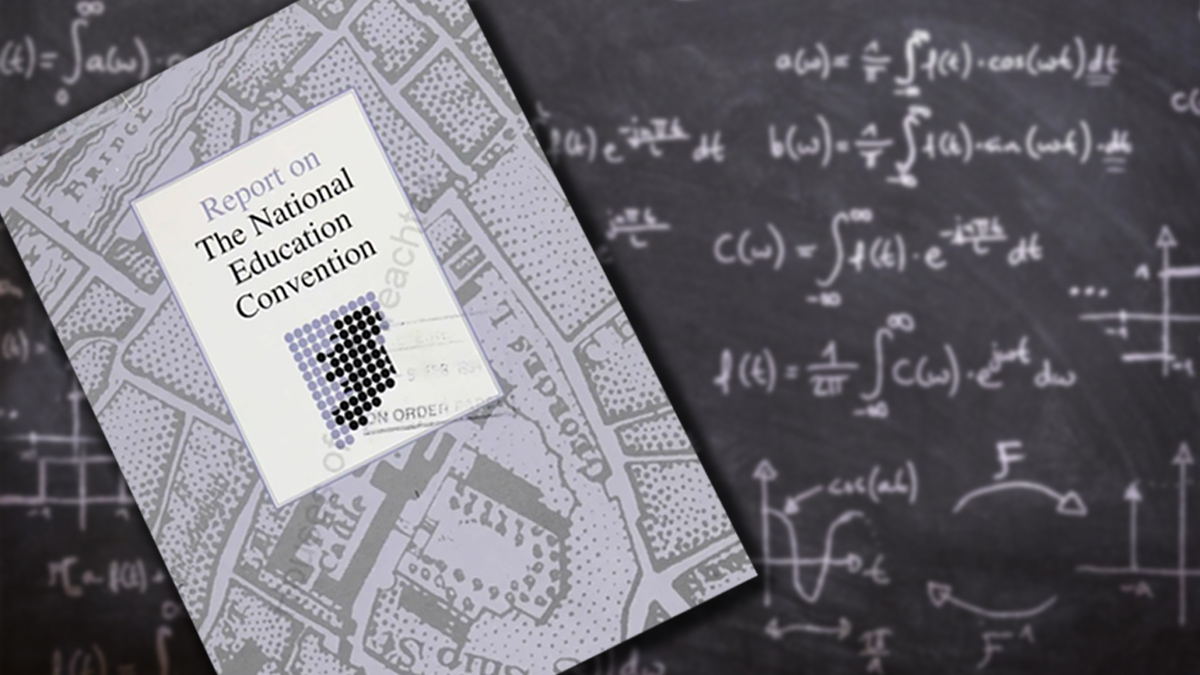
- John Coolahan, Report on the National Education Convention