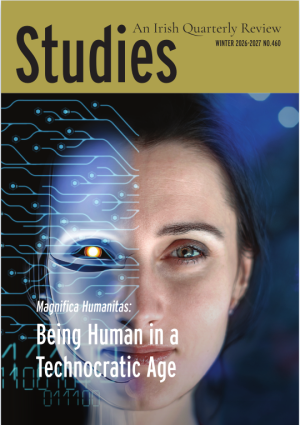


Peadar Kirby
Today, the liberal illusion that harmony could be born from the free play of private interests, and that modern society no longer needs civic virtue, has finally shown itself to be dangerous; it puts in question the very existence of the democratic process. Whence comes the necessity of a new political culture which … restores dignity to politics. Chantal Mouffe1
Working together for the common good means having a shared vision. It is clear that there are many ideological and practical differences among people, as well as differing interests and frequent disagreements, but that does not mean it is impossible to engage in dialogue to establish a set of basic agreements that enable the creation of a shared vision, upon which everyone can move forward together. – Pope Leo XIV, Magnifica Humanitas, par. 62
These two epigraphs, the first by Belgian political theorist Chantal Mouffe and the second from Pope Leo’s recent encyclical, Magnifica Humanitas, help identify the core challenge of contemporary politics. This can be summarised as overcoming a politics dominated by the free play of private interests, Mouffe’s ‘liberal illusion’, by means of moving towards a shared vision underpinning a form of progress in which all can participate. It brings the long-held Catholic principle of the ‘common good’ to the fore, the principle that plays a central role in activating the other key principles of Catholic social teaching (CST) as stated by Pope Leo in Magnifica Humanitas.
While the common good has been a core principle of CST for over a century, for most of that period it remained relatively uncontested and was indeed largely ignored in the cut and thrust of democratic politics. As Anna Rowlands writes, it was ‘often rejected by the political left over the last century as an inherently conservative notion’, while it was used by autocratic regimes and movements of the political right as a legitimation of their own programmes.2 With the rise of the MAGA movement in the United States, however, the term ‘the common good’, explicitly referenced to CST, has suddenly been thrust to the centre of ideological contestation, promoting an authoritarian project that has been very influential in offering intellectual heft to Trump’s rise to power. Meanwhile, Chantal Mouffe has been an exception among influential progressive political theorists over the past half century, arguing for the need of a version of the common good, though not explicitly referencing CST in doing so.
In this context, therefore, Pope Leo’s extensive use of the concept in Magnifica Humanitas takes on a significance beyond its particular utility to the core argument of the encyclical. Assessing the pope’s discussion of the common good, this article argues that Leo clarifies and sharpens in important ways how the common good is conceived, ways that are directly counter to use of the concept by leading right-wing US Catholic theorists. Furthermore, the pope’s clarification offers ways of addressing Mouffe’s difficulties with the concept, thereby allowing it take on a more active role in today’s vexed ideological politics.
This article begins by introducing some of the key ways in which the concept of the common good is being used by right-wing political theorists in the US. Following this, section two outlines the rationale that draws Mouffe to the concept and her difficulties with it. Section three then identifies in Magnifica Humanitas some ways Pope Leo both clarifies what the common good means and explains how it can emerge. The significance of these developments is then discussed. The conclusion summarises the argument and offers some examples in passing of its potential application.
Towards an ‘aristopopulism’
The striking term ‘aristopopulism’ comes from a book by one of the most prominent US Catholic intellectuals, Patrick Deneen. His 2023 book, Regime Change: Towards a Postliberal Future, has a chapter on aristopopulism, which he describes as follows:
The project at hand is the combination of two seeming opposites – a better aristocracy brought about by a muscular populism, and then, in turn, an elevation of the people by a better aristocracy. What is needed, for want of a better term, is a new combination of two long-standing opponents: ‘aristopopulism’.3
This follows his influential book Why Liberalism Failed, published in 2018, and goes further in promoting what he calls ‘common-good conservatism’, drawing explicitly on the term ‘common good’ as used in CST. Deneen is one of a number of prominent Catholics, most of them converts, promoting a postliberal future and invoking key concepts from papal social encyclicals as central pillars of what they are proposing. Among them are two of the most senior office holders in the government of Donald Trump, the vice-president, J. D. Vance, and secretary of state, Marco Rubio. Other prominent Catholic intellectuals are Adrian Vermeule, professor of constitutional law at Harvard Law School, and Chad Pecknold, associate professor of systematic theology at the Catholic University of America. He has taught a course entitled ‘Catholic Political Thought: Modernity and the Common Good’ at the Institute of Catholic Culture in Sacramento. His article ‘False Notions of the Common Good’, published in 2020, generated a lively debate on the meaning of the concept.4 He has recently become principal director for cultural outreach at the Office of Public Engagement in the US Department of Homeland Security, of which the immigration service ICE is a part. Pecknold’s move to the DHS has generated sharp critical comment from some Catholic commentators.5
Evoking the concept of the common good from CST then is common to this group. Vermeule, the most distinguished intellectual among them, promotes a common good constitutionalism that advocates a new moral framework for interpreting the US constitution, which he describes as a ‘substantively conservative approach to constitutional law and interpretation … [which] should be based on the principles that government helps persons, associations, and society generally toward the common good, and that strong rule in the interest of attaining the common good is entirely legitimate.’6 This draws on the work of the prominent German jurist Carl Schmitt (1888–1985), who was also a Catholic and whose jurisprudence became very influential in justifying the rise of Hitler. He held rabidly antisemitic views and was seen at the time ‘as the foremost proponent of a specifically National Socialist approach to law’.7 Not only does Vermeule cite Schmitt approvingly but bases his analysis of US administrative law on the thought of Carl Schmitt.8 Stefan Borg, a leading scholar of post-liberal thinkers, writes of Vermeule, A political project that, at least in Vermeule’s case, seeks to appeal to a standard intended to constrain and limit already existing individual autonomy, and using state power in doing so, would seem to approach unequivocal authoritarianism.9
Marco Rubio is the one non-academic in this cohort. He has outlined what he calls a ‘common-good capitalism’. In a presentation at the Catholic University of America in 2019 based on CST, he criticised ‘unguided’ markets for failing to create dignified work despite growing GDP and record profits. ‘Our nation does not exist to serve the interests of the market. The market exists to serve our nation and our people,’ he said. However, as analysed by one Catholic intellectual, Rubio’s speech was ‘unabashedly a populist jeremiad’, calling out financial, media, entertainment, and political elites by name, railing against their mocking of traditional middle America values and channelling the anger of those who feel isolated and alienated by fast-paced cultural and societal changes. ‘Common good capitalism owes much more to President Donald Trump’s “America First” populism and today’s angry GOP base than it does to Leo XIII’s Rerum Novarum,’ wrote Stephen Schneck, former head of the Institute for Policy Research and Catholic Studies at the Catholic University of America.10
That the concept of the common good has become a central tenet of Trumpian political discourse is indeed troubling and seems to confirm Hannah Arendt’s fear, as summarised by Rowlands, that the concept ‘was dangerous when it turned notions of the common good into narrow theories of race, ethnicity, natural order and power, used for dark causes’.11 It highlights both the fact that this key concept of CST is now central to the sharp ideological divide of Western politics and also the urgent need to contest its meaning and practical implications if it is to be rescued from being a tool used by one side of that divide.
Beyond the ‘liberal illusion’
The core division of today’s global politics seems increasingly to centre on defending the liberal order against the ever-strengthening authoritarian threats to that order. Yet, in certain intellectual circles, critiques of liberalism have emerged that focus on the ways liberalism has fragmented and atomised society resulting in an elitist political order in which economic elites increasingly restrict access to power by the majority. Some of this critique focuses on the co-option of the state to serve the interests of private capital accumulation. In his magisterial tome on the history of global capitalism, Sven Beckert traces the historical roots of this, reminding us that today’s liberal order began with the efforts of capital-owning elites in the mid nineteenth century, ‘exhibiting a profound desire to rule’, to achieve ‘considerable new sway over state institutions’.12
This critique is being recognised as a postliberalism, with right and left variants, both of which employ the term ‘common good’ as an antidote to an atomised individualism.13 However, the fact that both left and right aspire to a common good suggests a malleability to the concept that requires interrogation. One theorist not usually grouped under the rubric of postliberal is Chantal Mouffe, though her critique of the ‘liberal illusion’ echoes concerns of some postliberals. As the opening epigraph to this article illustrates, she makes a distinction between liberalism and democracy, seeing the former as a threat to the latter. Prising open this distinction helps her to avoid the illiberal tendencies that some right-wing postliberals seem quickly to fall into, as illustrated in the previous section. Instead, it opens a fruitful tension that helps deepen democratic participation.
For Mouffe, there is a struggle between the liberal and the democratic, with the former privileging the values of liberty and individual rights and the latter focusing on equality of participation. The specificity of modern democracy lies precisely in the tension between the democratic logic of equality and the liberal logic of liberty: ‘It is a tension that we should value and respect, rather than try to resolve, because it is constitutive of pluralist democracy,’ she writes.14 There are at least two central dimensions that constitute this tension: that between liberty understood as freedom from coercion, especially by the state, and that understood as the freedom to participate in public affairs and exercise an influence over the public agenda. The second dimension adds another layer, and this is the tension between the language of rights, often understood in an individualistic sense, and the language of virtue:
Liberalism’s exclusive concern with individuals and their rights has not provided content and guidance for the exercise of those rights. This has led to the devaluation of civic action, of common concern, which has caused an increasing lack of social cohesion in democratic societies.15
This echoes Rowan Williams’s excoriating critique of rights discourse: ‘The individual subject of human rights is an abstraction – and precisely and paradoxically because of this is also in practice a very specific kind of human subject, the sovereign possessor of unconstrained will, unfettered negotiating power, and the secure certainty of self-transparency.’16
This has grave implications for Mouffe: ‘Many of the problems facing liberal democracies today stem from the fact that politics has been reduced to an instrumental activity, to the selfish pursuit of private interests.’ Indeed, she sees this as a negation of the political since democracy is limited to a mere set of neutral procedures, the transformation of citizens into political consumers, and the liberal emphasis on a supposed ‘neutrality’ of the state. These ‘have emptied politics of all substance’.17 What this leads to is a post-democracy with politics becoming an affair of closed elites. The tension between the liberal and the democratic principles has been eliminated so that citizens have been largely deprived of the possibility of exercising their democratic rights. Politics has become more an issue of managing the established order, a domain reserved for experts, and popular sovereignty has been declared obsolete. ‘What now rules is an individualistic liberal vision that celebrates consumer society and the freedom that the markets offer,’ she writes.18
By contrast, Mouffe views the essence of democratic politics as being ‘the construction of collective identities and the creation of a “we” as opposed to a “them”’.19 By reducing politics to a rational negotiation of vested interests, liberal democracy strips individuals of their disruptive passions and beliefs, allowing illiberal forces occupy that space, as forces of the far right are showing today through their mobilising power and antagonism. Instead of the current practice of trying to keep such forces at arms’ length while trying to win over their supporters through offering them elements of the far-right agenda, notably controls on immigration, Mouffe argues that liberal democracy must acknowledge the violence and hostility inherent in social relations. The challenge is how to create the conditions through which these aggressive forces can be defused and diverted into a pluralist democratic order.
To do this, politics must move beyond offering voters a series of policies based on technical issues decided upon by experts, to become an arena for popular mobilisation giving due weight to affective appeals. ‘It is through the construction of a “people”, a collective will that results from the mobilisation of common affects in defence of equality and social justice, that it will be possible to combat the xenophobic policies promoted by right-wing populism,’ she argues in her book For a Left Populism.20 This brings Mouffe’s vision very close to that of Pope Leo as expressed in the epigraph to this article and elsewhere in Magnifica Humanitas.
While Mouffe refers to the common good, though without any reference to CST, she finds the concept problematic, as she sees it as harking back to a pre-modern society organised around a single substantive idea of the common good. This is not possible in a modern pluralist democracy, she writes, and, indeed, is seen by some liberals as having totalitarian implications. However, she does defend the notion if it is understood in strictly political terms as the political common good of a liberal democratic system. The mode of political association she advocates implies the idea of commonality, what she calls an ethico-political bond that creates linkages among participants, is the basis for common action and helps create a common identity. In her more recent writings, she relates it to the affective dimension of politics through which people can be mobilised to achieve common aims. Has Pope Leo in Magnifica Humanitas clarified the concept in ways that help overcome Mouffe’s difficulties with it?
Drawing the common good into democratic deliberation
As far back as Rerum Novarum in 1891, the common good was presented as a foundational principle of CST. But, as Rowlands writes, while the concept has been refined and developed by subsequent popes, their encyclicals ‘arguably contain areas of unclarity about the meaning, content, and implications of the concept of the common good’, with both practical and metaphysical components.21 Twentieth-century theories of the common good have tended to focus on extrinsic questions: differentiating public, individual, private, and common goods that enable human flourishing and attempting to offer more detailed accounts of the conditions that foster such goods. ‘Our current context seems to demand of us a fuller response,’ writes Rowlands.22 Arguably, that fuller response has come in Magnifica Humanitas.
Pope Francis only mentioned the common good in passing, though in ways that presaged Pope Leo’s fuller treatment. For example, in Fratelli Tutti he states that ‘a wide variety of practical proposals and diverse experiences can help achieve shared objectives and serve the common good’,23 and he mentions that trust can be built ‘only through dialogue that is truly directed to the common good’.24 Pope Francis appeals ‘for a renewed appreciation of politics as a lofty vocation and one of the highest forms of charity, inasmuch as seeks the common good’.25 In these ways he makes clear that the common good is not imposed from without but emerges from within broad political deliberation.
By contrast, from the beginning of Magnifica Humanities, Pope Leo says he is seeking ‘to identify new paths for the common good’,26 and he makes clear the centrality of ‘building for the common good’.27 In a very significant comment at the beginning of the first chapter, Pope Leo makes clear that the Church’s social doctrine is not ‘an external code of ethics imposed from above’ but emerges from ‘a Church that walks alongside humanity, recognising the autonomy of earthly realities’, which in that way ‘strives to serve the common good’.28 This shows an awareness of some common critiques of CST and clearly signals that he seeks a more democratic way of serving the common good. He emphasises this again in par. 89, where he gives examples of how the Church needs to act in a more just and transparent way so as to ‘be able to bear credible witness to society that seeking the common good together, with shared responsibility and fraternity, is not a utopia but a real possibility’.
In chapter two, on the foundations and principles of CST, the pope identifies the common good as the first major principle and shows how the other principles activate it. The common destination of goods reminds us that the earth’s goods are given to the entire human family and that every person has an inherent right to their use. Subsidiarity emphasises how individuals, families, local communities, and intermediary organisations should not be supplanted by high-level authorities while solidarity ‘is the concrete recognition that the future of each individual is connected to the future of all’.29 Social justice addresses not merely the fairer distribution of resources or the correction of current injustices but includes a restorative dimension, mending broken bonds and reintegrating those who have been excluded. Integral human development shows us that ‘development is not truly human if it increases consumption for some while shifting costs and burdens onto others, or relegates entire regions to subordinate roles, preventing them from realising their full potential.’30 Pope Leo applies this very tellingly to AI: ‘Technological innovations including artificial intelligence, are not neutral, for they can foster participation and justice, or they can exacerbate inequality, control and exclusion.’31 In chapter four, he writes that ‘the digital transformation invites us to rediscover truth as a common good, to protect the dignity of work, and to safeguard freedom against all forms of dependence and commercialisation.’32 Significantly, he identifies ‘the shared pursuit of the veracity of facts’ as a common good33 and makes clear that ‘the search for truth is an essential element of democracy, which is itself a means of contributing to the common good.’34
What Pope Leo has done is Magnifica Humanitas is to make the core concept of the common good an operational principle in political life. Whereas previous popes had fleshed out the concept in various ways, up until now it always ran the risk that it was seen as the Church imposing its view of what was good for humanity on the rest of society, an interpretation that informs the contributions of Vermeule and Deneen. For Pope Leo, the common good is something to be sought together with the rest of humanity, based on truth and transparency, opposing inequality, control, and exclusion, building towards a shared vision established through dialogue on which everyone can move forward together. This is very difficult to square with the elitist, authoritarian, and exclusionary versions of the common good espoused by right-wing proponents and is far closer to Mouffe’s ethico-political bond that creates linkages among participants, is the basis for common action, and helps create a common identity.
Most centrally, what Pope Leo does is to flesh out what civic virtue might mean in today’s political and ideological landscape, with particular attention to the challenges posed by AI. Though Mouffe uses the term ‘civic virtue’, the single mention of virtue in Magnifica Humanitas is a reference to solidarity as a virtue. But Pope Leo shows in practice how the principles of CST offer a basis for analysing these contemporary challenges in a rich and grounded way with clear guardrails. These he illustrates through showing how AI technology should be developed if it is to benefit humanity, including issues of ownership, design, and intention. This is clearly serving the common good of humanity as it grapples with the threats of AI. In a similar way, Laudato Sí could be seen as laying the foundation for a view of how to create a common ecological future for ourselves and the many species with which we share this beautiful planet. These examples show how politics can rise beyond the powerplay of vested interests to seek the common good.
Conclusions
Politics is in crisis. What a focus on developing a sense of the common good offers is to bring virtue into politics, moving it beyond ever greater atomisation based on conflicts around interests, and focusing instead on the great needs of humanity. While the far right has little sense of a common good, its leaders are far more successful in tapping into the malaise left by the decay of collective projects of social progress. What progressive forces need to offer is a shared vision and identity to take on the powerful forces that are so eroding public life. As Pope Leo puts it in Magnifica Humanitas, ‘It is the pursuit of the common good that gives life to a people, understood not as a mere collection of individuals, but as a living reality in which people learn to recognise that they themselves are interconnected and jointly responsible for the res publica.’35
Conceiving of a common good in today’s complex society may seem impossible to many. But, as Pope Leo writes, this is ‘not a utopia but a real possibility’. As examples, we have a number of recent authoritative proposals that are akin to laying out what today would serve the common good. The World Inequality Lab’s Global Justice Report offers a set of bold policy proposals to combat today’s polycrisis based on hefty wealth taxes, sharp reductions in working hours, greater investment in education and health, and cutting greenhouse gas emissions.36 Last April, the UN issued a roadmap for eradicating poverty beyond growth with contributions from more than 400 experts across the UN system, academia, governments, civil society, and trade unions. It offers concrete policy options for transitioning to an economy that reduces poverty and inequality without relying on socially and ecologically destructive economic growth.37 And, in explicit terms, economist Mariana Mazzucato entitles her latest book The Common Good Economy in which she outlines a purpose and direction for the economy, its co-creation by citizens, collective learning and reward sharing, and accountability.38 Finally, the inspiring speech by new UK prime minister Andy Burnham at the 2026 Labour Party conference laid out an ambitious agenda for the common good of UK citizens. He diagnosed ‘a country run for vested interests. Not in the public interest. With power held in too few hands. And too many places left to drift.’ And he went on to offer a radical vision of affordable homes for the young, of a decent care service, of water, energy, and transport back under public control, of a quality pathway to education for all young people, of devolving power closer to people, of electoral reform. This is bringing the common good to the heart of politics.39
Where the far right fosters a resentment, Mouffe counsels that, instead of condemning those who fall prey to such discourse, the important thing is to offer hope. And she reminds her readers that Émile Durkheim identified the mechanism leading from anger to hope as the origin of the socialist movement at the dawn of the industrial revolution. ‘Hope Again’ was the slogan of the UK Labour Party conference. This, then, is the starting point for the ‘better kind of politics’ that Pope Francis calls for in his encyclical Fratelli Tutti, ‘one truly at the service of the common good. Sadly, politics today often takes forms that hinder progress towards a different world.’40 Andy Burnham, who has quoted Pope Francis elsewhere, offers him an answer when he says he came back to Westminster ‘to make politics work’ for the people. The starting point for such a politics is mobilising around a clear sense of the common good. In clarifying this key point, Pope Leo has freed this core concept of CST to play an increasing role in the renewal of politics.
Peadar Kirby is Professor Emeritus of International Politics and Public Policy, University of Limerick. His most recent book is Karl Polanyi and the Contemporary Political Crisis: Transforming Market Society in the Era of Climate Change (Bloomsbury, 2021).
Notes
- Chantal Mouffe, The Return of the Political (Verso, 2020), p. 25.
- Anna Rowlands, Towards a Politics of Communion: Catholic Social Teaching in Dark Times (T&T Clark, 2021), p. 112.
- Patrick Deneen, Regime Change: Towards a Postliberal Future (Random House, 2023), p. 147.
- Chad Pecknold, ‘False Notions of the Common Good’, First Things, 23 April 2020.
- See Jonathan Heaps, ‘Chad Pecknold’s New Job’, Commonweal, 15 September 2026.
- Adrian Vermeule, ‘Beyond Originalism’, The Atlantic, https://archive.ph/ClgZB
- Jan-Werner Müller, A Dangerous Mind: Carl Schmitt in Post-War European Thought (Yale University Press, 2003), p. 40.
- See Adrian Vermeule, ‘Our Schmittian Administrative Law’, Harvard Law Review, 122 (2009), pp. 1095–1149.
- Stefan Borg, ‘In Search of the Common Good: The Postliberal Project Left and Right’, European Journal of Social Theory, 27:1 (2024), p. 17 (pp. 3–21).
- Stephen Schneck, ‘Rubio’s “Common-Good Capitalism” Considered’, National Catholic Reporter, 8 November 2019.
- Anna Rowlands, ‘Illuminating Dark Ties: The Surprising Relevance of Catholic Social Teaching’, Studies, 111:444 (2022), pp. 339–351. The quote is on p. 340.
- Sven Beckert, Capitalism: A Global History (Allen Lane, 2025), p. 538.
- See Stefan Borg, The Return of the Common Good: The Postliberal Project Left and Right (Routledge, 2025).
- Mouffe, The Return of the Political, p. 150.
- Mouffe, The Return of the Political, p. 65.
- Rowan Williams, Solidarity: The Work of Recognition (Bloomsbury, 2026), p. 75 (italics in original).
- Mouffe, The Return of the Political, p. 111.
- Chantal Mouffe, For a Left Populism (Verso, 2018), p. 18.
- Mouffe, The Return of the Political, pp. 140–41.
- Mouffe, For a Left Populism, p. 6.
- Rowlands, Towards a Politics of Communion, p. 169.
- Rowlands, Towards a Politics of Communion, p. 173.
- Pope Francis, Fratelli Tutti (The Holy See, 2020), 228.
- Pope Francis, Fratelli Tutti, 262.
- Pope Francis, Fratelli Tutti, 180.
- Pope Leo XIV, Magnifica Humanitas (The Holy See, 2026), 2.
- Pope Leo XIV, Magnifica Humanitas, 11.
- Pope Leo XIV, Magnifica Humanitas, 18.
- Pope Leo XIV, Magnifica Humanitas, 73.
- Pope Leo XIV, Magnifica Humanitas, 83.
- Pope Leo XIV, Magnifica Humanitas, 85.
- Pope Leo XIV, Magnifica Humanitas, 131.
- Pope Leo XIV, Magnifica Humanitas, 132.
- Pope Leo XIV, Magnifica Humanitas, 134.
- Pope Leo XIV, Magnifica Humanitas, 62.
- World Inequality Lab, Global Justice Report (Inequalitylab.world, 2026), https:// globaljusticeproject.wid.world
- Office of the UN High Commissioner for Human Rights, Roadmap for Eradicating Poverty beyond Growth, https://www.ohchr.org/en/special-procedures/sr-poverty/roadmap-eradicating-poverty-beyond-growth
- Mariana Mazzucato, The Common Good Economy: A New Compass (Allen Lane, 2026).
- Interestingly Stefan Borg sees Zohran Mamdani, the new mayor of New York, ‘pointing towards a kind of return of the common good’. See ‘Stefan Borg on Post-liberalism and the Return of the Common Good’, https://www.illiberalism.org/stefan-borg-on-post-liberalism-and-the-return-of-the-common-good
- Pope Francis, Fratelli Tutti, 154.