
Tobias Winright
During the weeks following their initial attack on Iran on 28 February, the US and Israel destroyed not only military targets, such as missile launch sites, naval vessels, and airfields, but also nonmilitary locations, including hospitals, bridges, rail lines, pharmacies, oil depots, steel plants, and power plants. One Tomahawk cruise missile meant to target an Iranian naval base also struck Shajarah Tayyebeh girls’ primary school, attended by both girls and boys, killing up to 175 people, most of them girls.1 Additional children were killed in other schools across Iran, leading UNICEF to issue a statement urging ‘all parties to uphold their obligations’ under international humanitarian law to ‘ensure the protection of civilians’, including children, along with the schools and hospitals where they receive education and health services.2
However, this duty to protect civilians is itself under attack. Civilian deaths around the world surged by 40 per cent during 2024, the third consecutive year of increasing noncombatant fatalities in armed conflicts, according to data released by the UN Human Rights Office.3 This rise in civilian casualties includes the 7 October 2023 terrorist attack in which Hamas intentionally murdered nearly 1200 persons, two-thirds who were civilians,4 in Israel, along with the more than 70,000 deaths, over half of whom were children, women, and the elderly, by Israeli Defence Forces in the Gaza Strip.5
In Ukraine, the number of civilians killed and injured by Russian troops, missiles, and drones increased by 26 per cent in 2025, making it the deadliest year for civilians since 2022.6 Only during the first three months after Russia’s invasion were there more Ukrainian civilian casualties. Over 15,000 Ukrainian civilians have been killed, and more than 42,144 people have been reported to have been injured since the beginning of the war.7 In contrast, civilians wounded or killed by Ukrainian forces in Russia or in Russian- occupied areas of Ukraine are far, far fewer.8
In Sudan, the brutal civil war between Sudan Armed Forces (SAF) and the paramilitary Rapid Support Forces (RSF) killed or wounded over 17,000 civilians between April and October 2023.9 In Myanmar, the civilian death toll has been high ever since the military coup in February 2021.10 Sadly, I could go on.
Rules-based order no longer functioning
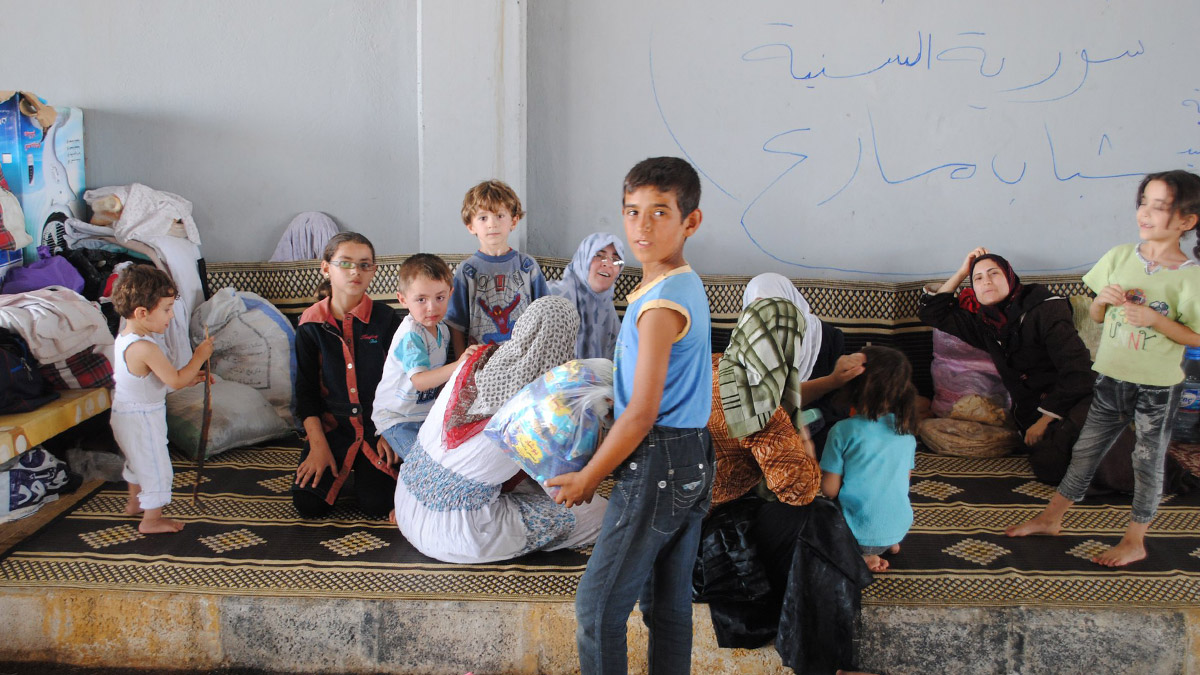
Significantly, as with the Shajarah Tayyebeh girls’ primary school, these casualties reflect ‘sobering failures’, observes UN high commissioner for human rights Volker Türk, ‘to protect some of the most vulnerable people’, including people with disabilities, women, poor persons, children, the elderly, and other members of marginalised groups.11 In Gaza, women and children comprised almost 70 per cent of the verified war dead.12 The percentage of women killed in wars doubled globally during 2023.13 As UN under-secretary-general Sima Bahous grimly notes, ‘Women and girls are being killed in record numbers, shut out of peace tables, and left unprotected as wars multiply.’14
These disturbing statistics are more than that; these are persons with immeasurable dignity. Each of them is an imago Dei, an image of God (Gen 1:26–27). This is why the US Catholic bishops, in their 1983 pastoral letter, The Challenge of Peace, wrote that ‘the possibility of taking even one human life is a prospect we should consider in fear and trembling.’15 Jason Abbott rightly writes, ‘These schoolgirls were not collateral damage. They were innocent civilian lives – lives that the laws of war are supposed to protect.’16 Yet, as Ian Overton, the executive director of the research organisation Action on Armed Violence (AOAV), laments, there is now ‘a wider collapse of restraint that is now visible across multiple wars’ along with an eroded and ‘no longer functioning international rules-based order’ that is capable of protecting civilians and holding those responsible for harming them to account.17 The US, which played a crucial role in creating that international rules-based order, can no longer be counted on to abide by the ethics and the laws of war. According to secretary of ‘war’ Pete Hegseth, in a speech to the 800 generals and admirals called from around the world to gather in Quantico on 30 September 2025: ‘We fight to win. We unleash overwhelming and punishing violence on the enemy. We don’t fight with stupid rules of engagement. We untie the hands of our warfighters to intimidate, demoralise, hunt and kill the enemies of our country.’18 By ‘enemies’ Hegseth does not distinguish between combatants and noncombatants. His is a ‘holy war’ approach that demonises and dehumanises the other, so that all are considered ‘legitimate’ targets.19
Reclaiming just war theory
Rather than no longer teaching or using just war theory, as some have urged,20 I suggest now is the time for Catholics and others of good will to retrieve and reclaim this moral tradition and its principles that have sought to retrain and limit, rather than sacralise, war and that have influenced the laws of war.21 A key criterion of just war theory is noncombatant immunity, and armed forces are expected to discriminate (or distinguish) between combatants and noncombatants, as well as to try to avoid or at least minimise civilian casualties. This is reflected in the Fourth Geneva Convention of 1949, which declared that ‘persons taking no active part in the hostilities, including members of armed forces who have laid down their arms and those placed hors de combat by sickness, wounds, detention, or any other cause, shall in all circumstances be treated humanely.’22
As the US Catholic bishops observe, the principle of discrimination ‘prohibits directly intended attacks on non-combatants and non-military targets’.23 Although foreseeable deaths and injuries of civilians may be permitted as ‘collateral damage’, these must not be intended and must not be disproportionate. In other words, militaries have a duty of ‘due care’ to avoid harming noncombatants and of ‘constant care’ to minimise harm to them, even if doing so means taking risks on the part of combatants.24
While the bishops acknowledge that it ‘is not always easy to determine who is directly involved in a “war effort” or to what degree’, they add that ‘not even by the broadest definition can one rationally consider combatants entire classes of human beings, such as schoolchildren, hospital patients, the elderly, the ill, the average industrial worker producing goods not directly related to military purposes, farmers, and many others.’25 Again, the bishops here emphasise, ‘They may never be directly attacked.’ To reinforce this retrieval of and recommitment to the just war tradition and its criterion of discrimination, or noncombatant immunity, I suggest it is time for the Church to rediscover the medieval movement called the Peace of God and the Truce of God. In his classic book The Just War in the Middle Ages, published 50 years ago, historian Frederick H. Russell observes that following ‘the chaos of the tenth century’ church synods and councils promulgated the Peace of God and the Truce of God.26
The Peace of God stipulated that the following persons should not be attacked: monks, clerics, nuns, women, merchants, shepherds, pilgrims, peasants, and visitors to councils. In addition to persons, certain places were off limits, including cemeteries, churches, and hospitals. The Truce of God prohibited warfare during certain times, including Sundays, Fridays, holy days, feast days, and whole church seasons, such as Advent and Lent.
Although Russell attributes the Peace of God and the Truce of God to a ‘peace movement’, he adds that it ‘was not necessarily pacifistic, for it was directed against violence rather than war itself’.27 ‘For a just war to remain a just war,’ Russell writes, ‘it had to be conducted properly, which meant that it could only be waged on other soldiers.’28 The Peace of God and the Truce of God, in other words, represented an effort to reinforce respect for the just war criterion of discrimination.
A new ‘law of the innocents’
My suggestion about retrieving the Peace of God and the Truce of God was anticipated recently here in Ireland. Inspired by the ‘law of the innocents’ (Lex Innocentium) from Adomnán (624–704 CE), abbot of Iona, and accepted by the Synod of Birr in 697 CE, there has been a call for a new Lex Innocentium for the twenty-first century.29 Unfortunately, though, this new document ‘rejects the just war theory’, which is actually the moral perspective that gave rise to the protection of the innocent as stipulated by Peace of God and the Truce of God.
Civilians, including women and children, need protection more than ever right now. Of course, as Cristina Richie noted a decade ago, we should avoid stereotyping women as weaker and as automatically to be assumed civilians, since women now serve in and are combatants in military forces. In her view, ‘Women in combat prompt us to return to classic just war demarcations based on active military involvement.’30 Still, as seen at the beginning of this essay, women, along with children and others, are especially vulnerable to being injured and killed in today’s wars. We must attempt to hold governments and their militaries accountable to adhering to the just war principle of noncombatant immunity enshrined in international law.
Tobias Winright is Professor of Moral Theology, St Patrick’s Pontifical University, Maynooth, and Associate Member of the Las Casas Institute for Social Justice, Blackfriars, Oxford University.
Notes
- Malachy Browne and John Ismay, ‘US Tomahawk Hit Naval Base Beside Iranian School, Video Shows’, New York Times, 8 March 2026, www.nytimes.com/2026/03/08/world/ middleeast/iran-minab-school-strike.html?smid=url-share
- UNICEF, ‘The Brutality of War Measured in Children’s Lives as Hostilities Escalate in Iran’, Statement by UNICEF in the Middle East and North Africa, 5 March 2026, www.unicef.org/ press-releases/brutality-war-measured-childrens-lives-hostilities-escalate-iran. Three decades ago, Todd David Whitmore and I wrote about ‘the besetting effects of war and violence on children’ in Sarajevo, Rwanda, Angola, Afghanistan, and Mozambique; see Todd David Whitmore and Tobias Winright, ‘Children: An Undeveloped Theme in Catholic Teaching’, in The Challenge of Global Stewardship: Roman Catholic Responses, ed by Maura A. Ryan and Todd David Whitmore (University of Notre Dame Press), pp. 161–185.
- UN Human Rights Office, ‘UN Data Shows Surge in Civilian Deaths in Conflict Globally, Highlights Pervasive Discrimination’, 18 June 2025, www.ohchr.org/en/press-releases/2025/06/ un-data-shows-surge-civilian-deaths-conflict-globally-highlights-pervasive
- Human Rights Watch, ‘October 7 Crimes against Humanity, War Crimes by Hamas-led Groups’, 17 July 2024, www.hrw.org/news/2024/07/17/october-7-crimes-against-humanity- war-crimes-hamas-led-groups
- Michael Spagat et al., ‘Violent and Non-Violent Death Tolls for the Gaza Conflict: New Primary Evidence from a Population-Representative Field Survey’, The Lancet Global Health, 14:4 (April 2026), www.thelancet.com/journals/langlo/article/PIIS2214-109X(25)00522-4/ fulltext
- Dan Sabbagh, ‘Ukrainian Civilian Casualties Surged by 26% in 2025, Say Researchers’, The Guardian, 16 February 2026, www.theguardian.com/world/2026/feb/16/ukrainian-civilian- casualties-surged-by-26-in-2025-say-researchers
- Statistica Research Department, ‘Number of Civilian Casualties in Ukraine during Russia’s Invasion Verified by OHCHR from 24 February 2022 to 28 February 2026’, Statista, 13 April 2026, www.statista.com/statistics/1293492/ukraine-war-casualties/
- Alexander Hill, ‘There Are Civilian Casualties on both Sides of the Front Lines in the War in Ukraine’, The Conversation, 20 July 2023, https://theconversation.com/there-are-civilian- casualties-on-both-sides-of-the-front-lines-in-the-war-in-ukraine-209719
- Amnesty International, ‘Sudan: Civilians Still Being Killed and Displaced after Six Months of Conflict’, 15 October 2023, www.amnesty.org/en/latest/news/2023/10/sudan-civilians-still- being-killed-and-displaced-after-six-months-of-conflict/
- Office of the High Commissioner for Human Rights, ‘Myanmar: Four Years on, Coup Leaders Ramp Up Violations to Unprecedented Levels, UN Finds’, 31 January 2025, www.ohchr.org/ en/press-releases/2025/01/myanmar-four-years-coup-leaders-ramp-violations-unprecedented- levels-un
- Office of the High Commissioner for Human Rights, ‘UN Data Shows Surge in Civilian Deaths in Conflict Globally, Highlights Pervasive Discrimination’, 18 June 2025, www.ohchr.org/ en/press-releases/2025/06/un-data-shows-surge-civilian-deaths-conflict-globally-highlights- pervasive
- Emma Farge, ‘Gaza Women, Children Are Nearly 70% of Verified War Dead, UN Rights Office Says’, Reuters, 8 November 2024, www.reuters.com/world/middle-east/nearly-70-gaza- war-dead-women-children-un-rights-office-says-2024-11-08/
- United Nations, ‘Percentage of Women Killed in War Doubled in 2023: UN Report’, UN News, 23 October 2024, https://news.un.org/en/story/2024/10/1156016
- UN Women, ‘Wars on Women Escalate as Global Conflicts Reach Record Highs’, 20 October 2025, www.unwomen.org/en/news-stories/press-release/2025/10/wars-on-women-escalate-as- global-conflicts-reach-record-highs
- National Conference of Catholic Bishops, The Challenge of Peace: God’s Promise and Our Response (United States Catholic Conference, 1983), p. 80.
- Jason Abbott, ‘Unjust War, Unjust Conduct: Just War Theory and the Iran War’, Fair Observer, 13 April 2026, www.fairobserver.com/world-news/middle-east-news/unjust-war-unjust- conduct-just-war-theory-and-the-iran-war/
- Sabbagh, ‘Ukrainian Civilian Casualties Surged by 26% in 2025’.
- US Department of War, ‘Secretary of War Pete Hegseth Addresses General and Flag Officers at Quantico, Virginia’, 30 September 2025, www.war.gov/News/Transcripts/Transcript/ Article/4318689/secretary-of-war-pete-hegseth-addresses-general-and-flag-officers-at- quantico-v/
- Tobias Winright, ‘Defense Secretary Hegseth’s Approach to the Use of Armed Force Is Wrong’, National Catholic Reporter, 5 November 2025, www.ncronline.org/opinion/defense- secretary-hegseths-approach-use-armed-force-wrong
- See ‘An appeal to the Catholic Church to Recommit to the Centrality of Gospel Nonviolence’, 15 April 2016, https://paxchristiusa.org/2016/04/15/statement-an-appeal-to-the-catholic- church-to-recommit-to-the-centrality-of-gospel-nonviolence/
- Darius von Güttner-Sporzyński, ‘Just War, Holy War and the Crisis of Language: What Is Lost When We Lose a Moral Framework for Conflict?’, ABC Religion & Ethics, 13 April 2026, www.abc.net.au/religion/just-war-holy-war-crisis-of-language-lack-of-moral- framework/106559550; Tobias Winright, ‘We Need Catholic Just War Theory Now More than Ever’, America, 5 January 2026, www.americamagazine.org/faith-and-reason/2026/01/05/ trump-venezuela-catholic-just-war/
- Geneva Convention (IV), Relative to the Protection of Civilian Persons in Time of War, Geneva, 12 August 1949, art. 3 (1), http://www.icrc.org
- National Conference of Catholic Bishops, The Challenge of Peace, p. 107.
- J. Toby Reiner, ‘What Are the Principles of Civilian Immunity in War? A Scholar of Justice in War Explains’, The Conversation, 18 January 2024, https://theconversation.com/what-are-the- principles-of-civilian-immunity-in-war-a-scholar-of-justice-in-war-explains-220732
- National Conference of Catholic Bishops, The Challenge of Peace, p. 108.
- Frederick H. Russell, The Just War in the Middle Ages (Cambridge University Press, 1977), pp. 34, 70.
- Russell, The Just War in the Middle Ages, p. 34. For a similar reading of the Peace of God and the Truce of God, see Joseph J. Fahey, War and the Christian Conscience: Where Do You Stand? (Orbis Books, 2005), p. 48.
- Russell, The Just War in the Middle Ages, p. 186.
- See https://lexinnocentium21.ie/lex-innocentium-21st-century/
- Cristina Richie, ‘Women in Combat, Civilian Immunity, and the Just War Tradition’, in Can War Be Just in the 21st Century? Ethicists Engage the Tradition, ed by Tobias Winright and Laurie Johnston (Orbis Books, 2015), p. 136. Richie relies on R. Charli Carpenter, ‘“Women, Children and Other Vulnerable Groups”: Gender, Strategic Frames and the Protection of Civilians as Transnational Issue’, International Studies Quarterly, 49:2 (2005), pp. 295–334.