
Fiachra Long
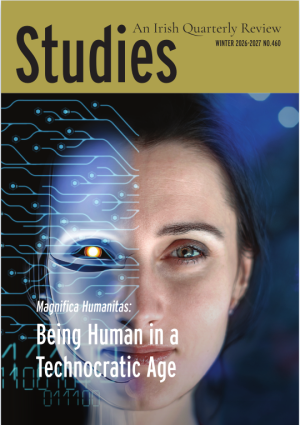
In this article, I identify some of the themes presented in the papal document Magnifica Humanitas,1 published in May 2026, before referring to the concept of selfhood dominating modern times (i.e. post-1600 CE). The result is an easy slippage from human selfhood to robot selfhood. Consider ChatGPT’s prompt: ‘How can I help you today?’ Would you like me to compare Descartes and Bacon for you?’ ‘I can write a short essay for exam purposes on the influence of Einstein on modern philosophy.’ In contrast to ChatGPT’s easy ‘selfhood’, the human self is a living being that depends for its success as a self on achieving a moral task, indeed a philosophical task. Humans do not arrive on this planet already advanced in self-reflection. They need to work hard at developing an understanding of who they are and what obligations they have. In an age of artificial intelligence, this encyclical challenges us humans to remember our need to become more human rather than less human. Nowhere does it suggest that we are the finished product already. It is ultimately this moral dynamism that can be overlooked as more and more routine tasks are handled by artificial intelligence. We easily forget what intelligence means.
The first section of this article looks at the presentation of this moral claim in Magnifica Humanitas. The second section looks briefly at the profile of the Cartesian Ego and the dogmatic slumber into which we have arguably fallen. The third section presents a radically different way of characterising human selfhood, a more biological model that opens up the critical importance for humans of learning from experience. The claim here is that this adaptation of the human organism to its environment over time describes exactly the purpose of human ‘intelligence’. Intelligence is not just thinking in our heads.
I
Magnifica Humanitas queries the politics and moral claims of artificial intelligence in contemporary society. It is a document written in the spirit of Vatican II’s Gaudium et Spes and follows on from Pope Francis’s idea of synodality as developed in Laudato Si’ and elsewhere. The bottom line is that all people, rich or poor, Catholic or non-Catholic, believer or non-believer, should promote the common good. The expression ‘the common good’ occurs repeatedly through this encyclical. It provides the ports for the argument’s journey and includes both private action and public actions. Not opposing technology per se, the document promotes once again that ‘public thing’, the res publica, whereby humans live peacefully and constructively together, contributing their collective energies to making this world more human and more peaceful. The encyclical clearly has a word of censure for those who claim to be an exception to this general rule and to withdraw support from public instruments of cohesion, such as the rule of law and other attempts at establishing the international world order. Indeed, sections of this document read as a political manifesto promoting artificial intelligence for mutual cooperation but also noting how it might signal a contrary attitude. This is a significant challenge for scientists and lay people today. The document develops a contrast between the metaphor of the Tower of Babel, representing dominance, univocity, and power, and the vision of Nehemiah (Neh 1–2), who encouraged the people to rebuild the Temple by collective work and cooperation. The document asks us to listen, discern, interpret the signs of the times, and to work together for the common good:
When it comes to applying these standards to the complex situations of our time, the contribution of philosophy and of the human and social sciences is essential. These disciplines help us understand and analyse cultural, economic, and political dynamics more deeply.2
No doubt artificial intelligence can be used in positive ways. It has enabled many recent medical cures, even progress in the cure for cancer. Its speed and high computing skill can identify objects and combinations at a cellular level in seconds, compared to the years it would take an entire research team to achieve the same result. This move to eliminate disease is entirely positive if applied to all people equally and not merely those with the proper contacts and money. On the other hand, making this technology available only to the rich would constitute an evil to be avoided. Similarly, some scientists have understood ‘human improvement’ in a transhuman sense as a call to dismiss weakness and fragility as inhuman, thereby encouraging the well-funded few to deny the human limits of life.3 Problems arise when weakness itself is thought to be inhuman, for the coast is then clear to eliminate the organic contours of human life altogether and claim scientific authority for doing so.
Moreover, to say that the common good should be a guide to human action is not to say that it is vague or beyond description. Philosophers since Plato have agreed that the quest for the good is possible to bring into effect through daily practices, even if they are not agreed on what practices are valuable. The document, however, dismisses the notion of an ordo amoris or ‘order of love’ if it means beginning with ourselves in the form of care for our own families, our own country, etc. and then working outwards when this has been accomplished. The reason is that this movement constantly favours the rich over the poor, the politically connected over the unconnected, and the essential outreach never occurs. So, the encyclical says, it is not ‘make one rich, the rest will follow’ (eventually), but rather we must all begin with a larger vision for the world, a world in which all human beings are called to participate, to become healthy and free,4 through the political structures we humans have made possible.
From a faith perspective, the equality of all humans in the eyes of God is particularly relevant in a world economy often no longer dominated by governments where public responsibility might reasonably be expected (although unfortunately this assumption is not sometimes evident) but by high tech actors, whose companies are often many times wealthier than governments. The pope dedicates an entire chapter to a discussion of the solidarity of all peoples.5 A society is just only when it enables all its peoples to participate and flourish, not from a position of servitude, which effectively identifies people with the wealth they create or don’t create, but as free, independent participants who have the (human) right to live, feed their families, educate their children. The issue of AI may now challenge this political aspiration. While automation can add speed and accuracy to production, the problem, as raised by the Dicastery for Education and mentioned in this document, is the possible surrender of human judgement to automated systems in complex areas of civil life, as well as in war.6 AI has now entered the decision-making process in situations where human supervision is no longer possible.7 The pope notes the danger of neglecting the important moral lessons of human limits in such scenarios. Are we not running the risk of surreptitiously surrendering key decisions to automated systems? Have we not in this way fallen victim to the many deceptions of self-sufficiency that have tempted humans in the exercise of power and which collectively damage every quest for ‘a communion that transforms’ the world, a light that might enlighten all peoples (Lumen Gentium)?8
II
This kind of communion has been challenged by screen culture and the disconnect between self and body or observer and actor. History is witness to a tendency to understand humans in dualist terms like these (soul and body, mind and brain, self and world), terms that have led Gnostics to believe that human beings do not belong to this world and that, as a result, we should not have any ultimate commitment to the organic conditions of life on planet Earth. This papal document, on the other hand, supports planet earth. It promotes the idea that this planet is our home, that people need this planet not only for its resources and its beauty but because it has supported our form of life along with the forms of life of many other creatures we love and admire. Furthermore, people need to form community with other people for their own sense of wellbeing and purpose. Robots do not help to achieve this. We are not passengers on a ship happy to disembark on our way to Mars. This is our one and only home.
This is an obvious point but one that has easily taken 500 years to learn since dualism was given renewed vigour in the thinking of René Descartes (1596–1650). Descartes argued for a clear separation of Ego from the ‘outside’ world, which he termed the res extensa. As a result, the Ego, he felt, should act on a separate plane from the body. Thinking, particularly mathematical thinking, could then operate as the sure and certain foundation of all science, and it was ‘sure and certain’ foundations that Descartes wished to find. Older but roughly contemporary with Descartes, and also concerned about the need to establish a proper scientific method, Francis Bacon (1561–1626), at the English court, appealed for an empirical method that generated scientific rigour. The benefits of an empirical method would be to separate science from superstition as well as from the many idols of the mind that had taken hold – the idea that the earth is flat, for example, or that the sun goes round the earth, theories whose contradiction may have led to Giordano Bruno being burned at the stake in 1600. As it happens, Bacon considered mathematics only of secondary importance to what he called science’s need for a properly empirical method. Ever since, both empirical observation and mathematical precision have contributed to scientific research, with some sciences closer to mathematics and others closer to empirical observation.
Artificial intelligence is a mathematical science, and as such it points more clearly in the direction of Descartes’ Ego rather than Bacon’s experiments. We can easily apply a mind–body dualism to endorse the plausibility of robots using the word ‘I’. So, what exactly does the word ‘I’ mean in the Cartesian context? Recall what Descartes wrote:
In the first place then, I considered myself as having a face, hands, arms, and all that system of members composed of bones and flesh as seen in a corpse which I designated by the name of body.9
Hardly a glowing tribute to one’s living body! However, Descartes prefers to look at bodies, including his own, as part of the res extensa (the outside thing) and thinks of humans essentially as spirits or intelligences only furtively linked to bodies. Later in the same text, he explains one of the central implications of this strange architecture. Notice how rarefied the human understanding has become:
But finally, here I am, having insensibly reverted to the point I desired, for, since it is now manifest to me that even bodies are not properly speaking known by the senses or by the faculty of imagination, but by the understanding only, and since they are not known from the fact that they are seen or touched, but only because they are understood, I see clearly that there is nothing which is easier for me to know than my mind.10
I have yet to find any evidence to support Descartes’ claim here. Bacon, of course, could not agree with it because it permits unrestrained power to multiply the ‘idols of the mind’. Indeed, it runs counter to the call of Socrates to ‘know thyself’, a lifetime task according to the Socratic tradition, but one that has been instantly achieved in the modern system, leading to the dismissal of Socratic reflection from the education of experimental scientists for the most part. Magnifica Humanitas does not examine this idea in any detail, but it presumes a closer organic connection between Ego and world than Descartes is willing to allow, exposing the need for artificial intelligence as a mathematical science to follow proper political and ethical guidelines. One key to doing this successfully is to accept that the human I is already organic, already corporeal, already part of the res extensa and not automatically isolated and operating from a position of ready-made power that is already self-reflective! This thought gives rise to the antidote profiling given below.
III
I float in your womb without knowing what I am doing and without having any opinion about anything. I relate but not with a polarity that uses hard borders. Without the nourishment you provide, I die, even though the possibility of death never appears with any clarity because I am not yet conscious. All things appear to me in a diffuse, pre-conscious way. I don’t make any choice to be here; nor do I sense in myself any kind of individuality. In this state, I am not aware of anything, except perhaps stress, if the floating chamber is stressed. Now, I am more liquid than solid. Under normal circumstances, I float happily here without distinguishing any here from there. Space has no meaning. Meaning itself has no meaning either. My bones, such as they are, even my cranial bones, are malleable and adjustable, still flexing and dependent on what you provide in the floating chamber where I swirl about. I am like a calf whale that recognises the song of the mother composed uniquely for it. I can hear preconscious sounds as they are transmitted through the fluid of my home. And yet I don’t know you or anything else, and I generate no memories of these signals. You are too close to me for me to know you because knowledge of things requires distance, but not the distance between mind and body, the distance between self and other. Even if I am hardening both in bone and identity, perpetually maturing by means of actions and reactions, even if I find myself bouncing against an organic wall and tumbling without any sense of up and down, even if I am learning to relate in new ways to surroundings that are neither you nor me, my learning self is closer to my liquid reality than any hardened Ego. If this link is obstructed or thwarted or removed, I have no choice but to become disturbed and effectively lost, a maladjusted case, a being without any basis, identity or direction.
Here I am, only a short time after floating in amniotic fluid, still without the advantage of time-consciousness, still without memory but intimately connected to the being which, under normal circumstances, has nurtured me up to this point and which I may soon begin to relate to as mother and carer. In normal circumstances, I am closer to this being than I am to my conscious self, which has yet to develop. I will always be closer to this being than to any self-centered fortress I may construct for myself later.
Soon my organic self emerges as a more solid thing but not entirely solid. I have been shocked into breathing in and out, having left my liquid home. Lungs now strangely gasp for air; bones are still pliable but hardening fast, organs soft, blood delivering oxygen to organs, nourishment coming in and waste flowing out. I am still happy in water and also happy to enjoy this new solidity that enables regular breathing and sound making. Air enables the beginning of a solid form of life in which relating to the world has a vectoral quality, moving from inside to outside and from here to there. A sense of space enables distance and closeness to define actions, and, without any awareness, I am able to suck and to pause over the feeding source. I use air not only for breathing but for making gurgling sounds. I will be open to air and the senses enabled by being in air, namely, smell and touch. I recognize another being by touching and smelling and soon there are sounds of pleasure and excitement. Sound and sight then begin to achieve precision. I begin to recognise smells and sights and alluring sounds, evidence that this new space-time distance is mine.
Gradually a sense of solidity establishes itself as a me, a being in some place, here not there, close or distant from the one who has always been there. Ironically, this space enables me to consciously touch you and move away. Or is it you that moves away? Distances become wider and time interludes longer and more varied. Because I am beginning a solid life in space and time, I begin to relate to things around me, first instinctively when I once folded my hand around your finger, then accidentally when I bump against rattles and such things, and finally intentionally when I move to grasp and let go or throw away things. Much of this development is un-self-conscious. I sense when I am comfortable and when I am not, even without anything more complex than the rudiments of a conscious I, even when I have learned to move deliberately in one direction or another. A sound addresses me frequently as a face comes close to my face and I soon recognise it. I do not know how to make that sound, but others make it and I gradually recognise that it refers to me. My history has begun as a conscious fact, and I begin to participate in a time-game and recognise myself as a time-being.
As a child, my learning is still bound up with my organic experience of motherly care. As growth occurs, this is still the case, for it is easier to learn in an environment where safety is assured. Soldiers on the front line also must learn things, but the proximity of imminent death makes anything other than survival difficult to learn. The learner is an emotional being who only learns when supported in the environment of learning surrounding it, which may explain why in certain situations of abuse, especially child abuse, the whole being of the victim is frozen and cannot learn. In ordinary learning environments, safety and togetherness are built into the way things are learned and reflected upon. Wirth noted that, in Dewey’s notion of education, ‘what the child learns in the classroom should resonate with home and community life and with societies of other times and places.’11 This is indeed the experience of the res extensa, but not of res extensa as a separate feature of the child’s life but of a res extensa that is already part of the child.
Everyone can recognise the benefits of schooling for children as they learn to transition from family to society. Their circle widens. The influences they encounter extend and become more complex, meaning that more complex forms of social interaction become possible and are best facilitated by competent and highly skillful human teachers. As a result, most children develop a moderately political sense of their own selves, selves that reach outwards and take responsibility in a certain sense for the world at large, a self deeply anchored in the organic conditions of life.
Where then is the ‘Me, Me, Me’ self, the one that teenagers come to believe no one understands, except perhaps some carefully selected online influencers? Could it be a false Ego, an invented Ego, more imaginary than real? The emptiness of this artificial self may appear plausible to unattached twenty-year-olds who imagine themselves pretty much self-sufficient, but before anyone can identify themselves in the ways social media avatars or influencers want, as strange consumers already alienated in a world of objects, the demands of the organism return.
Often it is because the proximity of biological life is experienced from the other side. The child is floating in one’s own womb or a partner’s womb. Now you as mother can feel the child bump and kick, and you are required to stretch and to manage the prospect of losing your shape, careful of what you eat, drink, the medicines you can take or not take. You are no longer alone or independent in a Cartesian sense (not that you ever were) but are intimately involved in what is happening without necessarily understanding everything about it. The organism teaches you about yourself and in some sense determines your choices as the embryo develops.
Now after the birthing process comes the weaning process. Once again, not a matter of individual opinion, but of the organism itself and the social and family structures gathered in around the new life. Organic and social demands then play a crucial role and the balancing process of managing the child or children and work. Career, financial pressures and the normal turbulence of the child growing up draw energies from far and wide. When does the parent reach a stage of returning behind the fortress walls of opinion or ever experience again the heady transcendentalism of the Cartesian Ego? Usually never, because people live out the worries of their children, keeping them constantly in mind, wishing for their happiness, hoping they are making the right decisions, hoping that they are well. There is no return to the illusions of self-made opinion that they may have once enjoyed as unattached twenty-year-olds.
Now, strange to say, I am not looking forward; I am looking backward. I recognise you now, my organic parent, and the nurturing you gave me. I now recognise what you did and how you are still part of me. My own experience has revealed this organic connection more clearly. You are always here with me, part of me, even when many years have passed, even when dementia has taken you away, even when you are deceased, even when these same forces are taking me away from others. My memory of you reassures me and enables me to float away in sleep as your touch once reassured me after a night-terror dream. Why do I think of these things now? I recognise you now in my own child and in their children. You are always there, except when you aren’t. Your being, wherever you are, enables me to understand myself as the organism I always have been and still am.
Conclusion
A philosopher critic might well respond to what I have written above by saying that it only addresses the question about what an ego is, not what it does, not its operations. The philosopher might say, if we are happy to think of the human ego as a unique but complex focus point for different biological elements, then what does it do essentially? In answer I would have to say that it changes, it learns to adapt to experience at first unconsciously as a nondescript human being, an infant (infans, ‘to be without speech’) but then quite quickly as a concrete being, as a human child. The ego must change radically, assuming control over the totality of the world as understood and yet unconsciously adapting in time to ever-changing circumstances. This is why many human cultures have invented patterns of education, including systems of schooling, that are particularly suited to the immense creativity of children’s inquiry. Talbot Brewer writes that engagement in the study of literature, art, and history enables the learner to generate that very type of reflection that develops selfhood, hence self-formative reflection. As an apologist for the humanities, he writes,
Now the human self is a very unusual subject of inquiry in that it does not remain unchanged as the inquiry proceeds. It brings itself into view by clarifying its inchoate ideas and giving expression to its inchoate creative visions – that is by self-formation rather than self-description. Nor does it seek to overcome its merely human perspective when engaged in this self-formative reflection.12
Brewer is right here to point to the importance of self-reflection as a contingent factor in human life. I have met many students who welcomed the chance to reflect on what they were becoming as people in the light of surprising ideas that arose in their reading. They found, in contrast, the routine of social media interactions uninspiring and dull, simply driving them into caves from which they longed for release. Chained to these repetitive memes (my birthday party, my visit to the dentist, my latest joy-rider experience), they displayed a longing to meet an educator who might show them how to escape these cultural shadows projected on the wall.
This encyclical has reflected on the magnificence of human beings, not as shining individual jewels, but as organic beings living with others in cooperation and peace. It has noted the great evil of social isolation and the importance of human-to-human interaction. Our argument has proposed that human selves are not ready-made but are rather possibilities connected to the organic conditions of life and the moral, political, and ecological conditions supporting them. Humans live out their selfhood from this organic sense of connection with others and nature. Leo XIV’s encyclical reminds us of the richness of these organic connections. Despite the insatiable need of automated systems for data scraped from everywhere, the appetite of the human self is only for those forms of self-definition that are bathed in the truth of things. ‘What is the truth?’ asked Pilate (Jn 18:38). That is our question too.
Dr Fiachra Long is retired Senior Lecturer in the School of Education, University College Cork. His most recent book is Essays in the Phenomenology of Learning: The Challenge of Proximity (Routledge, 2023).
Notes
- Pope Leo XIV, Magnifica Humanitas (The Holy See, 2026).
- Pope Leo XIV, Magnifica Humanitas, 23.
- Pope Leo XIV, Magnifica Humanitas, 12.
- Pope Leo XIV, Magnifica Humanitas, 64.
- Pope Leo XIV, Magnifica Humanitas, 73–76.
- Pope Leo XIV, Magnifica Humanitas, 100.
- Pope Leo XIV, Magnifica Humanitas, 103.
- Pope Leo XIV, Magnifica Humanitas, 128.
- Rene Descartes, The Philosophical Works of Descartes, ed and trans. by Elizabeth S. Haldane and G. R. T. Ross (Cambridge University Press, 1972), vol. 1, p. 151.
- Descartes, The Philosophical Works of Descartes, p. 157.
- Arthur W. Wirth, John Dewey as Educator (John Wiley, 1966), p. 133.
- Talbot Brewer, ‘What Good Are the Humanities?’, Raritan (New Brunswick), 37:4 (2018), p. 101.