
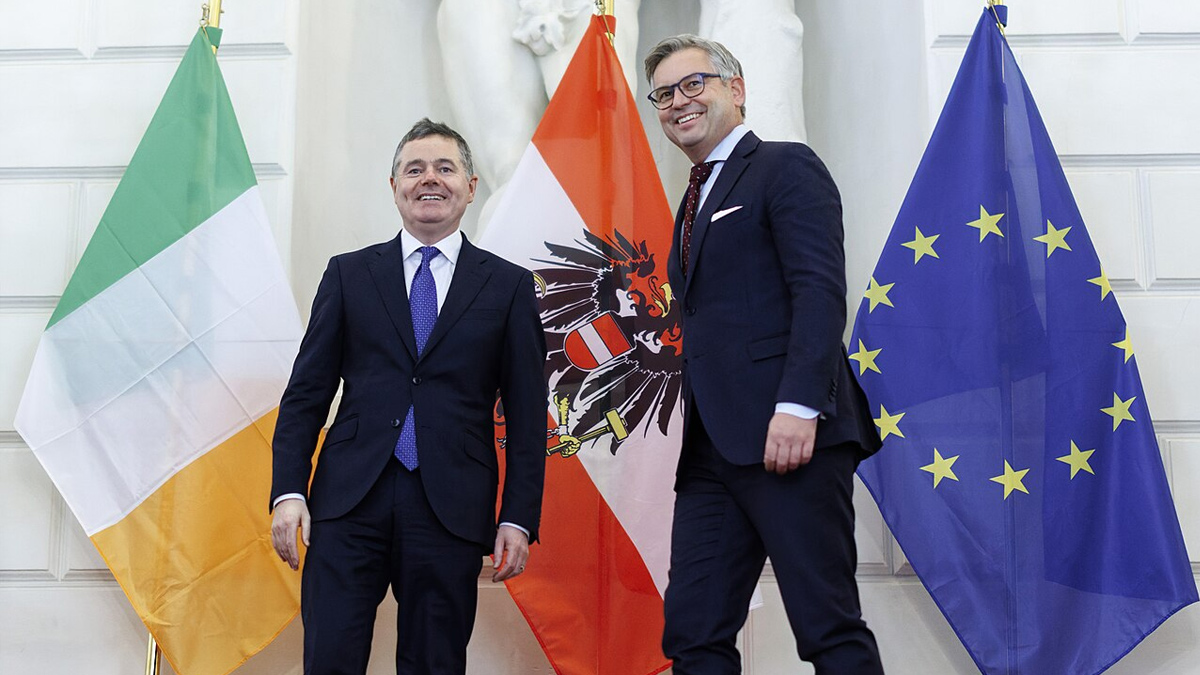
Paschal Donohoe
The European Union emerged from some of the darkest moments in history, conceived as a deliberate, structured effort to foster peace, stability, and prosperity. By pooling sovereignty, building shared institutions, and developing a common legal framework, European integration charted a course beyond the helplessness of hegemony and the irresponsibility of isolationism to achieve a permanent, peaceable cooperation between the free peoples of our continent.
The ideal of pax Europaea has been advanced for centuries, stretching as far back as the primordial Europe of nations that emerged during the Carolingian Renaissance, in which Ireland made a significant contribution. Irish scholars criss-crossed the continent, from the Atlantic coast as far east as Kyiv. Columbanus, to name but one, was an early pioneer of what today we might call European unity.1 The European integration project did not emerge suddenly after 1945 but from a timeless plea for meeting our common challenges through peace and unity that continues to resonate today. The guiding impulse for the construction of an integrated Europe was the terrible loss of life and destruction amid two world wars, which followed centuries of almost perpetual conflict
On 9 1950 an historic proposal for European cooperation delivered by then French Foreign Minister Robert Schuman ushered in a new era of unprecedented peace and prosperity through a profoundly different approach to international relations – the idea of sharing sovereignty2 rather than relying on a goodwill that too often fell afoul of beggar-thy-neighbour solipsism. The genius of this novel approach centred on common action coordinated through shared institutions. As the Schuman Declaration states, ‘The solidarity in production thus established will make it plain that any war between France and Germany becomes not merely unthinkable, but materially impossible.’3
Today, the European Union remains in essence one of the world’s most successful peace and reconciliation projects, symbolised by the EU being awarded the Nobel Peace Prize in 2012. The founding community of six countries has since grown into a union of twenty-seven. Ireland joined in 1973. A decade later, the fall of the Berlin Wall in 1989 symbolised a tectonic geopolitical shift that washed away the Cold War division of Europe, paving the way for countries of Central and Eastern Europe to join in 2004, 2007, and 2011. Europe Day (9 May) 2025 marks seventy-five years since the Schuman Declaration, which affords an opportunity to reflect on the EU’s achievements and Ireland’s place in this project.
A rather simple but effective place to start is to select the most popular of EU-developed freedoms, rights, polities, and initiatives according to opinion surveys.4 In this regard, 82% of Europeans support freedom of movement – the right for a citizen of an EU member state to travel, live, work, and study in any other EU country. Some of the tangible policies that embody this right are well known: the EU flag on passport lanes in airports denoting visa-free travel, the abolition of roaming charges on smartphones or mobile phones, and Erasmus+ study-abroad schemes. Others perhaps less so: low- cost airfares, requiring bank charges for financial transactions to be the same within EU countries and between them, and the European Health Insurance Card, which grants EU citizens access to medically necessary healthcare while travelling in another EU country.
The EU single market, one of the largest single markets in the world, has long been a vector of economic and commercial integration that has generated gains in prosperity for all member states. The euro, used by 349 million Europeans, has become a symbol of economic security and resilience with high levels of support across the twenty countries that use the single currency. It has boosted trade and become the second-largest reserve currency in the world after the US dollar. According to the autumn 2024 Eurobarometer survey, 81% of Europeans in the euro area support the common currency – the highest level of support on record.
Moreover, the EU’s leadership in addressing climate change through the European Green Deal demonstrates its capacity to enact forward-looking policies. With ambitious climate neutrality targets by 2050, including renewable energy promotion, sustainable transport development, and biodiversity protection, the EU endeavours to remain a leader in global environmental governance.
The EU’s collective response to the Covid-19 pandemic further exemplifies its essence. Not only did the EU develop collective procurement and distribution of life-saving vaccines, the EU response also adopted an economic recovery and resilience plan, funded for the first time by €750 billion in common borrowing. Europe can at times be derided for sclerotic decision-making, but it has consistently proven that in the face of adversity, it responds with steadfast resolve.
The place of Europe in a changing world
The early twenty-first century has been a time marked by great secular transformations and will continue to be shaped by the seismic changes of climate transition and the Artificial Intelligence revolution. Russia’s invasion of Ukraine in February 2022 has brutally challenged the concept that Europe’s borders are fixed by law, while wars rage elsewhere, notably in the Middle East and Sudan. The world remains scarred by the lingering socio-economic effects of the Covid-19 pandemic. Inflation in Europe and elsewhere has reduced purchasing power, casting a long shadow over several elections that took place post-pandemic. Finally, at least in the Western world, there is a sense that the parenthesis of five centuries of European and latterly American economic pre-eminence is coming to an end with the continued resurgence of other parts of the world – notably China and India. For most of the post- war period, the economies of the Group of Seven (G7) countries accounted for approximately two-thirds of global gross domestic product. In 2023, this share had fallen to 44%.
Any one of these factors could have the potential to trigger profound political change. European policy-makers, however, do not have the luxury of dealing with such challenges sequentially.
Socio-economic stability is the bedrock of peaceable society – in particular a stable financial foundation. A survey by the Martens Centre shows a widespread sentiment of economic insecurity among the European middle class but especially among lower-income households.5 Between 2007 and 2022, income inequality in the EU has fluctuated, with a number of countries seeing a pronounced decline in middle-income share, coupled with a rise in lower-income households. On the other hand, countries like Ireland saw gains.6 Amid the pervasive disquiet of a new ‘age of anxiety’, the siren call of populism rises as a lure, proffering simplistic solutions to complex problems (or ignoring them outright). Dani Rodrik has noted that elements of populism can be constructive in responding to what people feel needs to change, but they become dangerous when populism transmutes into a reactionary and caustic movement that inhibits consensus-building and compromise.7
The latter results in bad economic policies and the worsening of societal divisions. It can also lead to flawed diagnostics of what ails the labour market and households – leading to inflationary actions.
How can the European Union respond? The challenge for Europe in the twenty-first century will be to reduce our greenhouse-gas emissions and achieve carbon neutrality by 2050, boost the middle class by enhancing the competitiveness and fairness of our economies, and reduce global poverty and inequities. By design, the EU is built to use multilateralism to address complex transnational challenges. As international relations theorist John Ruggie argued, shared sovereignty can produce outcomes more effective than unilateral national action. In so doing, it creates an end that is more powerful that any national policy choice, even for the largest of European nations. Furthermore, it engenders a de facto solidarity. European integration may be led by function about ‘how’ to do something, but it has created a form, a ‘what’, that is of deep value in a world that is changing so quickly and so drastically.
When European politics is perceived as relevant or decisive that is a demonstration that citizens’ involvement in European politics is growing. That is positive. The average turnout at European elections rose from around 40% to slightly over 50% in both the 2019 and 2024 elections because in the years leading up to these elections the euro crisis, migration, climate, the pandemic, and the war in Ukraine made the importance of European decision-making very clear.
There is a recognition that in order to face the challenges of the future, the European Union needs to allow for a more efficient response than national action alone. This is borne out in opinion surveys that consistently show broad support in every EU member state in favour of continued membership. A retreat into a nostalgic and romanticised mirage of nationalism is not a responsible choice. Neither is pulling threads from the tapestry of international cooperation that has been woven so intricately since the devastation of the early twentieth century.
The European Union of tomorrow will be very different to the European Union of today. Luuk van Middelaar, in his masterpiece The Passage to Europe, expressed it beautifully when he wrote that ‘the European political body … long unimagined, resides in an intermediate status, half-old and half- new, that is gradually coming into its own, making a connection between events originating in the outside world and a joint response to them’.8
These huge events in the outside world, all happening together, demand and require change in the union. An enlarged European Union, which is the most constructive and most likely of the many scenarios that could manifest, means a very different European Union for Ireland.
The place of Ireland in a changing Europe
Since gaining independence, Ireland has been a leading voice for multilateralism in international affairs. The EU affords huge possibilities and opportunities for Ireland, with friendships to deepen, commerce to grow, and even more effective policy alliances to build. As this evolution takes place over the coming years, Ireland’s role in a changing Europe will be shaped by economic policy decisions.
The open economic model built from the 1950s has served Ireland well, transforming the country from the poorest economy in the European Economic Community upon joining in 1973 to a global economy with a budget surplus and a net contributor to the budget of the European Union. Ireland’s has been a long story of strong convergence supported by the Common Agricultural Policy and structural funds that built up Irish infrastructure. As a result, living standards have risen, reaching 120% of the Western European average in 2021, pivoting Ireland into the group of leading EU economies.9 Foreign investment in Ireland, predominantly from US firms, has created jobs and positioned Ireland as the most competitive gateway for US business into the European Union.
Yet the future is always uncertain. It is the role of policy-makers to hope for smooth sailing but to prepare for rough seas. Ireland has long been a competitive business location amid the global flows of capital, goods, and services. These factors have at times been disrupted, either unwillingly through the ebbs and flows of economic cycles or through the impact of deliberate policy choices. To prepare for all eventualities means further action is needed to enhance Ireland’s competitiveness – and by extension that of the European Union. The diagnostic of the gaps in achieving a more competitive EU were set out in a pair of reports written by former Italian Prime Ministers Enrico Letta and Mario Draghi, respectively, in 2024.
Much of this work has been deliberated upon in the Eurogroup, the informal body that brings together the finance ministers of euro-area countries once a month. Part of Europe’s weakness compared to other major economies is its fragmented nature. The advent of the euro spurred economies with a balance of payments surplus to invest in other countries in the EU. The euro crisis led to an abrupt halt in cross-border lending and led to a migration of capital leaving Europe to be invested elsewhere – predominantly the US, which absorbs much of the world’s savings. Despite a robust crisis framework having been put in place in the intervening period, the fragmentation remains. This is what the Banking Union and Capital Markets Union projects are designed to address. The Eurogroup has adopted statements on both elements in 2022 and 2024, respectively. These statements are in effect work plans that lay out the path to making progress by identifying policy actions, such as the agreement of a crisis management and deposit insurance framework for the Banking Union and the development of a pan-European savings product and the prudential treatment of securitisation for the Capital Markets Union.
At the heart of both projects is a twin objective. First, to decrease the demands on the public purse by fostering the conditions for greater private investment, which is positive for fiscal sustainability. Second, there is a potential €33 trillion investment opportunity for Europeans – this figure representing the total amount of private savings predominantly held in currency and deposits – if the framework conditions can be made conducive and attractive to incentivise people to invest. Ireland, as a competitive international financial centre, should seek to be at the forefront of shaping this work.
Capital is only one dimension of the competitiveness equation. Energy costs have a significant role to play, with decarbonised electricity increasingly replacing oil as the lifeblood of an increasingly data-driven economy. According to the International Energy Agency’s latest report, the global share of green electricity continues to grow, with Europe a major contributor to this expansion. The energy crisis of 2022 serves as yet another reminder of the risks of fossil fuel dependence in the same vein as the oil crisis of 1973. The noxious effects of the energy cost spikes to households’ purchasing power and the competitiveness of businesses underscores the fundamental nature of ready access to cheap electricity. Expansion of generation and supply, however, require a concerted and coordinated effort to create economies of scale. The historical roots of the European Union are in energy (coal). The future of the European Union will involve clean and renewable energy, interconnected across countries. This is central to Ireland’s economy, with ambitious but credible plans to become net energy exporters. Ireland can play a big role in this new energy future and in all of the debates about how to achieve it.
Further afield, Ireland will need to consider its role within the EU as it contemplates further enlargement, most notably toward the Western Balkans and potentially Ukraine. The EU will need to reconsider how institutions function, how decisions are made, and how to maintain the delicate balance of interests among member states. Ireland’s constructive engagement, sustained cultural openness, and robust diplomatic presence can help ensure that enlargement strengthens rather than dilutes the EU’s cohesion and values. Active participation in transnational networks, travel, student exchange programmes, and institutional secondments strengthen Ireland’s understanding of the diverse concerns across the EU. In my own tenure as president of the Eurogroup, this cultural diplomacy is an inherent part of articulating the national interest and building cooperation.
The political centre
The European Union was built through centrist compromise and remains dependent on a political centre willing to balance free markets, social welfare protections, and representative democracy. Political theorist Judith Shklar, who was born in Latvia and later taught at Harvard, defined the centre as the search for a society in which no one need be afraid. A simple formula but one that demands much from all participants in a liberal democracy.
The centre is also the art of compromise, which is intrinsic to the European project. It was the politics of the centre that built the European Union: a broad-tent consensus based on social contract consisting of free markets combined with elements of economic distributism and the welfare state, as well as opposition to extremes on both sides of the political spectrum.
It is the centre that will best respond to the challenges facing economies and societies through its recognition that free enterprise is at the heart of our economy and that it must be rewarded but accepting that the market alone does not make a decent society. An active and fair state must play its role, but it cannot do everything.
For Ireland, politics of the centre carries the spirit of reconciliation and reconstruction that built the European Union by recognising the importance of consent in the debate about the future of our island, making the case for the benefits of openness and tolerance but knowing that with every right there comes a responsibility.
The centre will make the case for the value of institutions, arguing that they are reflective of a society looking to order itself in a fair and inclusive manner, and that these institutions are both durable and fragile. There must be a political response to better control technology and Artificial Intelligence when they are used to disrupt our societies. The centre will always make the case for the European Union, for friendship with our neighbours in the United Kingdom and across the Atlantic, and for continued engagement with all our friends across the world. It will offer solutions to economic well- being, to climate change, to migration. The centre has always offered hope.
Conclusion
The European Union is the daughter of the Enlightenment: a consequence of the belief that reason and an appreciation of humanity can achieve progress. The passage of time has, however, demonstrated that there is not an inevitable arc towards progress. The European political project remains the most apt way of achieving this.
Hannah Arendt, the great German philosopher, in a different context wrote of ‘an isolated island of certainty in a sea of uncertainty’. That is why it is vitally important to strive to build and to improve the European Union. It is not an island, because it is not stationary, but it is far more than a life raft, as it has a firm and stable anchor. The ‘blood-dimmed tide’ may have surged, but Europe is not overwhelmed. Far from it. From the pandemic, to the wars, to climate action, concerted action evolved to keep pace with the pursuit of Europe’s shared values. That reinvention must continue to look ahead, to horizons that will be challenging but can be better.
Ireland, deeply integrated into this European project, stands to benefit from a union that remains outward-looking, dynamic, and principled. The European Union has saved us from the worst in our history. I am convinced that it is still our best hope for the future.
Paschal Donohoe is Fine Gael TD for Dublin Central and Minister of Finance in the current coalition government. He has been President of the Eurogroup since July 2020.
Notes
- In his letter to Pope Boniface IV, Columbanus writes of the concept of totius Europae – ‘all of Europe’. His letter appeals for a sense of shared purpose that transcends nationality: ‘refuse to consider us estranged from you; for we are all joint members of one body, whether Franks or Britons or Irish or whatever our race be’.
- The concept of sharing sovereignty in an Irish context is explained in Garret FitzGerald,‘Political Implications of Irish Membership of the EEC’, Studies: An Irish Quarterly Review, 51:201 (1962).
- https://european-union.europa.eu/principles-countries-history/history-eu/1945-59/schuman- declaration-may-1950_en
- Data is taken from the following opinion surveys: Standard Eurobarometer 94 (2021) and 95 (2022), which focus on EU citizens’ perceptions of values and priorities; and the 2024 special Eurobarometer, ‘EU Rights and Freedoms in Practice’, which evaluates public opinion based on fundamental EU freedoms.
- M. Lampert, P. Papadongonas and F. O. Reho, Middle-Class Concerns and European Challenges: A Data-Driven Study from a Centre-Right Perspective, Wilfried Marten Centre for European Studies, 2023, www.martenscentre.eu/publication/middle-class-concerns-and- european-challenges-a-data-driven-study-from-a-centre-right-perspective/
- Carlos Vacas-Soriano, Developments in Income Inequality and the Middle Class in the EU, Eurofound, 2024, www.eurofound.europa.eu/en/publications/2024/developments-income- inequality-and-middle-class-eu
- Dani Rodrik, ‘Is Populism Necessarily Bad Economics?’, AEA Papers and Proceedings, 108 (2018), pp. 196–99
- L. van Middelaar, The Passage to Europe: How a Continent Became a Union’ (Yale University Press, 2013).
- John FitzGerald and Patrick Honohan, Europe and the Transformation of the Irish Economy
(Cambridge University Press, 2023).