Editorial
At least since St Augustine’s account of the Earthly City in The City of God, human history has often been cast as a chain of crises and catastrophes.1 War, pestilence, natural disaster, famine, persecution – these were woven into the ordinary expectation of human life. The ‘state of emergency’, as Walter Benjamin put it, is ‘not the exception but the rule’.2 Yet for most of history, people assumed that such calamities, however devastating, would not last forever. There would eventually be a reprieve.
With the Cold War, however, a reprieve could no longer be taken for granted. Perhaps for the first time in history, people could reasonably fear a cataclysm from which there would be no return. Leaders and thinkers across the spectrum – Pope John XXIII, Albert Einstein, Bertrand Russell, Martin Luther King – warned of ‘unparalleled catastrophe’, ‘the abyss of annihilation’, ‘universal death’, ‘an end to the human race’. In 1961, between the Bay of Pigs and the Cuban Missile Crisis, after the Berlin Wall went up and as both superpowers raced to perfect thermonuclear weapons, Robert Lowell captured the mood in a letter to Elizabeth Bishop: there was, he wrote, ‘a half-apocalyptic, nuclear feeling in the air, as tho nations had died and were now anachronistic’.3 In his poem ‘Fall 1961’, he put it more starkly: ‘All autumn, the chafe and jar / of nuclear war;/ we have talked our extinction to death.’4
This pervasive sense of existential threat changed public discourse in a significant way. Posterity – the fate of future generations – emerged as effectively a new moral category. Scientific progress and political action could no longer be judged without reckoning with their impact on those who came after, and on the physical world that they would inherit. Humanity, it seemed, had crossed a threshold, leaving older ethical frameworks unequal to new tasks at hand, a crucial shift that Pope Paul VI appeared to sense in his 1971 social encyclical Octogesima Adveniens:
Man is suddenly becoming aware that by an ill-considered exploitation of nature he risks destroying it and becoming in his turn the victim of this degradation. Not only is the material environment becoming a permanent menace – pollution and refuse, new illnesses and absolute destructive capacity – but the human framework is no longer under man’s control, thus creating an environment for tomorrow which may well be intolerable.5 The vision here of out-of-control technology goes beyond the language of earlier papal social teaching, where technology mainly raised issues of workers’ conditions, their rights, and the fair distribution of resources generated by scientific progress – questions of the immediate present, that is. What the pope is intimating is that future generations have a moral status too. Do they not impose duties and responsibilities on us, just as our contemporaries do?
For the German philosopher Hans Jonas, whose work The Imperative of Responsibility6 (1979) had a marked influence on the Green movement in Germany and elsewhere, the answer is a resounding yes. What was needed, he argued, was a ‘new ethics of responsibility for and to a distant future’7 –a ‘future-oriented ethics’8 absent from earlier systems, which limited themselves to the immediate circumstances of human actions and largely ignored long- term consequences.9 His case was compelling. The unprecedented power that technology brought – ‘over matter, over life on earth, and over man himself’10 – produced a radical shift in humanity’s relationship to the world. Following his former teacher Heidegger, Jonas held that modern technology discloses the world, including nature and even humanity, not as beings in their own right but as resources for use and manipulation. Yet unlike Heidegger, he insisted that this transformation opens up ‘a whole new dimension of ethical relevance’.11
In this novel situation, ethics could no longer remain anthropocentric or neutral towards the nonhuman world. It had to confront ‘the critical vulnerability of nature’12 to technological intervention. The entire biosphere has now become subject to human power, and therefore has a moral claim on us – ‘for its own sake and in its own right’13. From this, Jonas derived his ‘new imperative’: Act so that the effects of your action are compatible with the permanence of genuine human life.14 Humanity has become a danger not only to itself but to the whole spectrum of life on earth. As a result, Jonas asserted, ‘a kind of metaphysical responsibility beyond self-interest’15 has devolved on us in this latest stage of human existence.
No one can doubt that the existential threat to both humanity and the biosphere is starker now than ever. Even more than in the 1970s, when Jonas was writing, this threat arises not from a single cause but from a web of deeply interconnected factors – a ‘polycrisis’, in which ‘disparate crises interact such that the overall impact far exceeds the sum of each part.’16 Apart from runaway technological development and the climate breakdown and environmental degradation it has effected, we face the erosion of democratic institutions, declining solidarity between nations, debt crises, culture wars, and extreme wealth inequality, to name just a few factors. As Jonas would have it, new circumstances require new thinking. Faced with this unprecedented threat, we must be ready to revise and reshape institutions and practices across all sectors of society. Above all, given the future orientation of the threat, we need to rethink the very purpose and practice of education. In Laudato Si’, Pope Francis emphasised the critical role of education in bringing about ‘deep change’ in prevailing mindsets. Calling for an ‘integral ecology’ that unites human and environmental concerns, he warned: Our efforts at education will be inadequate and ineffectual unless we strive to promote a new way of thinking about human beings, life, society and our relationship with nature. Otherwise, the paradigm of consumerism will continue to advance, with the help of the media and the highly effective workings of the market.17
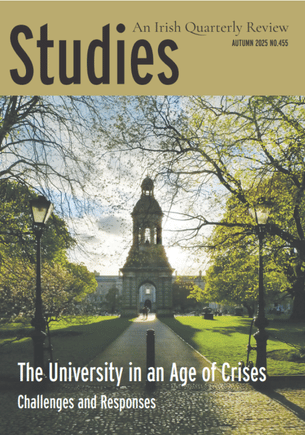
Where, then, might such new ways of thinking arise? Given its institutional depth and intellectual resources, the university holds a uniquely privileged role in this task. Yet the path to progress here seems increasingly obstructed. In recent decades universities have indeed developed research programs and curricula that engage directly with global crises, and they have generated a rich academic discourse on critical themes across multiple disciplines; but at an institutional level they are often severely constrained by market- oriented values and metrics. Students are treated as customers seeking a return on investment in the shape of ‘human capital’ and ‘marketable skills’. Universities themselves function less as communities of scholars than as corporations, where what matters is ‘key performance indicators’, cost- effectiveness, and rankings. The internalisation of market logic undermines their capacity to respond – as they have the resources to do – to urgent social needs and the global common good.18 What is required, once again, is new thinking.
***
Jennie Stephens’s Climate Justice and the University: Shaping a Hopeful Future for All (2024) responds admirably to the challenge of rethinking universities in the light of current realities. Setting the theme and the tone of this issue of Studies, she reprises her main arguments in an essay here, ‘The Case for Climate Justice Universities: Restructuring Higher Education for Transformative Change’. It is a bracing challenge to the university sector to galvanise its strength and influence in the interest of the public good, particularly by helping to move society along a path towards ‘a more equitable, just, ecologically healthy, climate-stable future’. Stephens recounts her own experience in universities in the United States and Ireland – a ‘journey of learning and unlearning’. ‘Unlearning’, for her, is the critical process of letting go of traditional assumptions and making room for ‘a reimagining of what is possible’. She observes that Irish universities have not yet been ‘captured by private interests’ in the way US institutions have, allowing her to conclude on a note of hope.
Her note of hope is tempered, however, by her observation in a second essay that capture by private interests is a growing concern in Irish higher education. Co-authored with Laurie Reilly and Conchúr Ó Maonaigh, ‘Academic capture: Investigating Industry Funding of Higher Education in Ireland’ argues that the Irish government has actively promoted collaboration between the university sector and industry. Reductions in public funding of universities have made such partnerships essential in some cases, leading, among other deleterious effects, to the prioritisation of research with commercial value over non-commercial research.
In ‘On Reading Jennie C. Stephens’ Climate Justice and the University’, former president of the University of Galway Ciarán Ó hÓgartaigh offers a response framed as a ‘retrospective self-criticism’. Drawing on his experience in Galway, he engages with Stephens’s core themes and highlights particularly her call to ‘unlearning’. One dimension he believes deserves more attention is the role of students – rather than administration or faculty – in activating the university’s transformative possibilities.
Pat O’Connor was the first female full professor of sociology in Ireland and the first female professor in any discipline in the University of Limerick. In an edited extract from her recent memoir, A Proper Woman? One Woman’s Story of Success and Failure in Academia, she recounts her experience of gender disparities and power dynamics in Irish universities. In ‘Continuities and Changes in Gendered Practices in Academia: The Perspective of a “Proper” Woman’, O’Connor describes how male-generated academic discourse has long militated against women embracing public power.
In ‘Trump versus the University: Scandal or Calling to Account?’, American scholar Joseph Rivera casts a cold eye on the Trump administration’s interference with the independence of US universities. The universities are not perfectly innocent victims, he argues, as their exorbitant tuition fees effectively victimise ordinary families, and for this they must be held accountable. He acknowledges, however, that Trump’s interference is really just narrowmindedness and an exercise in power, and its effect is to frustrate universities in achieving their proper educational ends.
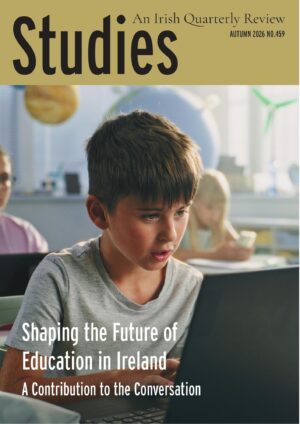
The transformative potential of education is the subject of Ciara Whelan’s essay, ‘Education for Sustainable Development: Ireland’s Success and the Path Forward’. Decisive government intervention is critical, she asserts, to ensure that education at all levels is inclusive and equitable, and that it generates ‘positive spillovers benefiting the common good’. Ireland, she notes, has made significant progress in integrating sustainable development into its education system, but a challenge remains: ensuring that this integration leads to ‘transformative outcomes’, particularly by equipping students with frameworks for understanding how social, economic and environmental issues are interlinked.
***
Whelan’s essay builds on a chapter she has co-written with Paul Devereux in the fifteenth edition of The Economy of Ireland: Policy Making in a Global Context, a core text for students of the Irish economy since John O’Hagan first compiled and edited it in 1975. O’Hagan has edited – or more recently co-edited – every edition of the book, giving him a unique perspective on the highs and lows of the Irish economy over the past half-century. In ‘Reflections on Fifty Years as Editor/Co-Editor of The Economy of Ireland’, he recalls the many changes during that time in authors, themes, and even publishers. He also notes how the Irish economy responded to successive policy challenges and how these were treated in each edition.
Continuing the theme of the last issue of Studies, on Trump’s second term, James Kelly, in ‘Language and the Question of Truth: A Critique of Trump’s Version of Reality’, offers a philosophical analysis of language and truth. He argues that Trump has steered his country towards authoritarianism by manipulating language to create the ‘horrifying spectacle’ of a post-truth world.
In ‘Key Preoccupations in the Work of English Rock Artists of Irish Descent’, David Clare identifies characteristics shared by many rock musicians born into Irish diasporic families in Britain, including an anti- monarchic streak and a strong pull towards Irish music, both traditional and showband. At the end of the article, there is a QR code that links to a Spotify playlist of the songs referenced.
The role of Robert Dudley Edwards and T. W. Moody in the professionalisation of academic history in Ireland is recounted by Declan O’Keeffe in ‘Irish History Writing before the 1960s: The Legacies of R. W. Dudley Edwards and T. W. Moody’. These men laboured successfully to bring greater scientific rigour and awareness of methodological issues to the study of history. Among the fruits of their ‘revolution’ were two historical societies, a journal, a radio series, a television series, a new history of Ireland, and an Irish Society for Archives.
In ‘Reshaping European Democracy’, Edmond Grace SJ argues that the renewal of democracy in Europe requires genuine citizen participation that avoids being obscure or elite. He draws lessons from the Irish experience of citizens’ assemblies, and he suggests that the democratic deficit would be reduced by regular ‘citizens’ juries’, at local, national, and European level.
Prompted by a photo of a war grave marker in his mother’s papers, Desmond Gibney traces the lives of two of her relatives, in ‘Two Generations of Service Cut Short: RIC Constable Peter McRann and RAF Sergeant Peter B McRann’. Both Peter and Brendan McRann pursued state service but saw their careers cut short: the father by the RIC’s disbandment in 1922, the son by death in a 1944 bombing raid.
This issue of Studies also carries the work of two renowned Irish poets, John F. Deane and Gerard Smyth.
Notes
- See especially Books I–III of St Augustine, The City of God.
- Walter Benjamin, ‘Theses on the Philosophy of History’ in Illuminations (London: Pimlico, 1999), p. 248.
- Thomas Travisano (ed.), Words in Air: The Complete Correspondence between Elizabeth Bishop and Robert Lowell (Farrar, Straus and Giroux, 2008), p. 381.
- Robert Lowell, ‘Fall 1961’ in For the Union Dead (Farrar, Straus & Giroux, 1964), p. 11.
- Pope Paul VI, Octogesima Adveniens (The Holy See, 1971), art. 21, www.vatican.va/content/paul vi/en/apost_letters/documents/hf_p-vi_apl_19710514_octogesima-adveniens.html
- Hans Jonas, The Imperative of Responsibility: In Search of an Ethics for the Technological Age (University of Chicago Press, 1984).
- Jonas, Imperative of Responsibility, p. 22.
- Jonas, Imperative of Responsibility, p. 12.
- Jonas, Imperative of Responsibility, pp. 5–6.
- Jonas, Imperative of Responsibility, ‘Preface to the English Edition’, p. ix.
- Jonas, Imperative of Responsibility, p. 1.
- Jonas, Imperative of Responsibility, p. 6.
- Jonas, Imperative of Responsibility, p. 8.
- Jonas, Imperative of Responsibility, p. 11.
- Jonas, Imperative of Responsibility, p. 136.
- World Economic Forum, Global Risks Report 2023, www.weforum.org/publications/global-risks- report-2023/
- Pope Francis, Laudato Si’ (The Holy See, 2015), art. 215, www.vatican.va/content/francesco/en/ encyclicals/documents/papa-francesco_20150524_enciclica-laudato-si.html
- See Wendy Brown, Undoing the Demos: Neoliberalism’s Stealth Revolution (Zone Books, 2015), especially chapter 6, ‘Educating Human Capital’, pp. 175–200.