
Back to Summer 2024
In his acclaimed work on the shifts in behaviour, manners and social norms from the Middle Ages into modernity that made up ‘the civilising process’, German sociologist Norbert Elias noted the tendency for distasteful things to be gradually ‘removed behind the scenes of social life’.1 Public nudity, the performance of bodily functions, public displays of punishment, and the like – all of these came to offend against the growing ‘delicacy of feeling’ that marked the emerging sense of ‘civility’. Disturbing aspects of life were moved to more private or discreet places. Another feature of the civilising process that Elias detected was that the nation states that emerged in the seventeenth century began to lay sole claim to the exercise of force. Violence, in other words, could only be legitimated through the centralised, bureaucratised world of the judicial system, the police, and the military.
Contemporary prison systems show the marks of both of these processes, and not in every respect for the better. The ‘civilisation curve’, as Elias knew well, can easily be interrupted by an opposite process, a ‘decivilising’ one. The latter may even, in fact, be facilitated by the civilising process itself. In spite of good intentions, making the management of crime and punishment equitable easily leads to an overdependence on incarceration as a single-model solution. Those that the system determines to punish become the distasteful elements that must be kept from public view. They are radically decoupled from their own lifeworlds, even for lesser crimes, which may well lead to the unjust disregard of the needs of their communities and dependents, as well as to a loss of personal dignity and to disproportionate damage to their reputation. A more nuanced policy is needed.
As Jeremy Travis, a prominent advocate of justice reform in the US, has repeatedly insisted, a principle of parsimony is needed when it comes to criminal justice. The state must be careful not to intrude on the life and liberty of citizens any more than is necessary to achieve a legitimate social purpose.2
There are many alternatives to incarceration for many types of crimes, and these may well be more effective at reducing crime, enhancing public safety, preserving personal dignity, and minimising the upset to the world of those – themselves perfectly innocent – whose lives are bound to that of the offender.
In January of this year, the Jesuit Centre for Faith and Justice, Dublin, hosted a one-day workshop to discuss and challenge current prison policy in Ireland and beyond. The workshop was generously funded by the St Stephen’s Green Trust. The three papers presented on that occasion are published in this issue of Studies, and three further essays, follow-up reflections on the theme of the workshop, are also given here. My thanks are due to Keith Adams, Penal Policy Advocate at the centre, who organised the workshop and who curated the essays for this issue. In his introduction, after this editorial, he summarises the six essays.
***
Apart from the set of essays on prison policy, this issue of Studies also includes ‘John Bruton: An Appreciation’, Kevin Rafter’s reflection on the person and the political career of the former taoiseach, who died in February of this year. Bruton was an occasional contributor to Studies. And in ‘The Rise of the Far
Right, Part II: Towards a New Politics’, Peadar Kirby continues his reflection on the correct way to respond to the far-right, specifically by developing what Pope Francis has called ‘a better kind of politics’, one that is ‘primarily concerned with individuals and the common good’.
The Friends of the National Collections of Ireland, a body that supports public galleries and museums throughout the country, celebrates its centenary this year. In ‘Friends of the National Collections of Ireland: A Century of Gifts’, the body’s current president, John Turpin, describes the work it has done since its foundation in 1924. And in ‘The Seven Pillars of Jesuit Wisdom: What Characterises Jesuit Education?’, Australian theologian Gerald O’ Collins SJ identifies what he calls ‘seven sources of human and Christian wisdom’ on which Jesuit pedagogy has been built since its inception.
Two Irish poets are represented in this issue of Studies, James Harpur and Peter Sirr, both members of Aosdána, the association of artists set up by the Irish Arts Council in 1981.
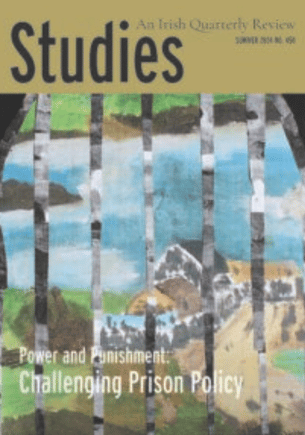
The cover image of this issue, ‘West of Ireland landscape’, is a mixed media composition by an inmate of Castlerea Prison. I am grateful to Tom Shortt, Arts Officer with the Irish Prison Service, for arranging that we could reproduce it here.
Notes
1 Norbert Elias, The Civilizing Process: Sociogenetic and Psychogenetic Investigations (Oxford: Studies • volume 113 • number 450 150
Editorial: Summer 2024
Basil Blackwell Ltd, 2000; originally published in 1939), p. 103. Also see Norbert Elias, ‘Power and Civilisation’, a 1981 essay published in Journal of Power, 1:2 (August 2008), 135–142. 2 See the Square One Project, <https://squareonejustice.org>. Also Jeremy Travis and Bruce Westen (eds), Parsimony, and Other Radical Ideas About Justice (New York: The New Press, 2023).