
David Neuhaus SJ
On 12 March 2026, the United States of America submitted an intervention to the International Court of Justice (ICJ) in the Hague with regard to the 1948 Convention on the Prevention and Punishment of the Crime of Genocide.1 Signed by the US secretary of state, Marco Rubio, it argued that ‘the allegations of “genocide” against Israel were false.’ Seeking to counter the legal process initiated by South Africa against Israel in its military actions in the Gaza Strip, the US intervention claimed that South Africa was wrong to claim that ‘Israel’s self-defence measures were inconsistent with Israel’s obligations under the Convention.’ Framing the South African process within supposed ideological hostility to Israel, the US argued that Israel has been consistently accused of genocide for decades and this was a consequence of malevolent propaganda, seeking to undermine the legitimacy of the state of Israel. Furthermore, the US claimed that the accusation of genocide in Gaza originated from Israel’s worst enemies. ‘Only days after Hamas launched its assault of mass rape, murder, and kidnapping on 7 October 2023, pro-Hamas actors, including the Islamic Republic of Iran, were already falsely charging Israel once again with “genocide”.’
The defence of Israel against the accusation of committing genocide in Gaza in the US intervention is shockingly brief. In just a few lines, the US claimed that accusing Israel is tantamount to ‘lowering the standards’, which risked ‘broadening the application of the term “genocide” such that it no longer carries its original weight and meaning, and invites attempts to misuse the Genocide Convention as a gateway for bringing extraneous disputes before the Court’. Furthermore, the US claims that ‘civilian casualties, even widespread civilian casualties, are not necessarily probative of genocidal intent, particularly when they occur in the context of an armed conflict involving urban combat. The law of armed conflict not only recognises the possibility of civilian harm but permits it so long as the relevant principles of discrimination and proportionality are met.’ The US intervention ignored the extensive South African documentation showing that the principles of discrimination and proportionality had been largely ignored, as well as ignoring the documentation of Israeli intent to commit genocide, including blood-curdling statements by the Israeli political and military leadership. Furthermore, the US argued that ‘intention’ must mean that declarations have been made that specifically include formal phrases like ‘with the purpose of’, ‘aimed at’, and, finally, ‘with intent to’ committing genocide.
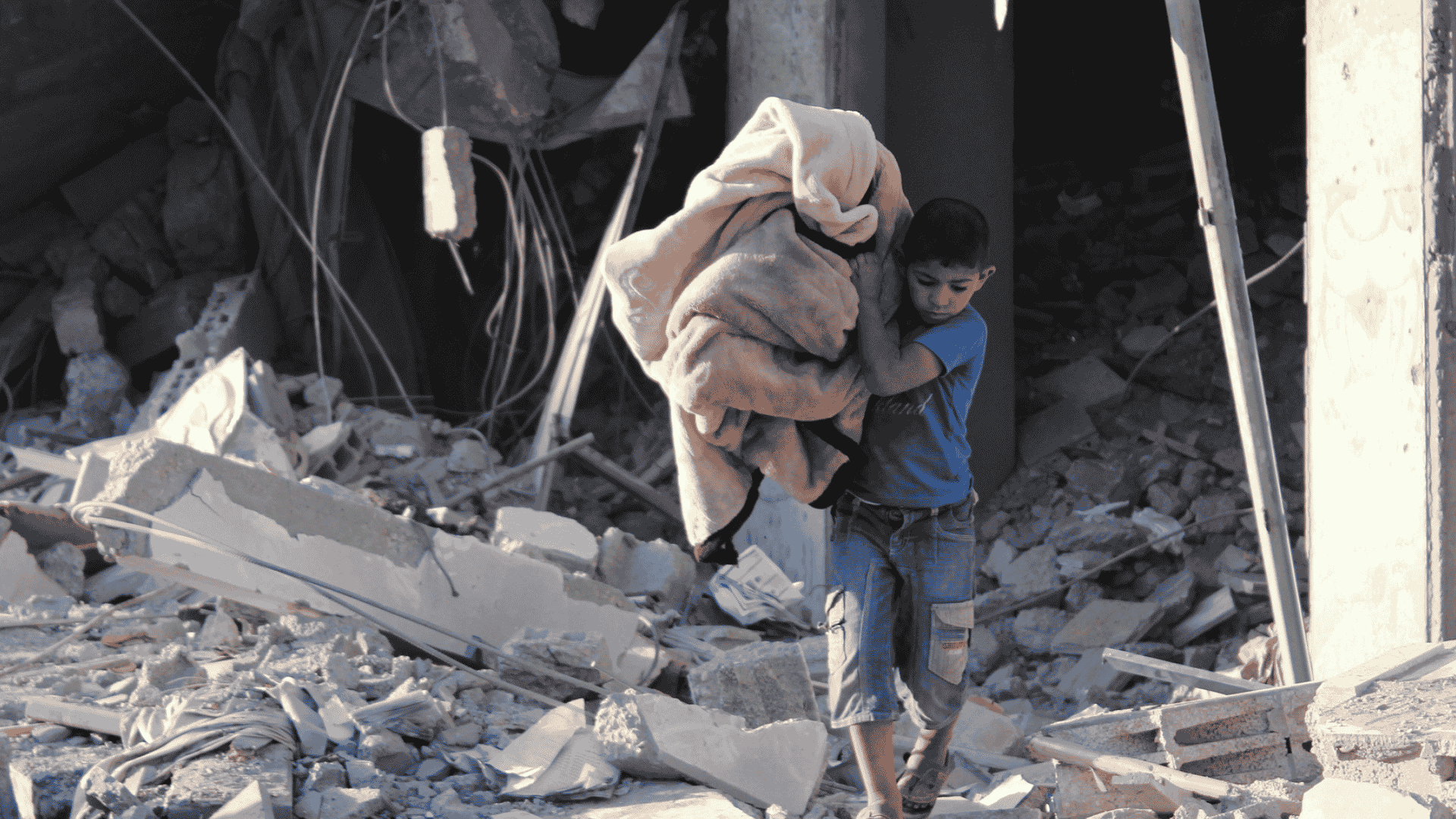
After reading the US intervention, I was flooded with feelings of sadness, disgust, frustration, and rage. The world has witnessed a relentless Israeli military campaign to reduce the Gaza Strip to a ruin, killing over 70,000 Palestinians since 7 October 2023. The brutal killing of Israelis on that awful day and the kidnapping of more than 250 people from Israel was not the beginning of the campaign against the Gaza Strip. Israel has waged a ferocious campaign against the population of Gaza since the Israeli withdrawal from the Strip in 2005, including imposing a suffocating siege and regularly engaging in full-scale bombardments. However, it also needs to be remembered that more than 70 per cent of the inhabitants of the Gaza Strip were driven from their homes inside what is Israel today by Israeli forces in 1948, tripling the population of the Strip and making it one of the most highly populated and most poverty-stricken regions in the world.
Furthermore, courageous Israeli non-governmental organisations recognised the nature of what Israel had done in the Strip after 7 October 2023. B’Tselem, the Israeli centre for human rights, published its report on the events in Gaza, entitled Our Genocide. ‘Since October 2023, Israel has shifted its policy toward the Palestinians. Its military onslaught on Gaza, underway for more than 21 months, has included mass killing, both directly and through creating unlivable conditions, serious bodily or mental harm to an entire population, decimation of basic infrastructure throughout the Strip, and forcible displacement on a huge scale, with ethnic cleansing added to the list of official war objectives.’ B’Tselem concluded, ‘An examination of Israel’s policy in the Gaza Strip and its horrific outcomes, together with statements by senior Israeli politicians and military commanders about the goals of the attack, leads to the unequivocal conclusion that Israel is taking coordinated, deliberate action to destroy Palestinian society in the Gaza Strip. In other words: Israel is committing genocide against the Palestinians in the Gaza Strip.’2
It is not surprising that the US has jumped to Israel’s defence. The US has supported Israel uncritically for decades. The timing too was telling. As these two allies wage a ceaseless war to create their ‘new Middle East’, reducing Israel’s surrounding neighbourhood to rubble – Gaza, the West Bank, Lebanon, Syria, Iraq, and now Iran, the US came to Israel’s defence once again. The US took on South Africa and the almost thirty countries that have associated themselves with the proceedings in the ICJ against Israel. South Africa has already paid a steep price for standing up against Israel – steps that include a drastic cut in US aid, the expulsion of the South African ambassador in Washington, D.C., and rhetoric defining South Africa as a racist entity engaged in persecuting White Afrikaner farmers.3
The most blaring omission in the US intervention was ignoring the entire history of Palestine, going back to the British Mandate and its application of the Balfour Declaration in the aftermath of the First World War. This is the essential context in which events in Palestine/Israel must be understood. Genocide in Gaza after 2023 is only one more step in a process of marginalising, discriminating against and occupying Palestine’s indigenous population, and whenever possible continuing an ethnic cleansing that began in the war of 1947/48.
The ideology of the Jewish European settlers who arrived in Palestine, political Zionism, emerging at the end of the nineteenth century, did not hide its intentions. As a colonial settler movement, it worked to substitute the indigenous, Palestinian, Arabic-speaking society (which included a majority of Muslims but also significant groups of Christians and Jews) with an ethnocentric Jewish society. It was the British foreign secretary, Arthur Balfour, signatory of the 1917 declaration that bore his name and which promoted the establishment of a Jewish homeland in Palestine, who declared, ‘For in Palestine we do not propose even to go through the form of consulting the wishes of the present inhabitants of the country … the Four Great Powers are committed to Zionism. And Zionism, be it right or wrong, good or bad, is rooted in age-long traditions, in present needs, in future hopes, of far profounder import than the desires or prejudices of the 700,000 Arabs who now inhabit that ancient land.’4
I do not want to reflect here on the troubling mobilisation and manipulation of biblical, religious and theological vocabulary to justify the violent transformation of Palestine into the modern state of Israel. Neither will I analyse how deep-seated prejudice against Muslims and anti-Arab racism were mobilised to legitimate the end goal. Rather, I want to focus on the struggle to monopolise victimhood status for the perpetrators of the violence in Palestine/Israel. This struggle to monopolise victimhood is one essential and confusing element in what is going on in Palestine/Israel today. Jacqueline Rose, prominent Jewish British professor of literature, has proposed that ‘Israel’s claim on a monopoly of suffering is the transcript for its continuing oppression of the Palestinian people.’5
At the outset, I want to be clear. The Jewish people have indeed suffered discrimination, marginalisation, persecution and genocide during the long centuries of their history, culminating in the Shoah, the Nazi murder of millions of Jews during the Second World War. Whereas today there is almost universal recognition of these facts, Holocaust denial is unfortunately not extinct. A few years ago, I taught a course on the Israel–Palestine conflict at a Catholic university in the United States. In an informal conversation with some colleagues, I shared my strong disapproval of the political options of the Israeli government, my ongoing opposition to the strategies of the Israeli army and my critique of the ideology of political Zionism. During a lull in the conversation, an urbane, elderly professor of English literature turned to me and with an anguished voice commented, ‘It is indeed terrible what those Jews are doing!’ I was taken aback, as I had not used the word ‘Jew’ in any of my comments about Israeli civil and military leadership and Zionist political ideology. However, what took my breath away was what followed. Gently he added, ‘But what really gets to me is the lies the Jews spread about the Germans … a more civilised nation has never graced the planet.’ My criticism of Israeli leadership and Zionist ideology had encouraged this genteel academic to share with me his antisemitic theories of Holocaust denial and Jewish conspiracy. Let it be said loud and clear: the Jews have been victims of the most horrific forms of persecution, particularly in Europe.
‘Never again!’ was the cry of many Jews liberated from the death camps in 1945. Among those that survived the Shoah were those who believed that Zionism was the formula to make sure that Jews would never again be the victims of their persecutors. Noteworthy is that the slogan ‘Never again’ was adopted as the title of the manifesto6 of one of the most radical Jewish Zionists, Rabbi Meir Kahane, who proposed revoking Israeli citizenship from Palestinian Arabs, ethnically cleansing all Palestinian Arabs from the lands controlled by the state of Israel, and banning marriage and even sexual relations between Jews and non-Jews. Considered an extremist in his time, Kahane continues to enjoy support among Jewish Israelis, including the support of members of Netanyahu’s government, the most prominent being the minister of internal security (responsible for the police), Itamar Ben Gvir. Rabbi Ahron Soloveitchik, a leading Orthodox rabbi, commented,‘What Kahane said was absolutely correct, just we don’t say it because the world will criticise us, but somebody had to say it.’7
It needs to be said loud and clear: the fact that Jews have been victims does not prevent them from becoming victimisers. Furthermore, whereas the Shoah is over, the Nakba – the Palestinian catastrophe that began during the 1947/8 war – is ongoing. This was brilliantly formulated by the recently deceased Lebanese writer Elias Khoury in his foreword to a masterful collection of essays, The Holocaust and the Nakba: A New Grammar of Trauma and History.8 Khoury writes, ‘The Holocaust has become a collective human memory that must be preserved and whose lessons must be internalised. It was a barbaric event that took place in a recent past and, in that sense, has become part of history and an inescapable truth imbedded in the collective human psyche. It must be protected from Holocaust deniers or those who attempt to use it to excuse any form of oppression, ethnic cleansing, or racism.’9 The Nakba on the other end is not a past historical event but on ongoing present reality. ‘The everyday reality of life in Palestine clearly indicates that the 1948 war was merely the beginning of the catastrophic event. It did not end when the ceasefire agreements of 1949 were signed. In fact, 1948 was the beginning of a phenomenon that continues to this day.’10
It is the fusion of Shoah and Zionism that has established a legitimacy for the politics of the state of Israel. It is also the key to Israeli exceptionalism – ‘a belief among many supporters of Israel that the country is somehow immune from moral reckoning’.11 Any criticism of the state is deflected with the claim that it is antisemitic and a dishonouring of the Shoah and Jewish suffering. In order to drive this home, those defined as enemies by Israel are depicted as Nazis. In an interesting falsifying of historical fact in 2015, the Israeli prime minister, Benjamin Netanyahu, even went so far as to accuse an early Palestinian leader of convincing Hitler to carry out the Shoah. ‘Hitler didn’t want to exterminate the Jews at the time; he wanted to expel the Jews. And Haj Amin al-Husseini went to Hitler and said, “If you expel them, they’ll all come here.” “So what should I do with them?” he asked. He said, “Burn them.”’12 Since October 2023, Netanyahu has repeatedly insisted that Hamas constitutes a new Nazi force. ‘The intention is the same; the Nazis acted in order to completely destroy the Jewish people. The Hamas murderers are instructed to do the exact same thing.’13 And this is extended to the Iranians as well, as Netanyahu insists, with regard to regime change in Iran, ‘You don’t want to replace one ayatollah with another. You don’t want to replace Hitler with Himmler.’14
Past Jewish victimhood is exploited by Israeli politicians and Zionist activists in order to stifle present Palestinian victimhood. Too often, especially in the US and European corridors of power, the claim on exclusivity of Jewish suffering has led to Palestinian suffering being overshadowed and silenced. Rising antisemitism, often a reaction, illegitimate as it may be, to Israeli military actions in the Middle East, is indeed a worrying phenomenon. However, the struggle to root it out has been deliberately confused with the ideological attempt to silence voices that protest Palestinian discrimination, occupation, and genocide. The International Holocaust Remembrance Alliance (IHRA) formulated a controversial 2016 position paper on antisemitism that has been widely adopted by various countries (including the US, the United Kingdom, Germany, France, Canada, Argentina, Australia, Colombia, and Switzerland) and organisations. Among the characteristics of antisemitism defined by the paper are a number that touch on attitudes towards Israel, including denying the Jewish people their right to self-determination, applying double standards by requiring of Israel a behavior not expected or demanded of any other democratic nation, and drawing comparisons of contemporary Israeli policy to that of the Nazis.15 The 2021 Jerusalem Declaration on Antisemitism critiques the IHRA definition. ‘The IHRA definition includes 11 “examples” of antisemitism, 7 of which focus on the state of Israel. While this puts undue emphasis on one arena, there is a widely felt need for clarity on the limits of legitimate political speech and action concerning Zionism, Israel, and Palestine. Our aim is twofold: (1) to strengthen the fight against antisemitism by clarifying what it is and how it is manifested, (2) to protect a space for an open debate about the vexed question of the future of Israel/Palestine.’16
The just struggle for an end to discrimination and occupation throughout Palestine/Israel and the genocide in Gaza cannot be defined as antisemitic. There is no contradiction between fighting for the liberation of the Palestinian people, on the one hand, and struggling to root out antisemitism, on the other hand. The fight against antisemitism and the fight for the freedom, equality, rights, and dignity of Palestinians are both part of one and the same struggle: a struggle for a world free of injustice, racism, and violence of any kind. There is a fine but clear line to be drawn to prevent legitimate criticism from becoming racist diatribe. However, ultimately this can only be done coherently and with moral integrity when the struggle against all forms of racism, injustice, and human rights abuses includes an awareness of both the pernicious traces of continuing antisemitism and the myriad forms of anti-Palestinian and anti-Arab sentiment, Islamophobia, and the brutal whitewashing of occupation, discrimination, and genocide in Palestine/Israel today. Ultimately, those fighting antisemitism, those defending the rights of Palestinians, and those promoting a vision of a society in Israel/Palestine based upon justice, peace, freedom, and equality should be allies in building a better world and not foes of one another.17
In his riveting analysis of divided societies, Mahmood Mamdani also turns his attention to Palestine/Israel. According to his analysis, ‘To be a Zionist is not just to believe that Israel should be the Jewish national home; it is to equate the Jewish people with the state of Israel.’18 In our terms, this means that whatever the state of Israel ‘suffers’ is by definition the suffering of the Jewish people, even when this is legitimate criticism or political activism aimed at changing the regime of discrimination, occupation, and genocide. Mamdani is careful to distinguish between a Jewish sense of connection to the ‘land of Israel’, also a Jewish presence in Palestine/Israel, constituting perhaps a ‘homeland’, and an ethnocentric state. This is the distinction he makes between immigrants and settlers. ‘Immigrants are unarmed; settlers come armed with both weapons and a nationalist agenda. Immigrants come in search of a homeland, not a state; for settlers, there can be no homeland without a state. For the immigrant, the homeland can be shared; for the settler, the state must be a nation-state, a preserve of the nation in which all others are at most tolerated guests.’19 Mamdani makes clear that the only way forward is to dismantle the Zionist system. He draws a parallel with the dismantling of the apartheid system in South Africa. ‘The heart of de-Zionisation is the realisation of Israel as a state for all its citizens.’20
This vision coincides with the vision presented by the Catholic bishops in the Holy Land in 2019. ‘We call on Christians in Palestine–Israel to join their voices with Jews, Muslims, Druze, and all others who share this vision of a society based on equality and the common good and invite all to build bridges of mutual respect and love. The proposal for a two-state solution has gone nowhere and is repeated to no avail. In fact, all talk of political solution seems empty rhetoric in the present situation. Therefore, we promote a vision according to which everyone in this Holy Land has full equality, the equality befitting all men and women created equal in God’s own image and likeness. We believe that equality, whatever political solutions might be adopted, is a fundamental condition for a just and lasting peace.’21 Ethnocentricity in the name of victimhood leaves open a wound that festers and creates many more victims.
David Neuhaus SJ was Professor of Theology at the Pontifical Biblical Institute in Jerusalem. Born in South Africa during the apartheid era, he has lived most of his life in Israel and is an Israeli citizen.
Notes
- International Court of Justice, ‘Application of the Convention on the Prevention and Punishment of the Crime of Genocide in the Gaza Strip’ (South Africa v. Israel), www.icj-cij. org/sites/default/files/case-related/192/192-20260312-int-02-00-en.pdf
- B’Tselem, Our Genocide (July 2025), www.btselem.org/sites/default/files/ publications/202507_our_genocide_eng.pdf
- Graham Burton Joseph, ‘Donald Trump, South Africa & US International Relations’, DiA: Democracy in Africa, April 2025, https://democracyinafrica.org/donald-trump-south-africa-us-international-relations/
- Lord Balfour quoted in D. Ingrams, Palestine Papers 1917–1922, Seeds of Conflict (G. Braziller, 1972), p. 73.
- Jacqueline Rose, ‘Afterword’, in Bashir Bashir and Amos Goldberg (eds), The Holocaust and the Nakba: A New Grammar of Trauma and History (Columbia University Press, 2019), p. 360.
- Meir Kahane, Never Again: A Program for Survival (Nash Publishing, 1971).
- Shlomo Moriah, ‘Thirty-Six Little-Known Admirers of Rabbi Meir Kahane’, Jewish Press. com, 18 November 2016, https://jewishpress.com/thirty-six-little-known-admirers-of-rabbi-meir-kahane/
- Bashir and Goldberg (eds), The Holocaust and the Nakba.
- Elias Khoury, ‘Foreword’, in Bashir and Golberg, The Holocaust and the Nakba, p. xiii.
- Khoury, ‘Foreword’, p. xiii.
- Michael Young, ‘Israel’s Exceptionalism Is Untenable’, Diwan (a blog from the Carnegie Endowment for International Peace’s Middle East Program and the Malcolm H. Kerr Carnegie Middle East Center), 14 August 2024, https://carnegieendowment.org/middle-east/ diwan/2024/08/israels-exceptionalism-is-untenable
- Prime Minister Netanyahu’s speech at the 37th Zionist Congress, 20 October 2015, www.gov.il/en/pages/speechcongress201015
- Prime Minister Netanyahu address at the opening ceremony for Holocaust Martyrs’ and Heroes’ Remembrance Day, 5 May 2024, www.gov.il/en/pages/pm-netanyahu-addresses-the-opening-ceremony-for-holocaust-martyrs-and-heroes-remembrance-day-5-may-2024
- TOI Staff, ‘Netanyahu Transcript’, Times of Israel, 20, March, 2026, www.timesofisrael.com/ netanyahu-transcript-we-have-to-be-more-powerful-than-the-barbarians-or-they-will-crash-our-gates-destroy-our-societies/
- International Holocaust Remembrance Alliance, ‘Working Definition of Antisemitism’, https://holocaustremembrance.com/resources/working-definition-antisemitism
- Jerusalem Declaration on Antisemitism, https://jerusalemdeclaration.org/
- The wording in this paragraph draws on my 2024 article published in the Vatican’s Osservatore Romano, ‘Antisemitismo e Palestina’, 7 May 2024, www.osservatoreromano.va/it/news/2024-05/quo-103/antisemitismo-e-palestina.html
- Mahmood Mamdani, Neither Settler nor Native: The Making and Unmaking of Permanent
- Minorities (Harvard University Press, 2020), p. 252.
- Mamdani, Neither Settler nor Native, p. 253.
- Mamdani, Neither Settler nor Native, p. 255.
- Assembly of Catholic Ordinaries of the Holy Land, Righteousness and Peace Will Kiss Each Other, 20, May 2019, www.ccjr.us/dialogika-resources/themes-in-today-s-dialogue/pasttopics/ isrpal/acohl-2019may22