Kevin Rafter
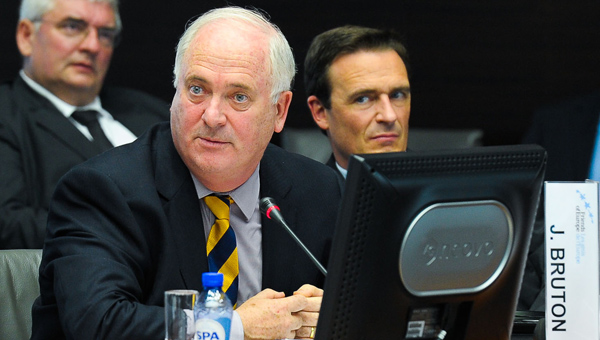
Whether it was of him powering down the corridors in Leinster House or hasitly arriving into a radio studio, the image of John Bruton that sticks in my mind is of a man on the move. He did not have the easy gait of an athlete, but he walked with powerful intent. And then there was the laugh, raucous but warm. It almost wrapped itself around those in his company. In my work as an academic, and my previous career as a political journalist, I interviewed John Bruton many times – as leader of Fine Gael, as taoiseach, and also in his very active years after leaving national politics in Ireland. He had been ousted as Fine Gael leader when we met, in late 2001, to discuss my biography of Martin Mansergh, then still a backroom advisor in Fianna Fáil and someone who had been an influential participant in the early clandestine moves to convince the Provisional IRA to end its campaign of violence. During our conversation, Bruton took issue with a point I raised. The information had been provided by another interviewee for my book. ‘Not true, not true’, Bruton replied, as he moved swiftly across the office to an adjacent storage room. Some moments later, he re-emerged holding a large cardboard box. Seated again at the table alongside me, he went through the contents – dozens of exercise copybooks, the type normally used by children in primary school. The pages were filled, in his own pen, with snatches of conversations and notes of meetings from the dramatic weeks in December 1994 when he became taoiseach.
Leafing through the copybooks, he found what he wanted. ‘Look, my notes from the meeting you mentioned’, he said, making the case that my earlier interviewee’s recollection was faulty. My attention had, however, been drawn to a separate copybook now also on the table. The opened pages contained the names of several Fine Gael TDs. There were lines through some names, others had departmental portfolios alongside them. Here was evidence of a party leader – a prospective taoiseach – doodling his fantasy cabinet. Seeing where my gaze had landed, Bruton quickly closed the copybook. ‘You’ve no need for that’, he said, with the booming laugh, as he returned the cardboard box back to the storage room.
Numerous times in subsequent years, I mentioned those copybooks and encouraged Bruton to write his memoirs. He was reluctant to embark on the project. ‘I do think about a memoir, but the work would be enormous because my memory is bad’, he wrote; ‘I would have to do a lot of research and even then could get things wrong. The notebooks tell nothing on their own.’1 It is a shame that John Bruton died in 2024 without penning his own record of a political career populated with achievement, drama, and controversy: from his election to Dáil Éireann in 1969 at the age of twenty-two, to holding junior and senior ministerial positions in governments led respectively by Liam Cosgrave (1973–77) and Garret FitzGerald (1981–82; 1982–87), to becoming leader of Fine Gael (1990–2001) and serving as taoiseach (1994– 97).
There were also several contentious leadership battles, including the one that finally ended his tenure as Fine Gael leader in 2001. An Irish Times/ MRBI poll in late January 2001 convinced his internal critics that the time for a much debated leadership change had finally arrived. Support for Bertie Ahern’s Fianna Fáil was at 41% (an increase of one point since a similar poll the previous September), whereas Fine Gael had slipped four points to 20% and was now in third place in Dublin behind Fianna Fáil and Labour. The findings contained other bad news for Bruton. He registered a personal satisfaction rating of 37%, his lowest level since November 1994 (just before he was unexpectedly elected taoiseach).2 Bruton called on his party colleagues ‘not to desert the colours’ but two senior Fine Gael figures, Jim Mitchell and Michael Noonan, smelt blood. In a parliamentary party where even critics of Bruton acknowledged his decency and hard work (and his record as taoiseach), Mitchell’s words were particularly bruising. ‘Regretfully, John Bruton is like a weak currency which can no longer be propped up,’ Mitchell wrote in a caustic newspaper article.3
I was working in Leinster House as a journalist on 31 January 2001, when the seventy-two members of the Fine Gael parliamentary party gathered to consider the no-confidence motion. The meeting lasted for seven-and-a-half hours. To the end of the meeting, nobody was clear about the outcome. It was just 10pm when news of the result leaked out of the meeting room. The vote was tight – Bruton had been beaten, but three votes switching sides would have allowed him to remain as leader (although his credibility in the role would have been seriously undermined). There was something momentous about the decision that I reported into Vincent Browne’s radio programme on RTÉ that night. It wasn’t just a party leader being removed from his position but also someone who had served as taoiseach. A few minutes later Bruton was on the steps of Leinster House looking out over the plinth towards Kildare Street. ‘I fully accept this democratic decision’, he said. His voice was full of emotion as he spoke of the ‘extremely adverse conditions’ of the previous few days. Standing alongside him there were tears among loyal supporters including his brother, Richard. The dignified manner in which he accepted the outcome spoke greatly of a deeply-held commitment to democratic politics. It was a commitment mentioned frequently in the myriad of tributes offered in the days after his passing on 6 February 2024 at the age of seventy-six.
The rainbow coalition
The many assessments of John Bruton’s political career covered similar ground – the budget defeat that led to the collapse of the minority Fine Gael–Labour coalition in early 1982, leadership contests, the intervention in the 1995 divorce referendum, and a long-standing apathy to militant republicanism. Bruton’s passing, however, also presents an opportunity to consider what factors form a successful political career and, in particular, what qualities are needed to become taoiseach. A commitment to public service is an essential starting point. You would hope societal ambition, a desire to leave the country a better place. Durability is certainly a fundamental quality, especially with the heightened demands on both the ‘time and thought’ of those who hold high office. The days of a taoiseach going home for lunch and signing off on the job at 5pm are long gone. The contemporary era also requires enhanced communications skills and an ability to deliver the public performance aspects of the position.
John Bruton was more than a lucky politician who stumbled into the office of taoiseach in the midst of huge political turbulence in late 1994. Taken as a whole, his thirty-five year career in Dáil Éireann shows a serious politician, someone who was conservative in his thinking on the economy and moderately liberal in considering social issues. He made mistakes, but he also enjoyed success, as would be expected from such a prolonged commitment to political life. He had an intellectual curiosity and an interest in the world beyond his constituency and country. He demonstrated an ability to consider a long-term perspective and, within that, to allow his views to evolve as other societal and economic factors changed. With contemporary politics increasingly framed in terms of a ‘horse race’ between winners and losers, his career is a reminder of the difficulty of political life and the complexity of governing.
John Bruton was elected taoiseach on 15 December 1994. It was the first time since the foundation of the Irish state that a new government had been formed during the life of a parliament without a general election being called. The three-party coalition comprising Fine Gael, Labour, and Democratic Left presided over a significant improvement in the performance of the Irish economy, which preceded the so-called Celtic Tiger era. There were challenges with the peace process, especially when the first IRA ceasefire ended in early 1996. More significantly, and perhaps more evident in retrospect, serious political process was made in conjunction with the British government, work that ultimately paved the way for the Belfast Agreement in 1998. The rainbow government was also defined by a genuine progressive ethos and introduced reforming policies in the tax and social welfare codes. Bruton’s legacy as taoiseach, however, will probably be defined by the divorce referendum in November 1995. His role in the successful campaign to remove the constitutional ban on divorce unquestionably guarantees a place in the history books.
He sought to lead the 1994–97 coalition on a consensus basis, although that did not mean there were no differences between the three government parties. There were strains surrounding the separate resignations in controversy of two senior Fine Gael ministers, Hugh Coveney and Michael Lowry. There were also policy disputes, but Bruton worked to lead a cabinet built on consensus. Among his government colleagues, there was strong praise for his ability to change his stance if convinced of the merits of a particular policy proposal. Proinsias De Rossa, the Democratic Left leader and Minister for Social Welfare, recalled one experience during the Irish presidency of the European Union in the second six months of 1996. ‘We were negotiating a new language in the [EU] treaties to allow for poverty programmes and anti-discrimination. We had been sort of battering Bruton’s head about poverty and social inclusion and how important they were, and how you couldn’t have a modern economy without dealing with them and so forth. And Bruton’s going, “tell me again about this social exclusion?”’4
There were very different relationships between the other two party leaders. Bruton and Labour’s Dick Spring had served in the 1982–87 Garret FitzGerald-led coalition. Set against a depressed economic backdrop of the 1980s, Bruton’s preference for private sector involvement in economic life and support for significant reductions in government expenditure ensured poor relations with Spring. By way of contrast, the positive relationship between the leaders of Fine Gael and Democratic Left was a genuine surprise. From an original position of political antagonism, largely influenced by their differing experiences of the Northern Ireland conflict, Bruton came to admire and respect his Democratic Left counterpart. ‘I remember having lots of conversations with Proinsias de Rossa. Of course there were things on which we profoundly disagreed, like abortion, but I found his method of discussion was one that was very easy for me to enter into. I knew if I said something to Proinsias he mightn’t answer me there and then, but he would go away and think about it.’ For his part, De Rossa saw the Fine Gael leader as a conservative politician, but he admired his intellect: ‘For all of Bruton’s instincts as a big farmer he is a highly intelligent man.’
Pat Rabbitte, a Democratic Left Minister of State who attended cabinet, witnessed their exchanges in government, ‘It was very odd, a rancher from Co. Meath who previously had shown a very conservative disposition, and an inner city radical. It was very peculiar.’ Rabbitte offered an explanation for the positive chemistry, ‘I think maybe their like-mindedness on Northern Ireland was probably a factor. And Bruton changed his views as he progressed in life and in politics. By the time he finished in that government he was quite a convinced social democrat and he had come from a very conservative position.’
After national politics
For many political leaders the loss of office is the end. Some pull the shutters down and retreat back into private life, others live out their days hankering for the adrenaline rush of their past political career. John Bruton, however, found another route that allowed him to continue to have an active role in public life. He had a second coming as the European Union’s Ambassador to Washington (2004–09). Many people urged him to consider being a candidate for the presidency when Mary McAleese’s second term ended in 2011, but he said he would not be comfortable in the position. Instead, among other involvements, he contributed with verve and acumen – and not a little controversy – to various national debates.
As well as lectures and media contributions, he wrote considered book reviews. I was very grateful for his positive review of my book on the rebuilding of Fine Gael after the disastrous 2002 general election (the contest that Bruton’s critics claimed they would win).5 He was less convinced about the party’s coalition with Labour in 2011, as the country grappled with an economic crisis of historic proportions. ‘[The book] gave just credit to Enda Kenny before it became fashionable to do so. But the qualities you described so well helped the party win office, but may not have served it so well in negotiating the Programme for Government.’6 In the years after he returned from Washington, those on his list of email contacts became familiar with messages that opened with the sentence, ‘I am sending you herewith something I have written about … ’ He was keenly interested in the decade of centenaries, the future of Northern Ireland, and the implications of the United Kingdom’s decision to leave the European Union. Several of these contributions were published in Studies.
Bruton long held a torch for John Redmond, the leader of the Irish Parliamentary Party (IPP) from 1900 until his death in March 1918.7 Redmond, a MP for Waterford, had helped to heal the bitter rift in the IPP after the Parnell schism. He also successful secured constitutional change at Westminster, which facilitated the passing of Home Rule legislation in 1914. In March 2018, Bruton spoke at a conference at Westminster to mark the centenary of Redmond’s death. In the IPP leader, Bruton saw the essence of his own understanding of what politics was about – namely, the importance of public service and the use of parliamentary activism to deliver change. He marvelled at how Redmond had worked to end the parliamentary veto of the House of Lords, rating it as a ‘a major constitutional achievement’. He long believed this legacy had been undervalued, in particular as removing the blocking veto facilitated the enactment (but not the delivery) of Home Rule in 1914. ‘The enactment of Home Rule, and its signature by the king, meant that the British parliament, and its sovereign, had consented to the principle of Irish legislative independence’, Bruton wrote. In itself this constitutional change was important but, in light of the revolutionary era that followed, Bruton was equally keen to emphasise that Redmond’s achievement came ‘without taking anyone’s life’.
Bruton may have overestimated Redmond’s political relevance once the Home Rule Bill was paused on account of the start of World War I, but Redmond’s commitment to peaceful political activism strongly influenced Bruton’s forceful, antagonistic view of Sinn Fein, not just in the historical context of the revolutionary era from 1916 into the 1920s but also in contemporary life on the island of Ireland. In Redmond, Bruton saw an Irish nationalist leader who made a serious attempt to understand, in a respectful way, the real fears and aspirations of Ulster unionism. In that regard, he considered Redmond a more appropriate model for a twenty-first century world than many of the so-called icons of Irish republican history. ‘Redmond’s example of courtesy, sincerity, and creative compromise is the best model for all of us to follow in this small European continent, as Europeans of all nationalities seek to protect ourselves in an increasingly dangerous and protectionist world, of the population of which we in Europe constitute a diminishing minority. “Ourselves Alone” is not the best way.’
Bruton supported the idea of Irish unity but only in circumstances where a unitary state offered stability and was not encumbered by a disgruntled minority population. Before consideration might be given to eliminating the border between the two jurisdictions on the island, he argued strongly for delivering the ambition of the Belfast Agreement of 1998. As he put it, this was the ‘vital task of this generation’.8 The principles underpinning the Belfast Agreement ended the zero-sum game of the Irish conundrum, where for centuries either the British identity had to win or the Irish identity had to win. As Bruton saw it, the 1998 deal offered the possibility of ending the contest between these two identities to allow for peacefully co-existence in Northern Ireland. The three interconnected stands at the core of the Belfast Agreement – power-sharing in the North, North–South cooperation and East–West relations – created a new type of politics.
A border poll
The Belfast Agreement allows the British secretary of state to hold a poll in Northern Ireland should the British government believe that a majority in Northern Ireland would support unification with the Irish Republic. But, as John Bruton correctly observed, the Belfast Agreement offers little guidance on the criteria that might guide such a far-reaching decision. There is also silence in the 1998 peace deal on the Dublin government’s role in ensuring how the different communities in Northern Ireland – and especially the one that wants to remain part of the United Kingdom – might be made welcome in a united Ireland. Neither, as Bruton also regularly pointed out, does the Belfast Agreement offer any consideration of the public finance and taxation implications of Irish unity.
Former taoiseach Bertie Ahern has suggested that a border poll could take place in 2028 on the 30th anniversary of the Belfast Agreement.9 Sinn Fein leader Mary Lou McDonald has predicted that referendums will be held in both jurisdictions by 2030.10 Bruton predicted problems in reducing a complex issue to a simple Yes/No question and suggested that such a binary choice would exclude creativity and compromise over any future constitutional arrangements. He was fundamentally opposed to putting a date on when a referendum might be held. ‘Setting targets for a referendum, before any details have been worked out, is reckless. As the Brexit experience in 2016 has shown, it can also lead to the oppression of minority viewpoints, lasting division, and unforeseen consequences.’
Writing in 2022, Bruton referenced an opinion poll in which a large majority (67%) in the South said they would support a united Ireland. But alongside that figure, only 41% said they would be prepared to pay higher taxes to accommodate Irish unity, and even fewer again said they would be willing to change the national flag or the national anthem to accommodate the British identity of the unionist community. For those who quoted survey data in making the case for majorities supporting Irish unity, Bruton offered the sharp analysis of a seasoned politician who had had his own experience of opinion polls: ‘Of course, answers to hypothetical poll questions about remote future possibilities are not reliable.’
In an interesting analysis, he challenged those who champion the border poll pledge in the Belfast Agreement to instead return to the Downing Street Declaration of December 1993. Published by Albert Reynolds and John Major, the Declaration affirmed the right of the people on the island of Ireland to self-determination and enshrined the principle of contest in how that self- determination might be enacted. In many ways a prelude, or a stepping-stone document, towards the Belfast Agreement, the Declaration is more expansive on how Irish unity might be achieved than the border poll commitment in the 1998 peace deal. Section 7 of the Declaration states, ‘Both governments accept that Irish unity would be achieved only by those who favour this outcome persuading those who do not, peacefully and without coercion or violence, and that, if in the future a majority of the people of Northern Ireland are so persuaded, both governments will support and give legislative effect to their wish.’ The key wording is where the Declaration says that Irish unity should be achieved ‘by those who favour it, persuading those who do not, peacefully and without coercion or violence’. As such, a border poll carried by even a small margin would legally achieve the requirement in the Belfast Agreement for Irish unity, but it is a moot point whether such a result would meet the political criteria in the Downing Street Declaration.
Bruton was taoiseach in February 1995 when his government, and John Major’s in London, jointly published the Framework Documents to progress the peace process. The idea of self-determination and the principle of consent were also at the core of this 1995 document. Paragraph 10 says that ‘the consent of the governed is an essential ingredient for stability in any political arrangement’. Writing in Studies in 2022, he argued that having a disgruntled minority in what was previously Northern Ireland would be a ‘huge problem that the newly created thirty-two county state would have to resolve’.
Bruton’s writings on a border poll are salient. The history of Northern Ireland through the last hundred years demonstrates the danger of attempting to impose, by a simple majority, a constitutional settlement on a minority who feel they have been overruled. Facing up to the reality that a significant minority in Northern Ireland might refuse allegiance to the outcome of a border poll is a real risk and would essentially repeat the errors of the 1920s. As Bruton observed: ‘This losing minority would be geographically concentrated in parts of the province where they might constitute a local majority. Experience suggest[s] that policing such areas could become difficult for the united Ireland government.’
Rather than fixating on the territorial sovereignty with a border poll, John Bruton proposed that there was a focus on allowing the aspirations in the Belfast Agreement to yield their full potential and more work towards reconciliation within Northern Ireland. Interestingly, he made the case that reconciliation within Northern Ireland – and achieving tolerance and mutual respect for all the people in the North – should be seen as an end in itself, and not as a preparation for either a united Ireland or a continuance of the Union. Bruton had established himself as a sane voice in the nascent discussion about a border poll. His involvement in the debate and any future campaign will be sorely missed. His thinking on a border poll – published in Studies – are a fitting contribution to public life that should not be overlooked.11
In the days after his passing in February 2024, one of the more heart- warming assessments of the former taoiseach was published in the letters page of The Irish Times.12 Bob Barry, from Ashbourne in County Meath, wrote about being Bruton’s company in the early 1990s. Barry was among a group who, after finishing a céilí, had adjourned in a local pub on a dark winter’s evening. Bruton was holding a constituency clinic upstairs in the building and arrived into the bar when his work was done. He did not know Bob Barry and his friends but still joined their company. ‘He was affable and friendly and on spying a squeezebox beside Ray, our man of music, he suggested a few tunes, and before long we were all in full voice’, Barry wrote. A song relevant to each county in Ireland, North and South, was duly played, and the music was interspersed with Bruton telling stories about his visits to the different parts of the island. As Bob Barry recalled, ‘It was remarkable to see this senior politician blend in so well and demonstrate his folk knowledge of our country. May he rest in peace’.
Kevin Rafter is Full Professor of Political Communication at Dublin City University. He has published extensively on Irish politics, including most recently Taoisigh and the Arts (2022). This article was written when he was a Fulbright Scholar at Boston College earlier in 2024.
Notes
- John Bruton, email correspondence with Kevin Rafter, 11 January 2016.
- Mark Brennock, ‘Coalition would win election according to poll’, The Irish Times, 26 January 2001.
- Jim Mitchell, ‘John Bruton like a weak currency which can no longer be propped up’, The Irish Times, 29 January 2001.
- Quotes from Proinsias De Rossa, Pat Rabbitte and John Bruton taken from Kevin Rafter, Democratic Left: The Life and Death of an Irish Political Party (Dublin: Irish Academic Press, 2011).
- Kevin Rafter, The Road to Power: How Fine Gael Made History (Dublin: New Island, 2011).
- John Bruton, email correspondence with Kevin Rafter, 1 June 2011.
- John Bruton, ‘The Redmond Family in Parliamentary Politics’, Studies: An Irish Quarterly Review, 107:426 (2018), 176–184.
- John Bruton (2019), ‘The 1918 Election and its Relevance to Modern Irish Politics’, Studies: An Irish Quarterly Review, 108:429, 93–103.
- ‘Border poll should be held in 2028, says Bertie Ahern’, The Irish Times, 1 February 2021.
- David Young, ‘Irish unity border poll will be held before 2030 Mary Lou McDonald predicts’, Independent, 8 February 2024.
- John Bruton, ‘Careful Thought Needed on Border Polls’ Studies: An Irish Quarterly Review, 110:439 (2021), 309–314; John Bruton (2022), ‘Partition: Are There Two Nations on the Island of Ireland, and Could They Be Fused into One?’, Studies: An Irish Quarterly Review, 111:444, 418–426.
- ‘Letters to the Editor’, The Irish Times, 9 February 2024.