
Peadar Kirby
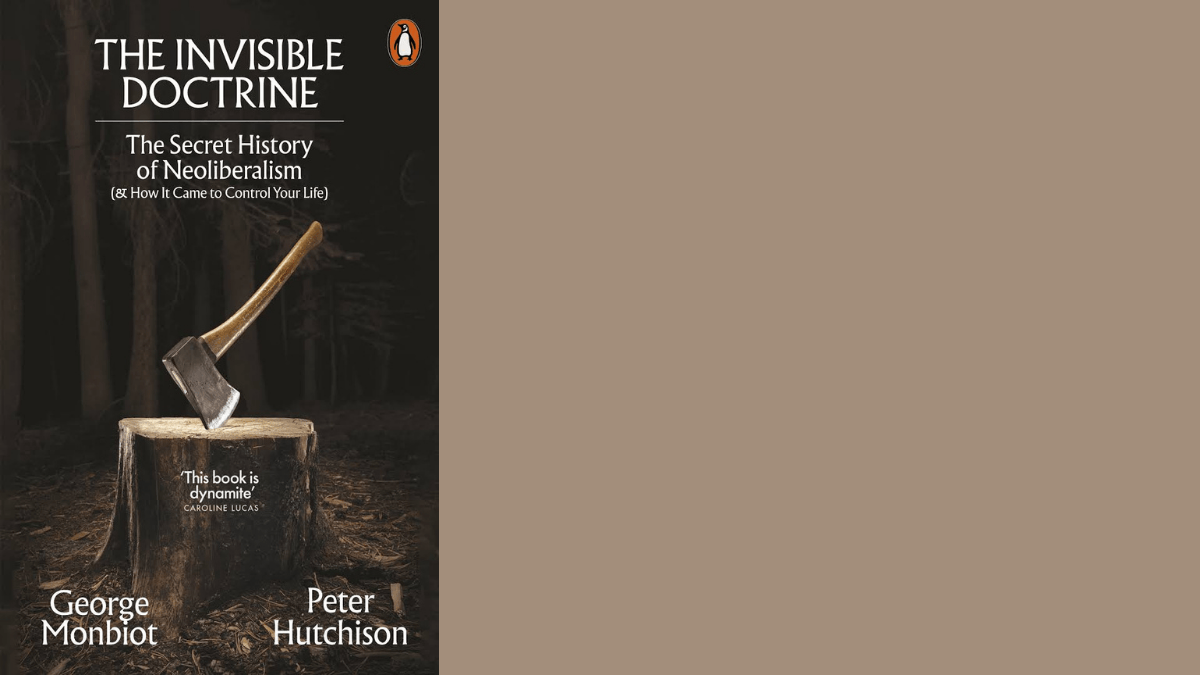
George Monbiot and Peter Hutchison, The Invisible Doctrine: The Secret History of Neoliberalism (London: Allen Lane, 2024), 218 pages.
Olivier De Schutter, The Poverty of Growth (London: Pluto Press, 2024), 132 pages.
Guardian columnist George Monbiot and filmmaker Peter Hutchison begin their deeply troubling exposure of neoliberalism with this invitation: ‘Imagine that the people of the Soviet Union had never heard of Communism’. But the situation we now find ourselves in throughout the world is precisely analogous to this, with our societies and even our personal lives profoundly reshaped by a doctrine that most have never heard of and many economists even deny exists, namely neoliberalism. While it is possible to define the central traits of this ‘invisible doctrine’ as the primacy of the market over the state, competition as the guiding principle of social life, the commodification of more and more spheres of life down to the most intimate, and an individualised hyper- consumption as its ubiquitous culture, this little book goes much further in exposing the forces that drive it and the ways it has profoundly reshaped our world.
Following the financial crash in 2008, many of the central claims of neoliberalism have become much more contested, but Monbiot and Hutchison focus more on its astonishing success in getting us to internalise and reproduce its creeds. Among these is that the rich are wealthy due to their own efforts, while the poor blame themselves for their situation because of their incompetence and failure to compete successfully. The nexus of structures that shape the way society operates is largely hidden to most as are the corporate bodies actively spreading the doctrine. Exposing the manoeuvres of the array of think tanks that grew up to promote this way of looking at the world, what the authors call the ‘architecture of persuasion’, and especially their strenuous efforts to shield themselves from any democratic scrutiny, is a major contribution.
The book also helps explain some of the deep shifts we are seeing in our politics. They explain the widespread phenomenon of ‘outrageous and Peadar Kirby absurd exhibitionists’ becoming political leaders in a wide range of countries worldwide as a move from corporate to oligarchic power seeking the destruction of the administrative state so that private groups can seize state assets amid the chaos unleashed. This is one of the paradoxes of neoliberalism; they write, ‘while it fetishises competitive enterprise, in reality it empowers rentiers and asset strippers – the opposite of the creative entrepreneurs it celebrates’ (p. 91). Another feature of contemporary politics, helping fuel the far-right, are the conspiracy theories that are poisoning political discourse. ‘The more we learn, the more we discover how much of the fury and loathing directed towards innocent people has been manufactured and paid for’, write the authors. They cite the power of the Koch brothers in the US and how they have, over years, funded networks that spew out false stories about shadowy elites and their nefarious activities, distracting attention from real oligarchic power and identifying oppressed minorities, such as migrants and Black people, as mortal threats to society and to individuals’ freedoms.
Monbiot and Hutchison write that ‘while we are mesmerised by imaginary threats, the power of the invisible doctrine continues to expand’ (p. 106); they do also offer some hopeful pointers as to how to counteract neoliberalism’s pernicious hold. Taking the example of the way the US transformed its economy in a very short space of time as it entered the Second World War, they state that ‘catastrophe is not a matter of fate … political failure, at heart, is a failure of imagination’ (p. 137). We need a new story to counter the destructive story that neoliberalism spread so successfully. Over recent years, findings from several disciplines show that we are not the competitive, grasping individuals that the neoliberal story promotes but, rather, we are motivated by more social values: altruism, empathy, family, community, and the pursuit of a better world, not only for ourselves but for others also. So they propose a new Restoration Story based on the common people fighting nefarious forces that try to divide and confuse and ‘building rich, engaging, collaborative, inclusive and generous communities’ (p. 145), thereby restoring harmony to the land.
They end the book by proposing a ‘politics of belonging’, building back society from the bottom up through popular assemblies that would gradually acquire control over elements of the local economy. They mention the example of the Kurdish people of Rojava in north-eastern Syria and the participatory budgeting of Porto Alegre in Brazil to show that this is being done. They end by reminding readers that ‘society, like a rainforest or a financial network, is a complex adaptive system’, and that participatory deliberative democracy ‘is better matched to the dynamics of a complex, self-regulating system’ (p. 152). Advocating for a society of ‘private sufficiency and public luxury’, they marshal evidence that points to us being at a tipping point towards radical social transformation.
While Olivier De Schutter’s book has a somewhat different focus, it is an excellent complement to Monbiot and Hutchison, very much strengthening the case for radical transformation. De Shutter is the UN Special Rapporteur on extreme poverty and human rights, and this book emerged from a meeting with Pope Francis at the Vatican in September 2022, when the author was asked to propose a diagnosis of global poverty and to identify levers that could be used to eradicate it. The result is a sharp, comprehensive, and innovative text. One can only imagine that it must have delighted the Pope and his advisors.
What is novel about this book is that De Schutter faces frontally the issue that is raised again and again as a justification for continuing economic growth, namely that it is needed to raise the poor out of poverty. He demolishes this argument in careful and well-substantiated steps, concluding instead that we are locked into a kind of growth that, far from lifting the poor out of poverty, actually benefits the rich predominantly and ends up in many cases actually making poverty worse. It is a ground-breaking book of the utmost political and economic importance.
De Schutter begins by interrogating what we mean by poverty, showing the lack of ambition that informs the dominant quantitative measures of poverty (those measures that are regularly repeated to claim that in fact poverty is being progressively reduced). He argues for a more multidimensional understanding focused on improvements to health, education, and standards of living. But even these measures have their limitations, he argues, as, beyond meeting basic needs, the deeper concerns of the poor relate to social exclusion, discrimination, and social or institutional maltreatment. He perceptively identifies that as societies become more affluent what results is the modernisation of poverty and ‘those living on low incomes remain socially excluded because social expectations rise with the increase in general affluence’ (p. 11).
In chapter 2, De Schutter asks if growth is the solution. Here he addresses the question of whether growth is for the already wealthy or for the poor. Answering this question leads him into a fascinating exposé of the ways in which the dominant prescriptions to boost growth mostly favour the already comfortably off rather than the poor. One example is export-led growth favoured by governments all over the world. Yet, De Schutter shows how those who succeed are those who can be competitive in global supply chains, leading to increased concentration of power especially in the hands of large buyers. Small and poor producers are further excluded in which a system. Thus growth promises far more than it can deliver: even if the income of the poor increases in absolute terms, their situation in relation to other members of society may well worsen as overall living standards increase. Furthermore, he points to the environmental destruction caused by economic growth, which increases threats to the livelihoods of the poor. Dismissing the claim that growth can be made consistent with emissions reductions, he advocates for a notion of sufficiency (‘lifestyle changes that allow for basic needs to be satisfied’) rather than the overconsumption that drives so much economic growth.
Globalisation, another growth-oriented paradigm, he sees as ‘creating value by commodifying life’ in which ‘the world and its people are transformed into resources to exploit’ (p. 42). He argues that the commodification of all spheres of life comes at a high price, as it crowds out other more altruistic motives and often opens the door to corruption. De Schutter is very strong on the ways in which the growth imperative results in a capture of democracy, putting an imperative on the state to facilitate entrepreneurs and resulting in the de-democratisation of society. This leads to people in poverty having less say and influence.
It is difficult to do justice to this remarkable book in a short review. Taking both of these books together, it can be said that many of their arguments provide a robust backdrop to the contributions in this special issue of Studies. They offer a deep diagnosis of the roots of many of the ills that plague all our societies in different ways and each also offers many helpful insights into ways forward. A final comment from De Schutter takes us to the heart of so much that drives our politics and our economic life: the problem is not so much growth itself as ‘the ideology of growthism’, which sees growth as the solution to the problems of society. It is high time that it be challenged.
Peadar Kirby is Professor Emeritus of International Politics and Public Policy, University of Limerick. His most recent book is Karl Polanyi and the Contemporary Political Crisis: Transforming Market Society in the Era of Climate Change (London: Bloomsbury, 2021