David Begg
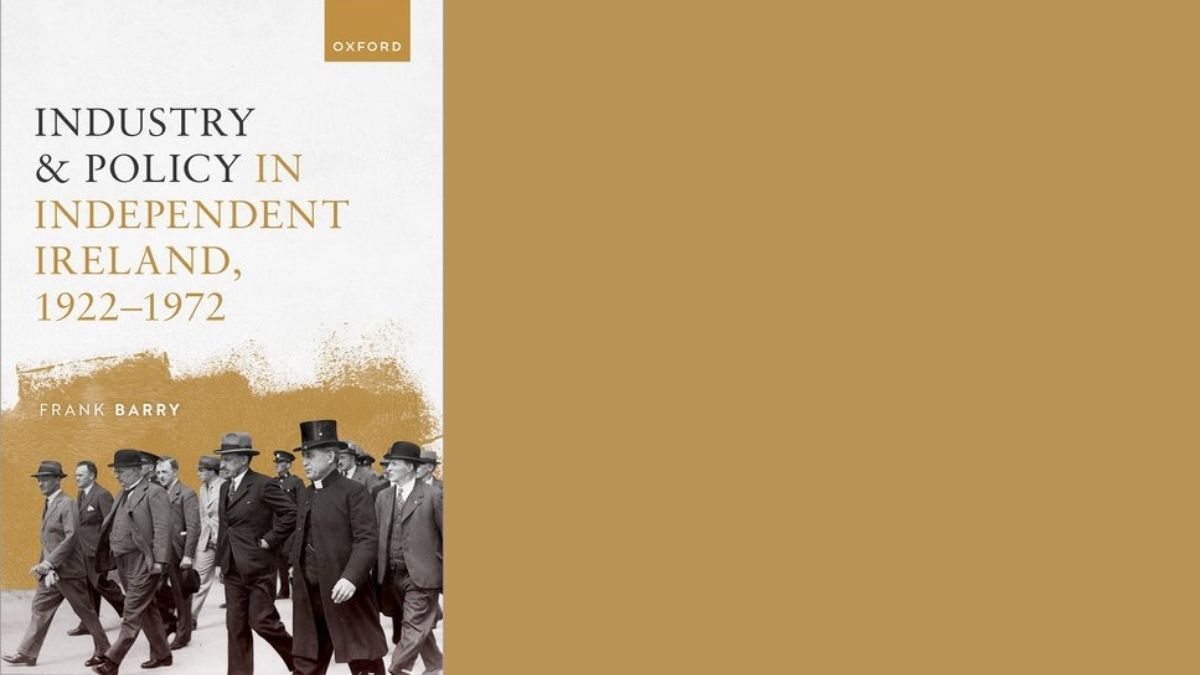
Frank Barry, Industry and Policy in Independent Ireland 1922–1972
(Oxford: Oxford University Press, 2023), 256 pages.
The Industrial Development Authority (IDA) is probably Ireland’s most successful state agency. It has been the cornerstone of industrial policy for over fifty years and is rightly proud of its success in attracting foreign direct investment (FDI). It might come as a surprise to the board of the IDA, and an embarrassment to the Department of Finance, to learn that the former was once regarded by the latter as ‘a gang of crack-pot socialist planners’. The finance view was that the IDA’s board of non-civil servants should not have it within their remit to ‘run or plan industry or any branch thereof’. This is one of many interesting revelations in this very fine book. To be fair, these views were expressed in 1948 and related to the most significant institutional innovation of the first inter-party government, which was given a statutory basis by the IDA Act of 1950.
In writing this book, Frank Barry has assembled an enormous amount of data about the state of Irish industry over the last one hundred years. It draws heavily on the Census of Industrial Production (CIP), which was first published in 1926. Apart from the narrative text, the book contains a wealth of data set out in sixty-seven detailed tables. But more than that, it is an economic, political, and social history of Ireland’s development from the foundation of the state to membership of the European Economic Community (EEC). The work is supported by extensive research, and the author has signalled his intention to make the entire database of several thousand firms available to the public at some stage in the future. If and when that happens, it will be an enormously valuable resource to scholars.
The book is structured in eight chapters dealing with different phases of development, starting with the pre-1922 Southern business establishment and its legacy, moving on through the foundation of the state, the Civil War and its consequences and the difficulty of preserving a viable industrial and fiscal framework. Strangely, the Great Depression had less of an impact on manufacturing employment than might be expected, but the Economic War with Britain over land annuity payments, which lasted from 1932 to 1938, was devastating for agriculture. The period from the Great Depression to the end of the Second World War, or the Emergency as it was called in Ireland, merits a separate chapter. The book then moves into the post-war era, and we begin to see the gradual development of export-orientated industrialisation and the use of tax policy to attract FDI. Trade liberalisation and the road to Europe is contextualised by reference to what was probably the most significant policy statement ever, the publication of Economic Development in 1958. Ireland’s trading relations with Britain is woven into every chapter, including the trade-offs accompanying the eventual acceptance of both countries into the EEC. The full implications of EEC entry in terms of industrial restructuring are reviewed in a chapter on the industrial landscape of 1972 and beyond. The book concludes with an epilogue, which is a reflection on the unrealised expectations of joining Europe until the rapid catch-up that began post-1987 and the beginning of the ‘Celtic Tiger’ period.
As mentioned already, this book is also something of a social history. For example, it brings to mind many of the sights and sounds of Dublin of the 1960s, when firms like Guinness and Jacobs were the big private sector industries. People of a certain age may recall the barges, with their funnels hinged to get under the bridges, as they made their way down the Liffey from the St James’ Gate brewery to the big ships moored at City Quay. Those ships, The Lady Patricia and the Lady Gwendoline, with their pristine yellow and blue livery, brought the barrels of Guinness to Liverpool. In 1972 the two- hundred-year-old brewery employed a workforce of 3,500. Jacob’s Biscuits, which dated from 1853, still employed a predominately female workforce of 1,500. Together with Cement Roadstone Holdings, these were the largest employers in the state.
Barry avers that the economic history of the state up to EEC accession is conventionally divided into three phases. The first comprised what is generally characterised as the laissez-faire era of the Cumann na nGaedheal governments of the 1920s, the second the dirigiste and protectionist policy regime of the Fianna Fáil administration that followed from 1932. The beginning of the third phase is typically dated to the late 1950s, when Seán Lemass took over from Éamon de Valera as taoiseach and leader of Fianna Fáil. Though Lemass had been the chief architect of protectionism, he adopted, with certain modifications, the broad principles of a plan prepared by the head of the civil service, T. K. Whitaker, who had feared during the severe economic crisis of the 1950s that ‘the achievement of independence would prove to have been a futility’. Protectionism was abandoned, an application to join the EEC submitted, and a Free Trade Area Agreement (AIFTA) signed with the United Kingdom in 1965.
However, the early part of the book is concerned with a review of conditions prior to independence. In this account there were 44,000 workers employed in large firms, more than three-quarters of which were under Protestant and Unionist control. The ethno-religious divide was clearly the major determinant of the overwhelmingly unionist disposition of the business establishment of the time. According to Barry, Unionism and Protestantism were intertwined with a sense of class and cultural superiority. On the other hand, the Dublin United Tramway Company (DUTC) was part of the business empire of the leading Catholic Nationalist industrialist, William Martin Murphy. Murphy was also proprietor of the best-selling newspaper, the Irish Independent, and part-owner of Dublin Department store Clerys. His various enterprises are likely to have employed at least 1,500 in the late 1910s. Murphy’s claim to fame (infamy?) was that he united the employers of Dublin, Catholic and Protestant, to defeat his co-religionist union leader, Jim Larkin, in the 1913 Lockout, although there is not much about this in the book. As an aside, this reviewer was taken aback to see a large portrait of William Martin Murphy adorn the boardroom of the Dublin Chamber of Commerce when attending a meeting there some years ago.
The book records that at the time of the foundation of the state, the Dublin Chamber of Commerce warned that partition would exacerbate the lack of economic expertise by depriving the prospective Southern parliament ‘of the steadying influence and business training of the men of Ulster’. Many, or most, on the Nationalist side appear to have assumed that self-government would bring prosperity. Arthur Griffith, founder of Sinn Féin, saw no reason why the island would not provide a living for a population of 15 million. Erskine Childers was one of the few to acknowledge publicly the financial difficulties that would have to be faced, particularly with regard to pensions. Although Barry does not draw attention to it, it is interesting that over 100 years later the same debate about the economics of unification remains unresolved.
The book suggests that, until the late 1960s in Ireland, the Catholic and Protestant communities essentially lived apart in a kind of mutually agreed apartheid. It cites businessman Michael Smurfit recalling in his autobiography that there were many companies, even in the 1960s, where Catholics could never join the management team no matter how good they were at their jobs. The record of the Free State Cumann na nGaedheal government with respect to industrial policy is treated with some sympathy. The immediate period post-independence was made extremely difficult by virtue of the Civil War. It was also a period when there were many industrial disputes, including a protracted one in the Post Office, which was a key public service. Not least of the problems was the establishment of the Civil Service. Until 1924, when open competition was introduced, the Civil Service of the Dáil was assimilated into the old Dublin Castle administration rather than the other way around. This created a legacy of mistrust. Suspicions pertained particularly to the Department of Finance and its two most senior figures, Joseph Brennan and J. J. McElligott, but this was not justified. The author praises the new government for its achievements in establishing new semi- state companies, especially the ESB and what it accomplished subsequently with rural electrification. It cites de Valera in later years observing to his son Vivion, after Fianna Fáil came to power in 1932, ‘when we got in and saw the files, they did a magnificent job’.
The initial approach to trade by the new Free State government was protectionist. They tried to protect jobs by imposing tariffs on imports. The first census of Industrial Production in 1926 suggested that 9,000 jobs had been created in sectors tariffed under the Finance Act of 1924, including such products as boots and shoes, soap and candles, sugar confectionary, cocoa preparations, and glass bottles. However, the protectionist voice diminished within the government over the course of the decade. From 1930, with the onset of the Great Depression, the potential for import substitution began to be looked at more seriously. This reached its apotheosis when Ireland operated what today would be considered a circular economy during World War II. The book explains the evolution of policy thinking and the changing approaches of the political actors in considerable detail in respect of this period.
Irish industry was only modestly impacted by the global depression. Manufacturing employment fell by only 2% compared to a 13% fall in the UK. The author notes that one reason for this was the lack of heavy industry. Moreover, Ireland entered the depression with low government debt and substantial external assets offering further significant benefits. There were no Irish banking failures.
Agriculture, on the other hand, did not fare well. The general election of 1933 saw Fianna Fáil retain office with an overall majority. In accordance with its election manifesto, the new government reduced land annuity obligations on farmers by half. British retaliatory duties had a huge impact on agriculture with a massive drop in rural living standards, with livestock farmers particularly adversely affected. The Economic War, as it was known, declined in intensity with coal–cattle pacts in the mid-1930s and was comprehensively settled in 1938.
Ireland’s post-war recovery was much less robust than for the rest of Europe. In fact Ireland was a laggard right up until the 1990s. Barry explains that this was in part due to our over-dependence on what was an underperforming UK economy. It was also due to some extent to our inability to fully avail of US Marshall Aid funding due to our refusal to meet the full range of conditions, including being willing to participate in the North Atlantic Treaty Organisation (NATO) because of our neutrality.
The post-war years saw the beginning of a long, slow policy reorientation towards trade liberalisation. On this topic John Barry engages in debate with another prominent academic economist, Denis O’Hearn. Specifically, he disputes the latter’s contention that the Irish regime change was dominated and redirected by a third force: a world capitalist political economy dominated by the institutions of First World capital. To the contrary Barry argues that the archival evidence demonstrates that the policy initiatives of the period emerged largely from within the Irish policy-making system, that significant components of the advice emanating from the United States was rejected, and that the US authorities and other external agencies, in criticising the Irish process, failed to understand the political economy difficulties it was designed to surmount.
It is a pity in a way that Barry does not pursue this debate with O’Hearn a bit further. While Barry emphasises the role of the Protestant business elite up to the 1960s, O’Hearn is much harder on the Irish capitalist class as a whole, criticising them for being much more willing to invest outside the country than in it.1 According to T. K. Whitaker’s biographer, Anne Chambers, he took a view closer to O’Hearn, noting that native Irish industry demonstrated a lack of entrepreneurship and ideas and largely failed to make use of investment opportunities.2
Whitaker himself was not wanting in ideas, and John Barry describes in some detail how he, with Séan Lemass, laid the foundations for what has been a very successful development model based on attracting export oriented foreign direct investment. In the immediate aftermath of the war, it became clear to policy makers that America would replace Britain as a potential source of investment. An external report on industrial policy was commissioned from the US consultancy Stacy May in 1952. This resulted in a strategy of industrialisation by invitation, which co-existed with import substitution in what the author describes as dual-track reform. Barry emphasises, however, that this strategy should not be conflated with the publication of the Whitaker report, Economic Development, in 1958 and the trade liberalisation of the following decade.
Unlike Anne Chambers,3 Barry does not engage in hagiography in describing Whitaker’s contribution. He points out that in October 1956 the then Taoiseach John A. Costello overrode objections from the Department of Finance, where Whitaker had become secretary in 1930, to announce the introduction of export profits tax relief. Costello’s speech is described in the book as one of the most significant economic policy speeches in the history of the state, thus the concept pre-dated Economic Development by two years. Though Whitaker favoured inward investment and removing restrictions on foreign ownership, only in 1960 did the Department of Finance explicitly accept that tax concessions had a key role in industrial promotion.
The author points out that the vast bulk of sectoral analysis in Economic Development was devoted to agriculture and the agri-food industries, which it assumed would be the engine of future growth. Other branches of manufacturing received relatively little attention. He makes the point that there was no meeting of minds between Whitaker and Lemass on broader economic policy, Lemass regarding him as being too deeply committed to traditional Department of Finance orthodoxy. Although Barry does not mention it specifically, it is the case that Lemass put his personal stamp on the first Programme for Economic Expansion (1958–1963), differing from Whitaker in his belief that industrial expansion was a pre-condition for economic expansion.
Nevertheless, the Whitaker Report helped to lift the mood of despondency and prepared the country psychologically for free trade. But Barry also makes the point that the first unilateral tariff cuts did not happen until 1963, and it was explicitly stated that this step was taken as part of the campaign to gain entry to the EEC, which could not have been envisaged at the time of the Whitaker Report. Therefore, he concludes, to credit the turnaround in trade policy solely or primarily to Economic Development is to ignore this crucial factor.
Whitaker believed that most pre-existing firms would survive outward reorientation. When EEC membership was eventually achieved, this expectation would prove hugely over optimistic. A 1972 government white paper on EEC accession had envisaged a net increase of 50,000 manufacturing jobs between 1970 and 1978, practically all of which were anticipated to come from new foreign industry. In fact, only half this number materialised, and existing industry contracted significantly. In fairness, the oil crises of the 1970s were a major factor in this poor performance and could hardly have been foreseen. But by 1987, the country was in a severe economic crisis.
In the epilogue Barry opines that Ireland’s growth performance from independence until well into the European Economic Community (EEC) era was poor by international standards. Nevertheless, real agricultural incomes rose by 40% over the years to 1978 under the common agricultural policy. Unimpeded access to a vastly broader market increased Ireland’s attractiveness as an export platform for foreign multinational corporations, and there was a dramatic positive change with a growth spurt in the 1990s. The indigenous and foreign sectors appear to have kept largely abreast of each other over the decades since EEC accession. By the early 2000s, foreign-owned firms comprised close to 50% of manufacturing employment. This remains the case to the present day.
This book should be essential reading for policymakers. It will also be a great resource, together with the promised future availability of a data bank on firms, for researchers and students.
What comes across clearly from the book is that industrial policy in Ireland has had to change direction many times since the foundation of the state. Will it have to do so again? Although the country is again at full employment, and the exchequer is awash with corporation tax receipts, it remains the case that Ireland is a small open economy living in uncertain times. Wars and geopolitical tensions, a retreat from globalisation, and potentially an isolationist administration in the US could all negatively affect foreign direct investment. Against this backdrop, it is slightly worrying that the flow of multinational investment, two thirds of which comes from the US, slowed in the first six months of 2024.4 As the small print advertising investment opportunities is wont to say, past performance is no guarantee of future results.
David Begg is a former General Secretary of the Irish Congress of Trade Unions and an Adjunct Professor at Maynooth University Institute of Social Sciences (MUSSI).
Notes
- Denis O’Hearn, The Atlantic Economy: Britain, The US and Ireland (Manchester and New York: Manchester University Press, 2001).
- Anne Chambers, T. K. Whitaker: Portrait of a Patriot (London: Doubleday, 2014).
- Chambers, T. K. Whitaker.
- Eoin Burke-Kennedy, ‘Pace of Multinational Investment and Jobs Flow Slows, IDA Data shows’,
The Irish Times, 9 July 2024, p. 14.