Dermot Roantree
John F. Kennedy’s successful bid for the US presidency in 1960 largely put paid to the Kulturkampf type of anti-Catholicism that had prevailed in the country since the late nineteenth century – the belief that Catholics ought to be excluded from high office as their allegiance to the state would always be subordinate to their allegiance to Rome. I don’t suppose, however, that anyone at the time imagined that Catholics would come to have the heightened presence and influence that they do now. In all the time from 1776 to the Kennedy administration, for example, there were just six Catholics on the Supreme Court; right now there are six Catholics serving on the Supreme Court at the same time – six out of a total of nine. Then, more than one third of Trump’s second-term cabinet are Catholic, including Secretary of State Marco Rubio, Attorney General Pam Bondi, Director of the CIA John Ratcliffe, and of course Vice President J. D. Vance. And perhaps most consequentially of all, many of the leading figures in the foundations and think-tanks that have contributed to Trump’s agenda are also Catholic – the people behind Supreme Court nominations, Project 2025, and the drafting of Trump’s executive orders, people like Leonard Leo at the Federalist Society, Tim Busch at the Napa Institute, Kevin Roberts at the Heritage Foundation, and Linda McMahon (now secretary of education) and Larry Kudlow at the America First Policy Institute. Catholics account for less than one quarter of the US population, but you wouldn’t guess that from their prominence among the movers, shakers, and policy makers of Trump’s America.
Postliberal conservatism
All the Catholics I have mentioned here, apart from one Supreme Court justice, Sonia Sotomayor, identify strongly as conservatives, and many of them are identifiable as postliberals, whether or not they accept the label. In itself, postliberalism is neither left nor right. It contests the fundamental principles of liberalism, in particular its emphasis on the protection of individual rights and freedoms through a value-neutral proceduralism, rejecting any specific conception of the good or of a just social order. The paradox here, as postliberals see it, is that sustaining such neutrality inevitably entails imposing its own set of values, and these invariably are individualist, consumerist, and relativist. American postliberals on the left, such as Stanley Hauerwas, Eugene McCarraher, and William Cavanaugh, reject the liberal notion of the self as an autonomous individual. They place the stress instead on human sociability and interdependence, and they advocate solidarity- based social structures that are attentive to the demands of justice, peace, and a care environment. Importantly, though, they imagine that a shift in values of this kind can be achieved in a bottom-up manner. Through solidarity at community level and through participatory discourse that engages critically with tradition, a shared value framework is allowed to emerge.
For postliberals on the right, however – including all of those who have gained prominence under Trump – the solution to the liberal paradox is very different. Their chief concern is the restoration of religious, cultural, and family values, and they are deeply suspicious of a discursive approach to achieving this. The parameters of a just society are clear. They are not teased out through discernment and dialogue. They are simply given. They are known through tradition, natural law, and right reason, and they must be imposed through state power, through government institutions, and the law. In the words of Patrick Deneen, who more than anyone else qualifies as the chief theorist of the movement, what is needed is ‘regime change’:
The peaceful but vigorous overthrow of a corrupt and corrupting liberal ruling class and the creation of a postliberal order in which existing political forms can remain in place, as long as a fundamentally different ethos informs those institutions and the personnel who populate key offices and positions.1
Concretely, what Deneen means by regime change, as Damon Linker explains, is ‘replacing the people and institutions that dominate America’s cultural, economic, and political life with a new elite willing to eschew liberal norms in service of supposedly higher ideals’.2
Most of these postliberals – Deneen included – look admiringly on the illiberal democracy of Viktor Orbán in Hungary, his installation of a highly centralised strongman regime, reducing democratic culture to a hollow ritual in which elections serve primarily to endorse the expansion of executive power. This is not far from the configuration they dream of for the United States.
American right-wing postliberalism is not an exclusively Catholic phenomenon, but many of its most prominent adherents are Catholics, either from infancy or through adult conversion. Deneen is Catholic, and he has frequently referred to the formative role of Catholicism in shaping his political philosophy. Also Catholic are Gladden Pappin, an advisor to Orbán, Sohrab Ahmari, author and columnist, Rusty Reno, editor of First Things, and theologian Chad Pecknold. And at the most intense end of the postliberal spectrum is Catholic convert and integralist Adrian Vermeule, whose common-good constitutionalism provides postliberal Catholics with a legal underpinning for their rejection of both originalism and procedural liberalism. A highly regarded scholar, he presents the case for the constitution to be interpreted in accordance with natural law principles and to be oriented toward moral and political ends consistent with Catholic Social Teaching. To achieve this, unapologetic ‘strong rule’ is needed. Common-good constitutionalism, he argues,
does not suffer from a horror of political domination and hierarchy, because it sees that law is parental, a wise teacher and an inculcator of good habits. Just authority in rulers can be exercised for the good of subjects, if necessary even against the subjects’ own perceptions of what is best for them – perceptions that may change over time anyway, as the law teaches, habituates, and re-forms them. Subjects will come to thank the ruler whose legal strictures, possibly experienced at first as coercive, encourage subjects to form more authentic desires for the individual and common goods, better habits, and beliefs that better track and promote communal well-being.3
For Vermeule, as for the other thinkers mentioned, Catholic philosophy, political theology, and historical models of Catholic rulership provide the essential resources for articulating the postliberal break not only from liberalism, but also from gradualist conservatism, neoliberalism, and libertarianism. A distinct lexicon of names and terms has taken shape in their discourse: Aristotle, Augustine, Aquinas, natural law, common good constitutionalism/ capitalism/ conservatism, King Louis IX, Joseph de Maistre, Juan Donoso Cortés, natural hierarchy, Carl Schmitt, Alasdair MacIntyre (though he has markedly distanced himself from their line of thought), the social kingship of Christ, teleology – elements that, to use Vermeule’s phrasing, contribute to ‘the rich and varied apprehension of higher things, the glorious pageant of Catholicism’ that spills over ‘to broaden the political and active imagination’.4
The conversion of J. D. Vance
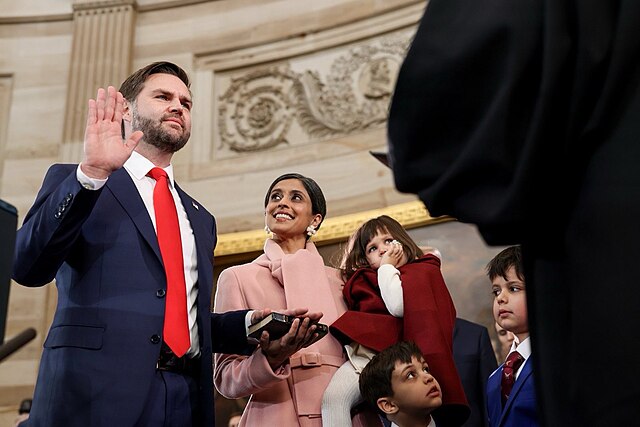
This was the intellectual milieu in which J. D. Vance immersed himself in the lead-up to his conversion to Catholicism in 2019. He formed a deep friendship with Rod Dreher, a postliberal Orbán apologist currently resident in Hungary,5 and he drew close also to Deneen and Ahmari. It seems probable that whatever about earlier influences that contributed to Vance’s conversion (to which I will return shortly), the company of right-wing Catholic postliberals who had a concrete vision of a dramatic remaking of American politics and society under a conservative president provided the final motivation. Vance converted during Trump’s first term. As Massimo Faggioli has put it, ‘[his] choice to join the Catholic Church did not interfere [with] but rather accompanied his conversion to Trumpism; while he had been very critical of Trump just a few years earlier, he then embraced and became Trump’s more presentable face’.6 ‘His is a very American Catholicism,’ Faggioli adds, ‘in some sense an “America First Catholicism”, at a distance from Vatican and global Catholicism … ’
In recent years, Vance has shared a platform with Dreher, Deneen, and Ahmari on numerous occasions. Also with Roberts, Vermeule, Pappin, Pecknold, Reno, and other leading lights of Catholic postliberalism.7 He has indeed explicitly said that he is on ‘the postliberal right’,8 and in some respects he has shown a leaning towards the more integralist end of that spectrum. Repeatedly he has claimed that his ‘views on public policy and what the optimal state should look like are pretty aligned with Catholic Social Teaching’.9 ‘I saw a real overlap’, he remarked, ‘between what I would like to see and what the Catholic Church would like to see.’10
The influence of René Girard
In the fullest account Vance has given of his conversion, he explains that Peter Thiel, the billionaire venture capitalist, introduced him to the theory of mimetic rivalry of the French philosopher and anthropologist René Girard, which made a deep impression on him.11 Particularly, he says, ‘It was [Girard’s] related theory of the scapegoat – and what it revealed about Christianity – that made me reconsider my faith.’
Vance’s summary of Girard is unexceptionable. ‘One of Girard’s central insights’, he writes, ‘is that human civilisations are often, perhaps even always, founded on a “scapegoat myth” – an act of violence committed against someone who has wronged the broader community, retold as a sort of origin story for the community.’ As he notes, Girard sees the Christian story to contain a crucial difference from the narratives of other traditions. ‘In Christ,’ Vance paraphrases Girard, ‘we see our efforts to shift blame and our own inadequacies onto a victim for what they are: a moral failing, projected violently upon someone else. Christ is the scapegoat who reveals our imperfections, and forces us to look at our own flaws rather than blame our society’s chosen victims.’
Vance is right to draw attention to Girard’s sense of Christian revelation not only as revealing the divine, but also as revealing humankind to itself. What we learn from the brutal execution of Christ, the innocent lamb who submits to being a scapegoat, is that there is a darkness at the heart of the human story. We progress by way of violence. Disordered, mimetic desire leads to violent conflict, which is eventually contained, though only temporarily, by the warring sides redirecting their violence towards a scapegoat, namely a person or group (or by symbolic extension, a principle, value system, or even the past itself12) that is commonly agreed to be responsible for the crisis. It is through such cycles of violence and reconciliation, according to Girard, that both religion and human culture emerge and develop. For this process to work, though, the scapegoat must be believed to be truly guilty. But this is where Christ interrupts the process. He exposes the mechanism for what it is, a useful fiction, a lie; and once the lie is uncovered its power is attenuated. Girard returned to the Catholic faith of his childhood in 1959, and in the years that followed, the application of mimetic theory to the biblical narratives played an increasingly central role in his work. Christ’s crucifixion, as he reads it, is the culminating instance of a revelatory pattern that runs through the Hebrew Bible, and it is this that makes Judaeo-Christian revelation unique: it is replete with narratives that take the side of the victim, that speak with the victim’s voice – Abel, Joseph, the Psalmist, Jephthah’s daughter, Job, Susanna, Isaiah’s Suffering Servant, Daniel, and of course the widow, the orphan, the foreigner, and the oppressed.
Christianity as a victim-centred master-narrative has been a great gift to civilisation, according to Girard, one that has even borne new fruit in the age of modernity. What he calls ‘the modern concern for victims’ has, he notes, become an absolute value in our age, and it is the rubric under which great advances may be gathered – the rights of individuals, the abolition of slavery, the protection of women, children, the aged, and the foreigner, the battle against poverty, the extension of medical care, and so on.13 This is, he says,‘the secular mask of Christian love’. But where does this leave J. D. Vance? His enthusiastic alignment with Trump’s agenda makes his engagement with Girard appear, as Paul Leslie has said, ‘more performative than deeply considered’.14 Notoriously, in September 2024, Vance propagated the false rumour that illegal Haitian immigrants in Springfield, Ohio, were abducting and eating domestic pets. The town managers were quick to correct the lie. The Haitian immigrants were legal, and there were no credible reports of any of them harming pets. Vance’s response when challenged was: ‘If I have to create stories so that the American media actually pays attention to the suffering of the American people, then that’s what I’m going to do.’ These are the words of someone who has learned enough from Girard to know how potent scapegoating can be, but who has opted to weaponise it rather than expose and disable it.
Of course, Trump’s entire performance, aided and abetted by Vance, revolves around dehumanising and scapegoating. Migrants, politicians on the other side of the aisle, Republicans who have not been loyal, left-wing academics, judges who have ruled against Trump, journalists who report things he doesn’t want to believe, foreign leaders who won’t submit to his demands – all of these are adversaries of one kind or another: animals, enemies of the people, vermin, thugs, corrupt, evil. The insult list is long. Migrants especially. Trump calls them murderers, rapists, ‘blood-thirsty criminals’, ‘the worst people’, who are ‘ruining the fabric of the country’, poisoning its blood, and so on. No political behaviour could be further from the vision of Girard. Vance, however, takes it in his stride, and every time he is asked about it, he defends Trump’s rhetoric combatively.
A different vision: Carl Schmitt
Vance’s public conduct bears little sign of a Girardian sensibility. What it does show, though, is a debt to another theoretical framework, a darker, more pessimistic one, namely the constitutional theory of the German jurist Carl Schmitt. In fact, Schmitt’s devastating critique of liberalism has left its mark right across the postliberal conservative world, and certain elements of his more prescriptive work are alarmingly apparent in pro-Trump apologetics.
Like Girard, Schmitt was Catholic. He was not devout, but he was intensely interested in what he called ‘the political idea of Catholicism’.15 The Church, for him, is a model of institutional rationality; it is a hierarchical and juridical entity that represents and mediates the will of the sovereign
God through clear structures of authority and decision-making. As such it is a counterpoint to what he saw as the liberal and Protestant emphasis on individual autonomy and a fragmenting proceduralism. He was not a traditionalist, but he admired the Church’s participation in the structuring of political reality in medieval Europe through the alliance of throne and altar. For him ‘all significant concepts of the modern theory of the state are secularised theological concepts’.16 So, for example, political sovereignty is drawn from the theological concept of God’s sovereignty; and just as God is over and above the law, so too should the political sovereign be. Then, as God may decide to suspend God’s own law in exceptional times, characteristically by performing miracles, the sovereignty of a ruler lies precisely in being free to decide on the state of exception – to decide, that is, when the law may be suspended and be replaced by direct, unfettered executive rule. And so it goes on: the rationally ordered state echoes the divinely ordered cosmos; natural law as embedded in the legal order matches the divine law written on the heart or revealed in Scripture; and political representation through parliament reflects Christ’s mediation between God and humankind.
Foremost in all this, of course, is the sovereignty of the ruler. How Schmitt saw this playing out in political action comes back to his fundamental anthropological attitude – that is, to his deeply pessimistic vision of humanity. He rejected the Enlightenment’s optimism about human rationality, especially its confidence that politics can be reduced to administration and procedures that operate within a culture of self-applying norms – the rule of law, in effect. He called this ‘normativism’, a kind of de-politicisation of the state, leaving everything in the hands of interpreters of the law. Humankind, he thought, is a fallen and irrational race, perpetually given to violence. How can normativism save the state when it is confronted by an existential threat from its enemies? What is needed is the decisive response of a sovereign ruler whose task it is to discern the ‘friend/enemy distinction’, declare a ‘state of exception’, and take appropriate action without being held back by laws and procedures. This Schmitt called ‘decisionism’.
Schmitt’s constitutional theory has dark origins. It came together in the context of Hitler’s rise in the early 1930s, and it provided the Nazis with theoretical justification for expanding Hitler’s power. Schmitt argued that democratic procedures and legal norms were slow and ineffectual in dealing with an existential threat to the integrity of the state, and he interpreted Article 48 of the Weimar constitution accordingly. This article stated that if public security and order were seriously disturbed or endangered, the Reich president could restore law and order by suspending civil liberties, ruling by decree, using the army if necessary. In the aftermath of the Reichstag fire in 1933, this reasoning became the grounds on which Hitler seized dictatorial power. Schmitt approved of this, even when it led to the suppression of political parties, the arrest of opponents, and the assertion of party control over institutions, media, education, and the law. Even, indeed, after Hitler ordered the extrajudicial killing of the leaders of the SA and other political enemies during the ‘Night of the Long Knives’ in June–July 1934. Notoriously, Schmitt wrote an article defending the purge. Hitler himself, he argued, was the source of law. ‘The true Führer is always a judge as well’, he wrote; ‘From his domain as Führer flows his domain as judge.’17 To separate the two domains would be to hand power over to an antagonist of the ruler, an ‘anti- Führer’, and so ‘to unhinge the state with the help of the judicial system’.
Trump’s Schmittian logic
In spite of the sinister circumstances of Schmitt’s development of constitutional theory, he has had immense influence on political thinkers on both the left and the right. His sharp critique of liberalism has raised issues of enduring concern – the validity of the friend/enemy distinction, the reliance of legal norms on prior political decisions, and the decisional rather than merely juridical nature of sovereignty, for example – and it has been taken up in one way or another by various important movements or schools of thought in recent decades. Not least among these is postliberal conservatism. There is no pretense here that the situation in the United States is substantially comparable to Germany in the 1930s, but it is easy to see a shared mentality. Schmittian logic is apparent all over Trump’s Agenda 47 and the Project 2025 ‘Mandate for leadership’. Trump’s effective rule by executive order; the denigration of the legislative and judicial branches of government and the expansion of presidential powers; the replacement of career office-holders with loyalists; the violation of court orders; the denial of due process – all of these are consistent with the authoritarian decisionism propounded by Schmitt. And Vance has been on board with all of this. His outbursts on social media during Trump’s initial flurry of executive orders displayed a remarkably brazen repudiation of democratic norms. He has repeatedly rejected the right of judges to interrupt Trump’s executive action, and he dismisses the very idea of due process when it comes to people that the administration considers outside the law. Judicial review, due process, the rule of law, the separation of powers – all of these have been targeted by the administration, and Vance has been to the forefront in this. A body of rhetoric is being amassed by Trump and his team that designates any person or institution that falls foul of the administration as an enemy. Trump has called political opponents ‘the enemy from within’; he has called the press ‘the enemy of the people’; he has called the European Union and other erstwhile friendly nations ‘worse than enemies’; his administration is looking into having gang members designated ‘enemy combatants’; and multiple executive orders have characterised migrants crossing the southern border as an invasion. Are there grounds for fear that this is an effort to declare a ‘state of exception’, an ongoing state of war – America under attack from enemies within and without – and to make this condition permanent? Could it even be invoked as justification for suspending elections?
The utilisation of the state of exception for the purpose of stripping people of their political status and depriving them of legal protection was not uniquely a phenomenon of the Third Reich. Referencing heavily – though critically – Schmitt’s constitutional theory, Giorgio Agamben has explored the exercise of decisionistic sovereignty in contemporary states. Even when no general state of exception is declared, it is under the rubric of the state of exception that certain individuals are reduced to a subhuman status. To ‘mere existence’, as Hannah Arendt calls it. 18 What the state of exception permits, according to Agamben, is the summary reduction of an individual to ‘de-politicised’ and unprotected life – to what he calls ‘bare life’. 19 The paradigmatic space in which this violent use of sovereign power is exercised, according to Agamben, is ‘the camp’ – the concentration camps of the Holocaust, of course, but in recent decades the same logic has been on display in extrajudicial detention centres, refugee camps, ‘black sites’, internment camps, occupied territories, and certain prisons. This is a point Agamben insists on: totalitarian logic continues to structure the state of exception in liberal democracies today.20 And that holds for Trump’s administration too, however much it has deviated from the liberal democratic order in other regards. In fact, the sheer obscenity of such an abuse of sovereign power seems nowhere more apparent than in the Trump administration’s use of Guantanamo, the CECOT maximum security prison in El Salvador, border patrol holding cells, and ICE detention centres. Such reduction to bare life, it must be noted, is a feature, not a bug, of the Trump team’s agenda.
In the light of this, how is it possible that so many of the pro-MAGA postliberals, including the Catholics I have mentioned, strenuously insist that illiberal democratic regimes can pave the way for a new social order that is in line with the Gospel? Perhaps they think it is playing out the strategy that Patrick Deneen urges in Regime Change: ‘the application of Machiavellian means to achieve Aristotelian ends’21 – in other words, decisive realpolitik, ruthless if needs be, in order to usher in a just Christian world that is oriented to the common good.
Vance and the order of love
There appears to be, at the heart of postliberal conservatism, a deep Augustinian pessimism about human nature. Human beings, profoundly damaged by original sin, are driven by pride, concupiscence, and disorder. Left to themselves they become incurvatus in se, selfishly turned inwards rather than outwards towards God and neighbour. They are incapable of achieving goodness or salvation without divine grace. Replace ‘goodness or salvation’ with ‘order and stability’ and substitute ‘strong authoritative action’ for grace, and you have the political anthropology not only of Schmitt, but also of the most critical influences on his constitutional theory, many of whom also feature frequently in dispatches from the postliberal right: Machiavelli, Thomas Hobbes, and the great counter-Enlightenment Catholic figures Joseph de Maistre, Louis de Bonald, and Juan Donoso Cortés.
Interestingly, what Schmitt takes from these thinkers’ ‘fundamental theological dogma of the evilness of the world and man’ is that it makes ‘the undifferentiated optimism of a universal conception of man’ impossible.22 Their pessimism, he insists, presupposes ‘only the reality or possibility of the distinction of friend and enemy’. So, thanks to human sinfulness, the Christian injunction to love all humankind is just not feasible. In another secularisation of a theological concept, this time eschatology, all we can do is separate the sheep from the goats, friends from enemies, and commit them to their separate fates.
Does this very idea not lie in hiding behind J. D. Vance’s recent exposition on the right ordering of love? Speaking to Sean Hannity of Fox News, he framed the MAGA agenda as the playing-out of ‘a very Christian concept’, the ordo amoris, or rightly ordered love: ‘You love your family, and then you love your neighbour, and then you love your community, and then you love your fellow citizens in your own country, and then after that, you can focus [on] and prioritise the rest of the world.’23 So, America first, then the rest. Vance takes his notion of the ordo amoris from the writings of St Augustine, whom he has credited with giving him ‘a way to understand Christian faith in a strongly intellectual way’.24 But is his understanding of it really that of Augustine? According to Vance’s schema, one’s Christian love, even if it diminishes in intensity as it stretches further away from one’s ambit, does indeed continue all the way. But in what universe could the current US administration’s demonisation of migrants, withdrawal of aid from the most necessitous countries on earth, ending of federal funding for refugee resettlement, and indifference to the calamitous effects of climate change count as any form of love, however depleted? Clearly it is much more a playing-out of the friend/enemy distinction than a playing-out of ordered love. It must be noted too that there is no suggestion in St Augustine that rightly ordered love is primarily a matter of proximity.25 It is, rather, about loving what ought to be loved, not loving what ought not to be loved – meaning, for example, not loving money or other created things before the Creator, loving the self but not more than one loves God, loving the sinner but not qua sinner. In other words, getting the measure of love right in each circumstance. All Christian love is modeled on and rooted in the universal love of God, and for Augustine the objects of one’s attention should be loved in proportion to their value in relation to God. Sin is misdirected love; it is putting amor sui before amor Dei. So, God first, and after God one’s neighbour as oneself.
But who is my neighbour? Augustine declares unequivocally that ‘all men are to be loved equally’. That, you could say, is the ethos of Christian love, its intrinsic character. However, from the perspective of phronesis, practical judgement in concrete circumstances, priorities may need to be set. True, one’s family has a special call on one’s love, but Augustine establishes two further principles for discernment: need and chance circumstances. Christ tells us, he says, that ‘he is our neighbour whom it is our duty to help in his need, or whom it would be our duty to help if he were in need’; also that ‘since you cannot do good to all, you are to pay special regard to those who, by the accidents of time, or place, or circumstance, are brought into closer connection with you’. But there is nothing in this that endorses parochialism or nationalism. Circumstances may leave you in a position to help people in need – people living in poverty, or migrants, or people who have suffered tragedy, even if they are half a world away. They, then, are your neighbours, just as the wounded man was to the Good Samaritan.
This was precisely what Pope Francis insisted on in his letter to the bishops of the United States, clearly in response to Vance’s citation of the ordo amoris as justification of a brutal deportation policy. He recognised that nations have a right to defend themselves and keep their people safe, but he added:
That said, the act of deporting people who in many cases have left their own land for reasons of extreme poverty, insecurity, exploitation, persecution or serious deterioration of the environment, damages the dignity of many men and women, and of entire families, and places them in a state of particular vulnerability and defenselessness. …
The human person is a subject with dignity who, through the constitutive relationship with all, especially with the poorest, can gradually mature in his identity and vocation. The true ordo amoris that must be promoted is that which we discover by meditating constantly on the parable of the ‘Good Samaritan’ (cf. Lk 10:25– 37), that is, by meditating on the love that builds a fraternity open to all, without exception.26
According to Vance, it is perfectly natural that you would love those closest to you most, and many conservative Catholic commentators concurred. At the end of the Sermon on the Mount, Jesus also concurs. What he teaches, however, is that the Christian call to perfection – the supernatural way – entails going beyond that love for those closest. ‘If you love those who love you, what reward do you have?’, he asks; ‘Do not even the tax collectors do the same? And if you greet only your brothers and sisters, what more are you doing than others? Do not even the gentiles do the same?’ His Father, on the other hand, treats all persons without making distinctions’: ‘ … he makes his sun rise on the evil and on the good and sends rain on the righteous and on the unrighteous’. And it is in these terms that the call to Christian perfection is framed: ‘Therefore, be perfect as your heavenly Father is perfect.’
Return to Girard
Both Girard and Schmitt saw conflict and violence to lie at the heart of the human story. But Girard did not share Schmitt’s pessimism. He even insisted that the cause of violence, the mimetic capacity of humans, is ‘intrinsically good’ as it constitutes an ‘opening out of oneself’ – an ‘extreme openness’ to others. It can be murderous, but it is also ‘the basis of heroism’ and of ‘devotion to others’. Mimetic desire, Girard concluded, ‘is also the desire for God’.27 And, of course, where Schmitt theologises violence by connecting it with the exercise of sovereign power, Girard’s whole enterprise is about de-theologising it, showing that its origins are always human, all too human. Christ, exposing the innocence of the scapegoat, forces humankind to face this fact about itself.
Girard’s insightful anthropology has God as a God of all, a God who abhors violence and victimisation. The kingdom of God, he says, ‘is always a matter of bringing together the warring brothers, of putting an end to the mimetic crisis by a universal renunciation of violence’.28 Once in the past, Vance gained from Girard a perspective of this kind, and it helped to change his life. It is greatly to be hoped that he would recover that perspective now.
Dr Dermot Roantree works for Irish Jesuit Communications and is editor of Studies: An Irish Quarterly Review.
Notes
- Patrick Deneen, Regime Change: Toward a Postliberal Future (New York: Sentinel, 2023), ‘Introduction’.
- Damon Linker, ‘The Post-liberal Catholics Find Their Man’, The Atlantic, 8 August 2024, www. theatlantic.com/ideas/archive/2024/08/jd-vance-post-liberal-catholics-thiel/679388/
- Adrian Vermeule, ‘Beyond Originalism’, The Atlantic, March 2020, www.theatlantic.com/ideas/ archive/2020/03/common-good-constitutionalism/609037/
- Adrian Vermeule, ‘“It Can’t Happen”; Or, the Poverty of Political Imagination’, Postliberal Order (website), www.postliberalorder.com/p/it-cant-happen-or-the-poverty-of
- See Dreher on Hungary as a safe, civilised and democratic country, in ‘Orbán: Guardian of Liberal Freedoms’, The Critic, November 2023, https://thecritic.co.uk/issues/november-2023/orban- guardian-of-liberal-freedoms/
- Massimo Faggioli, ‘J. D. Vance’s Catholicism: Theological Profile of Trump’s Heir Apparent’, Catholic Outlook (website), 24 July 2024, reprinted from La Croix International, https:// catholicoutlook.org/j-d-vances-catholicism-theological-profile-of-trumps-heir-apparent/
- See Michelle R. Smith and Peter Smith, ‘J. D. Vance’s Catholicism Helped Shape His Views. So Did This Little-Known Group of Catholic Thinkers’, AP (website), 4 September 2024, https://apnews. com/article/jd-vance-catholicism-postliberals-social-policy-7e37e43cb1976c516d642a95d4952 66a
- See for example ‘Regime Change and the Future of Liberalism’, YouTube (website), https://www. youtube.com/watch?v=2ZbsiKEhy-8
- Rod Dreher, ‘J. D. Vance Becomes Catholic’ , The American Conservative, 11 August 2019, www. theamericanconservative.com/j-d-vance-becomes-catholic/
- Elizabeth Dias, ‘How J. D. Vance Found His Way to the Catholic Church’, The New York Times, 25 August 2024, www.nytimes.com/2024/08/25/us/jd-vance-catholic-church-conversion.html
- Vance, ‘How I Joined the Resistance’, The Lamp, 1 April 2020, https://thelampmagazine.com/blog/ how-i-joined-the-resistance
- See René Girard, Things Hidden Since the Foundation of the World (London: Bloomsbury Academic, 2020), bk III, part 5: ‘Beyond Scandal’.
- René Girard, I See Satan Fall Like Lightning(Ottawa: Orbis Books, 2001), chapter 13, especially pp. 165–7.
- Paul Leslie, ‘From Philosophy to Power: The Misuse of René Girard by Peter Thiel, J. D. V