
Peadar Kirby
The return of Donald Trump, re-elected by a comfortable majority, has shocked many liberal and progressive observers around the world. It is perhaps the most decisive event yet to show that we have entered a new era in world affairs. As Guardian columnist Nesrine Malik puts it,
The truth is that, all over the world, the old order is gone and the new one is bewildering. People feel trapped and want a sense of release, a promise of a dramatically different future, or just a future. … And they want to feel as if they are part of something bigger and stronger as they get lonelier and weaker and their worlds fracture and atomise by the day. 1
Similar to revolutionary turning points in the past, it is scary and unpredictable, full of threat for some and of promise for others. And the quote also identifies key elements that drive such transformative moments: deep anger at the status quo but also the demand for a better future and the need to belong.
It’s not the first time such elements have burst open in different societies, propelling a surge of change that often leads in very unexpected directions. In trying to make some sense of the present moment, therefore, it is worth going back to the writings of Karl Polanyi (1886–1964), a seminal thinker who grappled with the breakdown of the liberal capitalist order in the first decades of the twentieth century. As Gareth Dale writes in the new Penguin Classics edition of Polanyi’s classic work The Great Transformation, first published in 1944, the polycrises of today’s world are reminiscent of Polanyi’s when ‘the collapse of liberal institutions and utopias … raised profound questions’. Polanyi devoted his life to examining these questions: ‘How extensive a rupture with liberal civilisation was taking place, and was liberal political economy entering a terminal decline?’ And, the most important question, ‘Why had the global expansion of commerce and market society led not to peace and prosperity, as liberal theory had predicted, but to war, economic collapse, fascism and more war?’2
Central to Polanyi’s genius and to his importance for us now is, in the words of his daughter Kari Polanyi Levitt, his ability ‘to step outside the box of formal models of market transactions to explore the real needs of real people and the variety of institutional arrangements that can satisfy them’.3 Or, as Dale identifies it, Polanyi’s analysis traced the strains that moved ‘between the political and economic spheres and the national and international scales, a tracing of the ways in which the various crises of the age – democracy, market society, international order and world economy – interlaced, with each connection multiplying the intensity of the crisis as a whole’.4 The analytical originality of Polanyi’s analysis is then a rich resource to mine as we seek to make sense of the ‘great transformation’ taking place before our very eyes. As England puts it, ‘Karl Polanyi provides many hints and lessons concerning the revolutionary right that have yet to be internalised, but which deserve to be studied with great care.’5
This article focuses on a number of interrelated themes in Polanyi’s work. It begins by examining the importance of his emphasis on the embeddedness of the market in society and the stresses and strains on society when the market mechanism becomes its organising principle, stresses and strains that are ever more obvious in political contestation today. This led Polanyi to posit a contradiction between capitalism and democracy, which the rise of the far-right in Europe, the US, and beyond is now bringing into focus again for the first time since the 1940s, and this is the subject of the second section. The third section interrogates why this revolutionary moment is being aroused through far-right analyses and actions rather than, as in the past, being led in more progressive directions, what some see as the re-emergence of fascism. The article ends by asking what might be done about this.
Stresses and strains of the liberal order
The central insight that provides the analytical core of The Great Transformation is key to understanding the appeal of Trumpism and, indeed, of the far-right around the world. It takes us back to the British Industrial Revolution which, according to Polanyi, introduced a novel system whereby society was made to obey the self-governing mechanisms of the market. Up to then in human history, markets were always embedded within the institutions and value systems of society, but for the first time a system was created that handed the fate of society and nature to an autonomous market mechanism. This entirely new relationship between economy and society meant that ‘instead of economy being embedded in social relations, social relations are embedded in the economic system’, which ‘required that the individual respect economic law even if it happened to destroy him’. 6
‘The conflict between the market and the elementary requirements of an organised social life … produced the typical strains and stresses that ultimately destroyed that society’, argues Polanyi.7 He outlines in detail how the central mechanism of the market, which requires treating land (nature), labour (human beings), and money as commodities – what he calls ‘the commodity fiction’, since they can never be reduced to items bought and sold in a marketplace – supplied ‘a vital organising principle in regard to the whole of society’.8 Importantly, Polanyi recognised that what destroyed society was not primarily material poverty and deprivation but rather the destruction of the institutions that provided a sense of securing belonging:
Not economic exploitation, as often assumed, but the disintegration of the cultural environment of the victim is then the cause of the degradation. The economic process may, naturally, supply the vehicle of the destruction, and almost invariably economic inferiority will make the weaker yield, but the immediate cause of his undoing is not for that reason economic; it lies in the lethal injury to the institutions in which his social existence is embodied. The result is loss of self-respect and standards, whether the unit is a people or a class, whether the process springs from a so-called culture conflict or from a change in the position of a class within the confines of a society.9
This is where Polanyi parts company with more typical left-wing diagnoses of the growth of the far-right, diagnoses that often fail to account for the fact that leaders like Donald Trump appeal to much wider sectors of the population than the economically deprived. His emphasis on the cultural helps explain what often baffles observers, namely the combination of economic grievances with a moral discourse relating to God, family, nation, and freedom. These themes are reflected in the four pillars of the Heritage Foundation’s Project 2025, widely seen as the policy platform guiding the current Trump administration; many of the authors of Project 2025 have been appointed to key government posts. The 900-page document rests on four pillars: restore the family as the centrepiece of American life; dismantle the administrative state; defend the nation’s sovereignty and borders; and secure God-given individual rights to live freely.
US political theorist, Wendy Brown, summarises well the role that moral discourse plays in the worldview of today’s far-right:
Tradition, secured by religion … acquires the mantle of incontestability and symbolic truth at the same time as it serves as a limit on the political. This formulation explains a strand of the rationality organising our current predicament: truth withdrawn from political life is rolled over to moral and religious claims rooted in the authority of tradition. The effect is to sever truth from accountability (a recipe for authoritarianism), to contest equality and justice with tradition, and to eliminate the legitimacy of popular sovereignty.10
Brown traces the importance of tradition back to Friedrich Hayek, the father of neoliberalism. Hayek’s fear of state encroachments on individual liberty led him to emphasise individuals’ uncoerced capacity for endeavour and experimentation but within codes of conduct generated by tradition enshrined in law and morality. Of course, the aggressive and at times vicious discourse that has become a hallmark of the far-right and, in particular, of Trump himself is far from the anchoring in tradition that Hayek had in mind. He looked to tradition as the refining of the bases for social order based on generations of experience, resulting in what he called ‘a high degree of voluntary conformity’ by individuals to its norms. Instead, today’s discourse echoes the ‘loss of self-respect and standards’, which Polanyi foresaw as a feature of the stresses and strains unleashed by submitting society and nature to the mechanism of the market.
Central to the moral discourse of neoliberalism is an extreme individualism, eloquently expressed by Margaret Thatcher in an interview with Women’s Own magazine in September 1987 when she stated, ‘There is no such thing as society.’ This echoes Hayek’s own dismissal of the social as false and dangerous, meaningless and hollow, destructive and dishonest, a cover for the coercive power of government. Allied to this is the dismissal of social justice as a grave threat to the values of a free civilisation. At heart, therefore, neoliberalism was committed to what Brown calls ‘the project of dismantling and disparaging the social state in the name of free, responsibilised individuals’.11 In contrast, Polanyi emphasised that social responsibility is the essence of freedom, ‘which is not a form of releasing oneself from society but the fundamental form of social connectedness, not the point at which solidarity with others ceases but the point at which we take on the responsibility of social being, which cannot be shifted onto others’.12
Polanyi’s diagnosis of the ills of the liberal world, which as an economic journalist in Vienna in the 1930s he saw collapsing before his eyes, points to the need to re-embed the economy in society so that the economy serves the needs of people rather than vice versa. His research into the relationship of market and society in societies around the world prior to the British Industrial Revolution identified the three forms of integration working in different combinations in every society he and his team studied: reciprocity (essentially a gift-giving culture in societies with strong bonds of community); redistribution (carried out by a strong centralised state as in the Inca empire); and exchange (in local markets similar to our farmers’ markets and often based on barter rather than on monetary exchange). The socialist society he worked for and which, at the end of his life, he said he had never lived in, would emerge through ‘a reform of human consciousness to be reached through the recognition of the reality of society’.13
Contradictions between capitalism and democracy
Viewing the pressures from economic elites in the inter-war period to eliminate the influence of working-class parties and movements over policy, and the threat of capital flight to put pressure on progressive governments, Polanyi identified an essential contradiction between capitalism and democracy. As Dale summarises it, Polanyi came to the conclusion that ‘democracy was not a natural accessory of capitalism’, but the two systems were ‘irreconcilably antagonistic’.14 As demands from voters for protection from economic crises prevented markets from functioning efficiently, elites faced a choice – either see an economy reconstituted to serve the interests of society (which Polanyi saw as moving towards socialism) or purge capitalism of all democratic elements through backing fascist parties. Economic elites flocking to support Trump carry menacing echoes of what Polanyi observed.
The post-war period of social democratic capitalism seemed to belie this antagonism. It was ‘real existing socialism’ in the USSR and its satellites that was seen as antagonistic to democracy, while the managed capitalism of social democracy seemed to have found a way of successfully combining both. In this period, Polanyi came to be interpreted as a champion of social democratic means of taming capitalism through state regulation, and he was convinced that the utopian experiment of the self-regulating market was finished and would not return.15 However, with the growing influence of the neoliberal ideas of Friedrich Hayek and Milton Friedman over public policies, beginning with Thatcher in the UK and Reagan in the US in the early 1980s, a counter-tendency of capitalism taming democracy has become evident; both centre-left and centre-right parties have become virtually indistinguishable in imposing market mechanisms on society. Indeed, as Brown identifies, neoliberal thinkers explicitly aim ‘at limiting and containing the political, detaching it from sovereignty, eliminating its democratic form and starving its democratic energies’.16
While elements of this erosion of democracy have been evident for decades as the social welfare state erodes and basic services, including education, health, and housing, are more and more commodified, the new Trump administration illustrates starkly the fundamental rationale. This is well expressed by Monbiot and Hutchinson:
When the thick mesh of interactions that binds us to the state – cherished and effective public services, laws that protect the weak as well as the strong, a sense of shared civic life and citizenship, mutual obligation and fair exchange – are stripped away, all that remains are the worst aspects of state power: coercion and oppression. The state becomes our enemy.17
While neoliberal thinkers might share common principles about the dethroning of politics, as Brown puts it, they greatly differ on what they seek to achieve. Hayek was concerned about the threats posed to liberty by forms of coercive government that he saw resulting from democratic demands. Enhancing liberty therefore required restricting democracy, eliminating the social state in favour of the family, and replacing social justice with moral law. Numerous right-wing campaigns, particularly in the US over recent years, have gradually sought to restrict democratic rights (privatisation of education; school vouchers; restricting rights to contraception and abortion; eliminating diversity, equity, and inclusion programmes; limiting and undermining freedom of speech) but Project 2025, being implemented with speed by the Trump administration, is mounting a concerted attempt fundamentally to restrict and reshape the administrative state. This is at the service of a national conservative project to return the US, both internally and externally, to a previous position of dominance. The politics of Trump’s beloved tariffs are seen as a central means of achieving this objective.
But there is another neoliberal view of the state that points in a very different direction and which is beginning to generate tensions within the Trump administration. This was the view of the German ordoliberals.
While they also seek to restrict democracy, their objective is to build a strong technocratic state operating on competitive market principles. This requires technical expertise to guide what is in effect an authoritarian-technocratic liberalism required for success in the conditions of contemporary capitalism. The writings of US far-right blogger Curtis Yarvin, who styles himself a ‘neo-reactionary’ thinker and is a leading figure in the ‘Dark Enlightenment’ movement, are seen as having a significant influence on key figures in the Trump administration, particularly J. D. Vance. He argues that democracy has failed and should be replaced by a kind of techno-feudal state to be run like a corporation with the president as its CEO.18 This is the project of Silicon Valley techno-libertarianism, which is championed by Elon Musk and the other tech billionaires who have attached themselves to Trump but who are growing very uneasy at the trade war he has begun.
US data analyst Ben Davis clarifies the fault lines between these two reactionary visions:
Trump and the national conservative’s dream of a return to a pre- financialisation manufacturing-based economy, where the US has security through economic self-reliance, and the tech right’s commitment to creating shareholder value at all costs, and whose entire model is based entirely on the result of financialisation, are incompatible and on a collision course. Different sections of capital – tech on the one hand, and the revanchist small capital class who form national conservatism’s base on the other – have different and competing interests and control of different sections of administration policy. The consequences of this internecine competition are enormous.19
Whatever way this competition plays out, we are clearly in a moment when democracy is under explicit attack from those who see this as the only way to advance capitalism. The neoliberal utopia of Hayek and Friedman, in which individuals and families would be freed from the heavy hand of a coercive and intrusive state and in which market dominance would ensure a depoliticised administration, has, in Brown’s words, ‘produced a monster its founders would abhor’.20
There are also echoes here of Polanyi’s fears that ‘industrial technology is showing itself wholly capable of generating suicidal tendencies that strike at the roots of liberty and life itself’.21 Since Polanyi’s time, technology has become more ubiquitous and has come to dominate even intimate spaces of our lives and of our relationships. Yet his warnings about ‘the menace of a cultural development’ resulting in ‘the fragmentation of man [sic], the standardisation of effort, the supremacy of mechanism over organism and of organisation over spontaneity’ ring ever more true. Polanyi’s emphasis on ‘the safety of society above the requirements of maximum technological efficiency’22 remains powerfully pertinent.
Re-emergence of fascism?
For Polanyi, the emergence of fascism in the 1930s flowed from the fact that capitalism was incompatible with democracy. The extension of the vote and the incorporation of wider sections of the population into the franchise marked, for Polanyi, the inevitability that what he called that ‘property system’ would eventually be destroyed. ‘For fascism is no more than the most recent form of the recurrent attack of capitalism to popular forms of government. The ruling classes had good reason to fear the establishment of popular government’, he wrote in 1940.23 In the same essay, which began as notes for a possible book to be called ‘The Fascist Transformation’, which he never wrote, he traced the way in which the antagonism between capitalism and democracy ‘was latent for a few decades, giving rise to a false sense of security among democrats but only to develop into an all-pervading world- wide tendency in our days’. These words could well be written to describe the contemporary emergence of the far-right after decades of its being excluded to the outer margins of liberal democratic systems.
The title Polanyi gave to these notes ‘the fascist virus’ is instructive. For him, fascism was more than a set of economic ideas to save capitalism; it was a culture, indeed an aesthetic. In terms of its economic thrust, England summarises Polanyi’s argument that fascism was ‘fundamentally a reaction that draws on the coercive power of the state to save industrial capitalism during a terminal crisis by attempting to reconstitute it on a national basis’.24 In key ways, this encapsulates the core of Trump’s project, as perfectly expressed when he revealed his suite of global tariffs in the White House Rose Garden on 2 April 2025. But this fails to account for its wider popular appeal, particularly to those who are among the victims of contemporary capitalism. This is where the fascist principle of what Polanyi called ‘vitalism’ takes on key importance. Just as the Nazi mass rallies incorporated Germans into a new aesthetic communal identity led by a father figure, so does Trump through his discourse of making America great again, his mass rallies, and his harking back to a supposed golden age create his own aesthetic appeal and adulatory following.
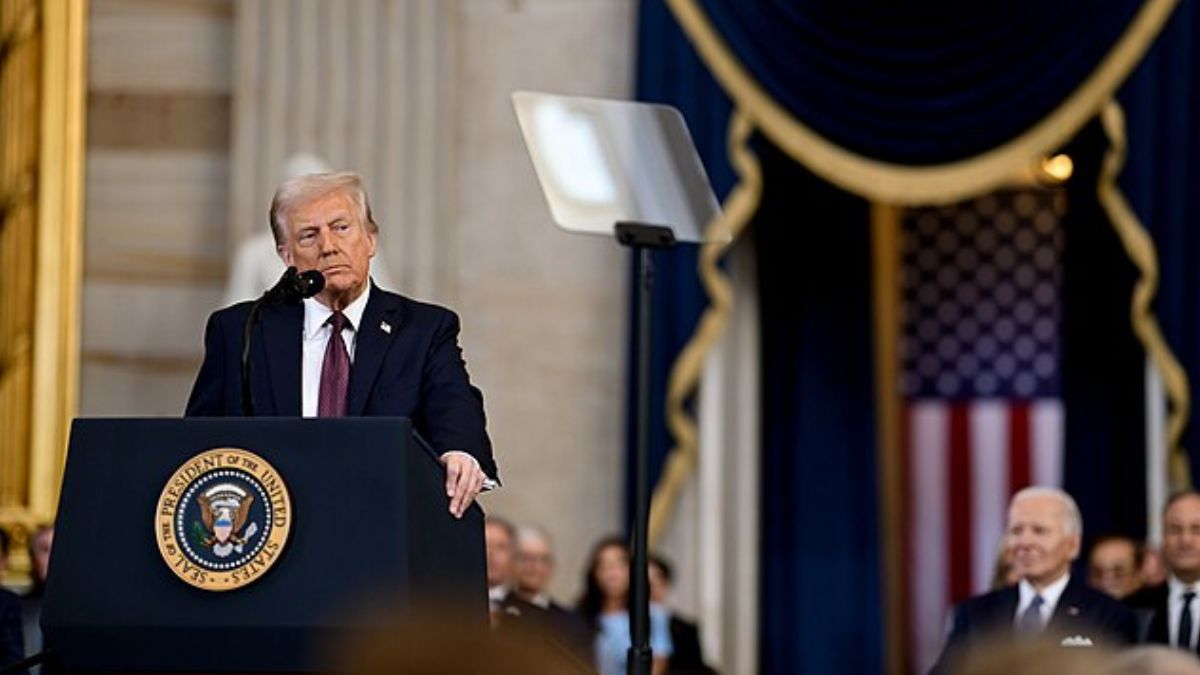
The radical denunciatory discourse of Trump devoid of consistency and often of any factual basis is what distinguishes him from more mainstream leaders of left and right. Surrounded by some of the wealthiest people on the planet at his second inauguration, his self-presentation as a victim of the elites, who are responsible for the carnage of crime and job losses that he sees as ravaging the US, is what many identify with. For US essayist Ta- Nehisi Coates, Trump is a cultural president in a way his predecessors, both Democrat and Republican, were not: he appreciates the power of stories. He contrasts Trump with Obama, who could also tell stories, but, for Coates, Obama revealed himself to be essentially a conservative in that he did not seek the overthrow of the status quo.25 By stark contrast, Trump’s discourse and his avalanche of radical activity once he took office seem to offer those alienated from the status quo the assurance that issues are being dealt with and transformative change is happening. The rationale or outcomes don’t seem to matter to many; the frenetic activity is sufficient.
In this contrast of Trump and Obama, Coates offers a compelling reason why the revolutionary ferment of the present moment is coming from the far- right rather than from the left. Since the fall of the Soviet Union in particular, the left has become far too tame, too technical in its discourse, and too respectful of market dictates. As Thomas Piketty and Michael Sandel ask in in a recent conversation on equality, ‘What has become of the left’s traditional emphasis on solidarity, civic pride, and the mutual obligation of citizens? A healthy sense of civic pride can offer an alternative to xenophobia and hyper- nationalism. And isn’t it also necessary to support the more generous welfare state that social democrats and democratic socialists care about?’26 Yet, the reality is, as both acknowledge, that ‘now the richest places vote Democrat, and this is what made Trump possible in a way’.27
The issue of equality is key here, both socio-economic equality but also equality of respect, dignity, and esteem. Monbiot writes that ‘there is strong evidence of a causal association between growing inequality and the rise of populist authoritarian movements’. One study he quotes finds that for a one-unit rise in the Gini coefficient measure of growing inequality, support for demagogues rises by 1%.28 Yet, it is economic growth that preoccupies the left, not radical action to reduce inequality. Just witness the discourse of Britain’s Labour government over recent months.
This gets to the heart of the failure of the left to offer compelling responses to the crisis of neoliberalism. There are two related dimensions, both by and large overlooked by today’s left. The first is that the social democratic response to the neoliberal challenge of leaders like Blair in the UK, Clinton in the US, and Schroeder in Germany never challenged the principle that market mechanisms are the primary instruments for defining and achieving the public good, continuing to believe that markets deliver rising prosperity. The second dimension, as Sandel in his work emphasises,29 is that we more and more value people for their success or failure in this market system, cultivating hubris among the winners and humiliation among those left behind. ‘This sheds light on how our societies became so polarised in recent decades’, writes Sandel.30
Conclusions
A line at the end of Polanyi’s The Great Transformation sums up the challenge still before us eighty years later: ‘Yet the shifting of industrial civilisation onto a new non-marketing basis seems to many a task too desperate to contemplate.’31 In another essay on the essence of fascism, Polanyi furthermore recognised that what democracy is based on and what fascism seeks to destroy is the unique value of the human person, as expressed in the Gospels: ‘The Fascists setting out to deliver mankind from the alleged delusions of socialism cannot pass by the question of the ultimate truth or untruth of the teachings of Jesus.’32 We were blessed in our time to have had a pope who renewed Catholic Social Teaching in ways that respond to both of Polanyi’s concerns here. We live in ‘a world that has grown heartless’, wrote Pope Francis at the beginning of his final encyclical, Dilexit Nos, on the Sacred Heart.33 And he closes with a call that I read as a direct response to the concerns raised by Polanyi (and indeed by Sandel):
In a world where everything is bought and sold, people’s sense of their worth appears increasingly to depend on what they can accumulate with the power of money. We are constantly being pushed to keep buying, consuming and distracting ourselves, held captive to a demeaning system that prevents us from looking beyond our immediate and petty needs. The love of Christ has no place in this perverse mechanism,34 yet only that love can set us free from a mad pursuit that no longer has room for a gratuitous love.35
Pope Francis’s contribution lay not just in his critique of the market system and his unyielding affirmation of human dignity and equality, but in the fact that his is a message based on a religious worldview and values. For, as mentioned above, discourse about God, tradition, and community has been instrumentalised to provide a philosophical basis for an authoritarian and divisive politics. The threat is immense but we can affirm, with Polanyi, that it encounters an insurmountable obstacle in any authentic praxis of Christian living. These need to be an essential part of a much more forceful fightback.
Peadar Kirby is Professor Emeritus of International Politics and Public Policy, University of Limerick. His most recent book is Karl Polanyi and the Contemporary Political Crisis: Transforming Market Society in the Era of Climate Change (London: Bloomsbury, 2021).
Notes
- Nesrine Malik, ‘Behind Trump’s Victory Lies a Cold Reality: Liberals Have No Answers for a Modern Era in Crisis’, The Guardian, 18 November 2024.
- Gareth Dale, ‘Introduction’, in Karl Polanyi, The Great Transformation: The Political and Economic Origins of Our Time (London: Penguin Classics Edition, 2024), pp. xi and xiii.
- Kari Polanyi Levitt, ‘The Power of Ideas: Keynes, Hayek and Polanyi’, International Journal of Political Economy, 41:4 (2012–13), pp. 5–15 (p. 14).
- Gareth Dale, ‘Introduction’, p. xvii.
- Christopher M. England, ‘Karl Polanyi and the Rise of Fascism’, New Political Science, 44:4 (2022), pp. 628–49 (p. 649).
- Karl Polanyi, The Great Transformation: The Political and Economic Origins of Our Time (London: Penguin Classics Edition, 2024), pp. 66, 99.
- Polanyi, The Great Transformation, p. 287.
- Polanyi, The Great Transformation, p. 84.
- Polanyi, The Great Transformation, p. 182.
- Wendy Brown, In the Ruins of Neoliberalism: The Rise of Antidemocratic Politics in the West (New York: Columbia University Press, 2019), p. 102.
- Brown, In the Ruins of Neoliberalism, p. 29.
- Karl Polanyi, ‘The Economy as Instituted Process’, in George Dalton (ed.), Primitive, Archaic and Modern Economies: Essays of Karl Polanyi (New York: Anchor Books, 1968), pp. 139–74 (p. 149).
- Polanyi, The Great Transformation, p. 148.
- Gareth Dale, Reconstructing Karl Polanyi (London: Pluto Press, 2016), p. 69.
- See Fred Block and Margaret R. Somers, The Power of Market Fundamentalism: Karl Polanyi’s Critique (Cambridge, MA: Harvard University Press, 2014).
- Brown, In the Ruins of Neoliberalism, p. 57.
- George Monbiot and Peter Hutchinson, The Invisible Doctrine: The Secret History of Neoliberalism (London: Allen Lane, 2024), p. 51.
- Ed Simon, ‘What We Must Understand About the Dark Enlightenment Movement’, Time, 24 March 2025.
- Ben Davis, ‘Two Visions within Trump World Are Battling for Primacy. Which Will Win?’,
- Brown, In the Ruins of Neoliberalism, p. 17.
- Karl Polanyi, The Livelihood of Man (New York: Academic Press, 1977), p. li.
- Polanyi, The Livelihood of Man, pp. xlix, li.
- Karl Polanyi, ‘The Fascist Virus’, in Michele Cangiani and Claus Thomasberger (eds), Karl Polanyi, Economy and Society: Selected Writings, (Cambridge: Polity, 2018), pp. 108–122, (pp. 108–09).
- England, ‘Karl Polanyi and the Rise of Fascism’, p. 629.
- Ta-Nehisi Coates in Guardian Podcast, 14 April 2025. See also his latest book The Message (London: Hamish Hamilton, 2025).
- Thomas Piketty and Michael Sandel, Equality: What It Means and Why It Matters (Cambridge: Polity, 2025), p. 102.
- Piketty and Sandel, Equality, p. 112.
- George Monbiot, ‘Right-Wing Populists Will Keep Winning until We Grasp This Truth about Human Nature’, The Guardian, 13 April 2025.
- See, in particular, Michael J. Sandel, What Money Can’t Buy: The Moral Limits of Markets (London: Penguin, 2012) and The Tyranny of Merit: What’s Become of the Common Good? (London: Allen Lane, 2020).
- Piketty and Sandel, Equality, p. 50.
- Polanyi, The Great Transformation, p. 288.
- Karl Polanyi, ‘The Essence of Fascism’, in Michele Cangiani and Claus Thomasberger (eds), Karl Polanyi, Economy and Society: Selected Writings (Cambridge: Polity, 2018), pp. 81–107.
- Pope Francis, Dilexit Nos (Vatican: The Holy See, 2024), 22, www.vatican.va/content/frances- co/en/encyclicals/documents/20241024-enciclica-dilexit-nos.html
- Whether intended or not, this has echoes of Polanyi’s focus on the market mechanism as the cause of social and environmental degradation.
- Pope Francis, Dilexit Nos, 218.