
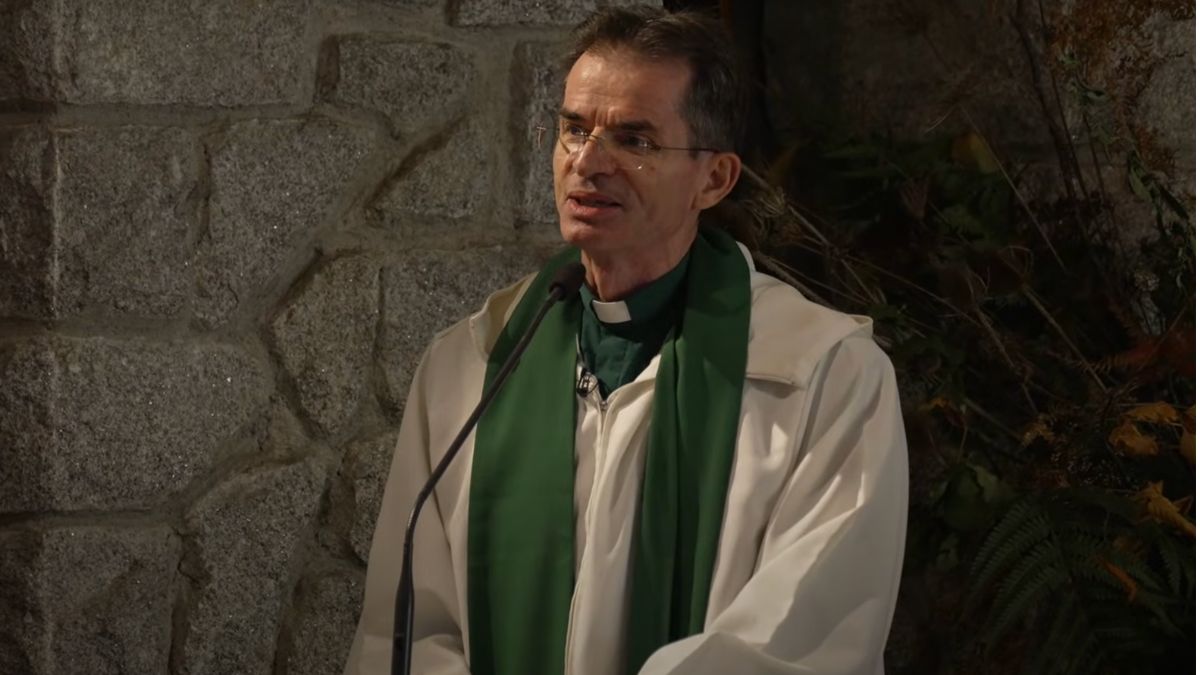
Tom Casey SJ
There is, they say, a fifth province in Ireland: an Cúigiú Cúige. Although it is not found on any map, it is alive in the spirit of those who awaken to wonder. It is the province of soul, of silence, and of story. It is the realm that lies between the seen and the unseen, between the old language and the new world. And it is Manchán Magan who has opened that fifth province for us. He pointed to a doorway that we did not even know was there. And he invited us, gently, laughingly, and lovingly, to step through.
I visited him a few days before he died. Frail, yes, but bríomhar fós, still full of life. Ruán, his ever-faithful brother, whispered to me, ‘Speak to him in French.’ So I did. And at the sound, he leapt, as though some spark from another world had caught fire in him again. We began a quiet duet. As he once wrote in Thirty-Two Words for Field: ‘Different languages dance differently in the world.’ And how he danced them! Irish, English, French: all were music to him, for he knew that language was not just an instrument for talking but a path for walking through the world.
Manchán loved Ireland. But he loved the world as well. He was fíor-Ghael i gcroí is i gcnámh, a true Gael in heart and bone. But he had the vision of one who saw the sacred in every tongue, in every creature, and in every dawn. He was a gatherer of light, drawing wisdom from the living word, from ag éisteacht le guth agus le glór na talún: listening to the voice and the glory of the land itself. He listened to the whisper of bees, to the murmur of bog and oak, to the laughter of hens and to the quiet knowing of pigs: sna coillte, sna beacha, sna cearca, sna muca. He lived in conversation with creation: ag comhrá leis an gcruthú féin. He found wonder everywhere. He found it in language, in story, and in community. He saw that tá gach rud ceangailte le chéile: everything is connected. And it was Aisling Rogerson, the love of his life, whom he married just weeks before his death, who helped him deepen and express this love for the world. She encouraged him not to limit himself to Ireland alone, but, without ever losing his roots, to open his heart to the whole world, to see home everywhere, and everywhere as home.
For his funeral service, the chapel of Gonzaga College SJ was filled with lush, blooming plants and foliage from his own farm, a living offering from the soil he tended. According to Jewish tradition, before the fall of humanity ever took place, Adam spoke to the Garden of Eden and it answered, for his words carried the divine breath of creation. When he spoke, the plants grew in reply. Manchán, too, had that gift. In his own Eden, ag caint lena chuid plandaí agus lena bheacha, he spoke gently to his plants and to his beloved bees, and they answered him in blossom and in honey. He saw that God’s world was alive, and helped creation itself to remember this truth.
Manchán was fear lán d’iontas: a man of wonder. John Moriarty, the Kerry mystic and sage he admired so much, once wrote of Connemara, ‘And yes, there are days in Connemara when speechlessness isn’t a choice. You look up from your work, out over the lake to the mountains, and as well as losing your grip on your spade you lose your grip on yourself and your world. And for as long as it lasts, what a wonder it is, having no grip.’ In such moments, said Moriarty, ‘every bush is a burning bush … and every stone is a-stone-ishment.’
Manchán was like that. He was a man without grip or gripe: gan ghreim, gan ghearán. He didn’t cling to things, but was unburdened by possessions and open to surprise. He was leanbh mhór an nádúir, a great child of nature, saor le hiontas, free to wonder. For Manchán, every bush truly was a burning bush. To live astonished, maireachtáil le hiontas, that was his calling. He heard the created world whispering, speaking in the language of mystery. Every day was, for him, a miracle, gach lá ina mhíorúilt.
He was, in truth, a prophet. Not one who foretells the future, but one who tells forth into our present, who speaks with the voice of the spirit into the silence of our forgetfulness. His prophecy was not command but invitation. And his message for our time? It is as simple as it is seismic: if we do not walk the path of spirit, our footsteps will fade from the world. Muna siúlfaimid slí an spioraid, imeoidh ár lorg ón domhan. Without spirit, there is no future for humankind. Gan anam, níl aon todhchaí.
Manchán walked the spiritual path quietly, joyfully, and with a rare fidelity. He was both rooted and roaming. He travelled widely, yet his soul was anchored in ten acres of Westmeath, that green middle ground where the four provinces perhaps once met. There, near Lough Lene, in a grass-roofed house in an oak wood, he found home. And it was from that hearth that he reawakened for us an Cúigiú Cúige: the Fifth Province.
In Irish, we call a province a cúige, a word born from cúigiú, meaning fifth. So, hidden in every province’s name is a whisper of another, unseen province, one beyond the map and beyond measure. Yet, as every schoolchild learns, there are only four provinces: Leinster, Munster, Connacht, and Ulster. All of Ireland, it seems, is already accounted for. But still the word itself remembers that there is more. The word itself carries within it the memory of that fifth province, an Cúigiú Cúige, the province of the heart.
Where is this fifth province? It cannot be found by compass. It does not appear on GPS. It lies in the realm of the spirit, in the country of the imagination. It is the Ireland that cannot be conquered or divided, because it is the Ireland of the soul. It is a province where the Irish tongue rises again, ina n-éiríonn an Ghaeilge arís, not only in word, but in way. A way shaped by thirty-two words for field and ninety-nine words for rain – and yes, one for sun! A way formed by story and solitude, by belonging and by wonder. It is a province of breathing, not boundaries.
And it is Manchán who gave us the courage to believe that such a place still exists. Through his storytelling, his filmmaking with his brother Ruán, such a wonderful companion to him always, and his childlike enthusiasm for the ‘isness’ of everything, he showed us that Ireland is not merely a land to inhabit but a mystery to enter. He reminded us that we are not only people of place, but people of presence. We cannot reach this fifth province by road or rail, with all due respect to his TV series Manchán’s Europe by Train! We only reach it by kindness, by vision, and by faith, by walking softly on the earth and listening keenly to its song.
So let us live as he lived, le lúcháir, le hiontas, agus le spiorad beo: with joy, with wonder, and with a living spirit. Éistimis, let us listen, to the whisper of the world. For Manchán has shown us the way: the path of wonder, the path of spirit, and the path of kinship between soul and soil. And if we follow that way, le cúnamh Dé, we too may come to see that every bush is indeed a burning bush, that every stone is a small astonishment. We too may come to feel the pulse of the divine moving through all that is, and know, as Manchán knew, that the breath of God is still stirring within creation: tá anáil Dé fós ag séideadh tríd an saol seo. Then, perhaps, we too shall glimpse the hidden Ireland of the soul, and rejoice in it, as he did.
Manchán has crossed the threshold now, trasna an tairseach, into that fifth province he opened for us in life. Not a land beyond life, but a life beyond any land we can imagine. And yet his spirit still speaks to us, for he has not gone from us, but has only gone before us: ní imithe uainn é, ach imithe romhainn. Something of his voice whispers in the humming of the hives and in the patient turning of the seasons. He speaks now from within the web of things he loved so well. He leaves us no monuments. But he does leave us acorns and seeds: seeds of seeing, and acorns of reverence. He leaves us a way of walking more lightly upon the earth. He leaves us a way of looking that is gentler and slower. Each time we pause to listen, to truly listen, éistimis go fíor, to the murmuring of the wind in the grass or the thrilling song of a bird, we keep his memory alive.
For Manchán’s life was not an abstract theory but a wonderful doorway. A doorway that opens whenever we remember to be amazed. He taught us that the sacred hides in small and ordinary things. It hides in the shape of a word and the shimmer of a raindrop. He showed us that the divine is not elsewhere but here and now, anseo agus anois. It’s in the clay beneath our feet and in the very companionship of being alive. For in all that lives, he glimpsed rún Dé, the mystery of God speaking quietly in his creation.
Perhaps that, after all, is where the Fifth Province truly lies: not on the map, but in the marrow. It is a landscape of the heart, tír an anama, the country of the soul. It begins whenever we awaken to wonder, nuair a dhúisíonn muid d’iontas, and find ourselves at home in mystery. The Fifth Province is within us and among us: in the way we greet a neighbour, in how we bless our food, and in every moment we give to prayer. It is there in the music of our native tongue, in the sheer majesty of our world, and in the simplest act of kindness. It is the Ireland of the heart, where Dia still walks among us in the evening air. So let us walk reverently in God’s footsteps, go réidh agus go ciúin, carrying God’s and Manchán’s light into the fields of our own lives. Let us speak to the earth, and let us pause to listen for its answer. Let us live le lúcháir, le grá, agus le hiontas beo, with joy, with love, and with living wonder.
Whenever we marvel at the sun turning bog water into gold, or delight in learning a new word as Gaeilge, let us remember that we are already standing in the Fifth Province. It is here. It is now. It is in every person and place, and in every heart that truly listens. And may we say, as Manchán surely says now, from that bright country we cannot see, much less imagine, ‘Tá an domhan beo.’ The world is alive. And so, buíochas le Dia, are we.
Tom Casey SJ is a former Dean of the Faculty of Philosophy at St Patrick’s Pontifical University, Maynooth. He is currently chaplain at Gonzaga College SJ, Dublin.